Ashish Kumar Gupta ji’s Bharat Gatha series is dedicated to Guruji Ravindra Sharma ji of Kala Ashram, Adilabad—an intellectual and cultural worker whose life’s attention remained fixed on the inner structure of Indian society. The series was born of a quiet but persistent concern: much of Indian knowledge has long been filtered through European categories or contemporary American frameworks. That scholarship has often been rigorous and useful. Yet, it frequently leaves out something irreducible—the lived texture of Indic practices, the internal grammar of Indian indigenous/Bhāratīya institutions, and the civilizational instincts through which India has understood itself.
This absence has troubled Ashish Kumar Gupta ji and many other rooted Indic thinkers for decades. Bharat Gatha, therefore, attempts something both simple and radical: to present an Indian worldview—how India interprets its own creations, its social order, and its cultural life. The experiment has been pursued with steadiness. Around seven volumes have already appeared, out of which some have been reviewed here on Dhīti by Dr. Anurag Shukla, one on India’s textile traditions and another on the Bhikṣāvṛtti lineage.
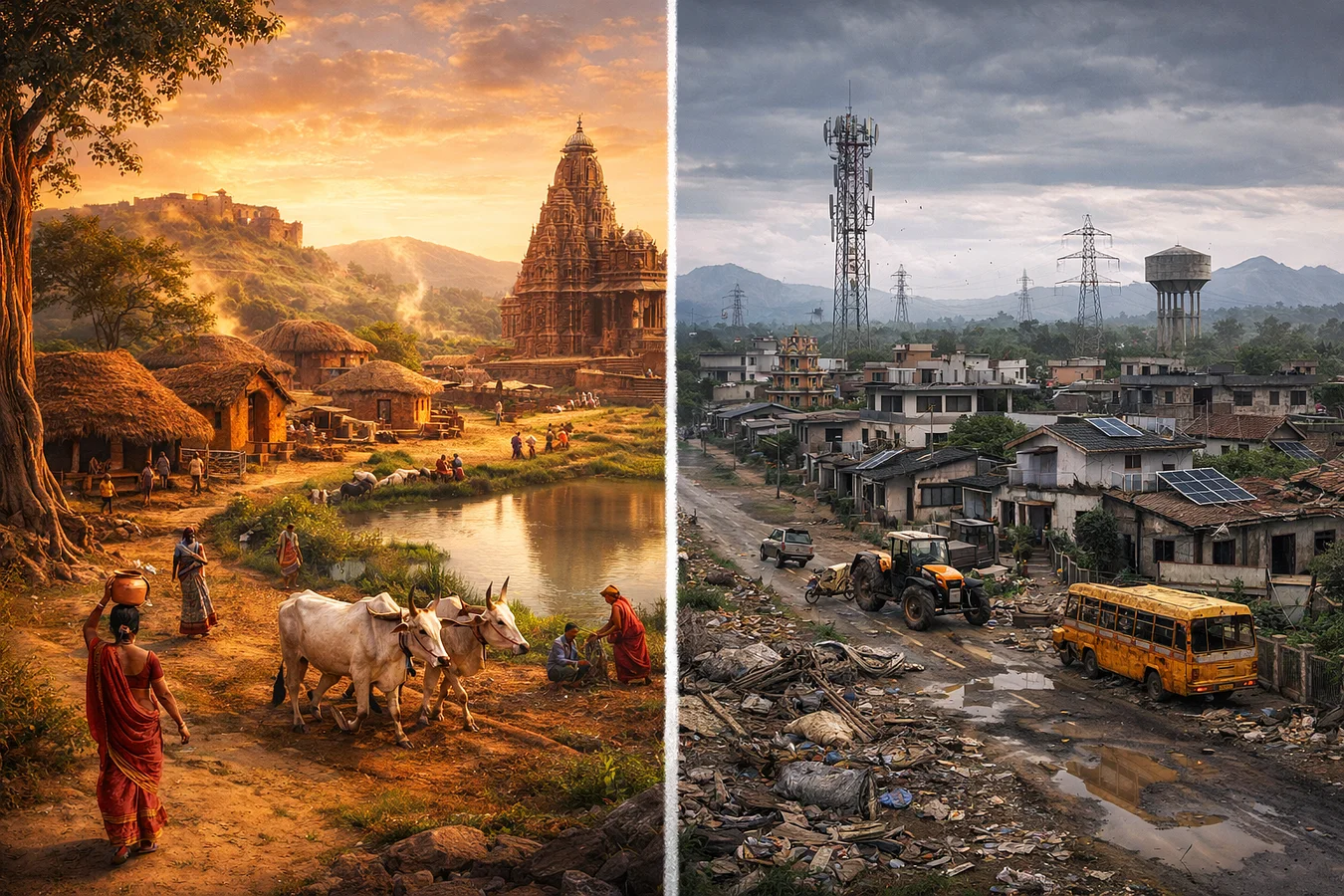
The present volume, which is the sixth in the series and was released recently, turns its gaze toward a foundation stone of Indian life: the village system, the Bhāratīya grāma-vyavasthā.
Ashish ji often speaks of Guruji Ravindra Sharma ji not only with respect but with a kind of wonder. Wherever Guruji spoke—whether in lecture halls or community gatherings—he appeared in traditional rural attire, and yet could hold the most urban audiences spellbound. The secret of his presence was not performance but depth. He could travel, in a single discourse, between the widest civilizational panorama and the smallest human detail—between the “macro” of culture and the “micro” of daily life—with a naturalness that few scholars possess. This ability made his thinking not merely informative, but revealing.
At the heart of Guruji’s work was an inquiry into the structure and functioning of Indian society. He observed the Indian mānasa—its capacities, its skills, its temperaments, its inner dispositions—and the intricate web of relations through which people lived with one another. In that sense, Guruji becomes a vital pivot for anyone seeking the ethos, even the soul, of Indian civilization—beginning from the village upward, not from the city downward.
This perspective becomes urgent in times like ours, when external forces—economic, cultural, technological—are rapidly reshaping behavior, institutions, and social imagination. If we wish to articulate a distinctly indigenous worldview, if we wish to understand India as India understands itself, then Guruji Ravindra Sharma ji’s work is not optional reading; it is essential.
The Village as India’s Historical Backbone
One of Guruji’s striking observations is demographic and historical: roughly two centuries ago, more than 95 percent of India lived in villages. And this was not a temporary arrangement—it was the pattern of thousands of years. Ancient texts—Smṛtis, Śāstras, and even the Vedas—return again and again to the grāma. In a profound sense, Indian society and village life have often been almost synonymous. To understand the Bhāratīya grāma-vyavasthā is therefore to understand India in its most continuous form.
Interestingly, this reality was not invisible even to colonial administrators. Charles Metcalfe, acting Governor-General of British India in the 1830s, famously described Indian villages as “little republics, having nearly everything that they want within themselves… Dynasties fall and are replaced, but the village communities remain the same.” For Metcalfe, villages were self-sufficient economic and political units that survived regime change—from Mughal to British—more resilient than imperial capitals themselves.
Henry Maine, in Village Communities in the East and West (1871), observed that Indian villages preserved ancient communal property systems, governed daily life through customary law and councils, and represented a form of “living antiquity” in governance.
Thomas Munro, Governor of Madras, called every village “a little republic,” noting their enduring autonomy and administrative continuity.
Mark Wilks described village communities as rational, cooperative units managing land, irrigation, and taxation without central oversight.
Baden-Powell later argued that communal land tenure and collective responsibility were ancient civilizational forms destabilized by British property law.
Even John Stuart Mill, working from East India Company records, acknowledged that villages were India’s primary social and economic units.
What these observers consistently admired were four features:
self-sufficiency, institutional continuity, local autonomy, and economic resilience.
Their core insight remains significant: villages, not cities, were the backbone of Indian civilization.
Villages, Cities, and the Civilizational Tradeoff
Ashish ji raises the unavoidable modern questions: why focus on villages today? What relevance can they possibly hold in an age of megacities and digital economies?
India, he argues, is a country of villages not merely by compulsion, but by civilizational choice. Even in 1881, two-thirds of Indians lived in villages. At Independence, nearly 80 percent did. Despite colonialism, industrialization, and urbanization, a vast proportion of Indians still live in villages. India’s economy still rests on rural food, water, labor, and ecological systems.
The book places this in a longer arc. India was once described as Sone ki Chidiya—the golden bird. Angus Maddison’s economic history suggests that India held a substantial share of world GDP for many centuries beginning around 1 AD, followed by a long decline and a slow, unfinished recovery. The village system, in this telling, is not a remnant of backwardness but a civilizational infrastructure that once supported enormous productive life—and may still contain resources for renewal.
From this wider frame, the book turns its critique toward the condition of modern Indian cities. Earlier civilizations settled near natural sources of water. Today, the opposite appears to be true: many major cities—Delhi, Mumbai, Ahmedabad, Hyderabad, Pune, Kanpur, Nashik—have reduced nearby rivers into polluted drains. The irony is not only ecological; it is cultural. People have forgotten that the drain was once imagined as a smaller version of the river carrying clean water, which is why nadī and nālā have historically shared a conceptual link.
Urban expansion does more than pollute water; it consumes surrounding villages, dismantles self-reliant local economies, and pushes villagers into migration. Many arrive in cities only to find not dignity and opportunity, but slums and precarious labor. Meanwhile, cities remain deeply dependent on villages for essentials—milk, vegetables, grains, and countless forms of labor and raw material. What kind of symbiosis is this, the book asks, when the city destroys the very sources that sustain it?
Even with high-technology facilities and grand infrastructure projects, cities show little evidence of genuine well-being. Ghettos, degraded air, polluted water, and widespread social fragmentation have become normal. The rise of orphanages, shelters, crèches, widow āśramas, disability homes, old-age homes, and the relentless expansion of hospitals—these, the book notes, are overwhelmingly urban phenomena. Their relative absence in villages, whatever else may be said about rural hardship, reflects the continuing strength of ethical, moral, and familial bonds that village life still holds together.
Ashish ji also recalls an earlier balance between rural and urban life. Two or three centuries ago, cities were fewer—often royal capitals or merchant hubs—with smaller populations serving specific functions. Supply and demand were not so violently mismatched. Today, the imbalance has reversed, with swelling urban centers unable to sustain the humans they absorb. In one evocative symbolic reference, the book invokes Indra as Purandara—the destroyer of cities—suggesting that civilizations permitted cities to rise, but destroyed them when they overextended. The image becomes a warning: nature insists on limits, and renewal is cyclical, not linear.
Dr. Rana Singh Arya, quoted from the Bijnor conclave, is then brought into the discussion: if humanity has a future, it lies in villages. The glitter of cities has placed us in a stupor, a kind of mental captivity. We have been trained to see villages as problems—spaces waiting to be “fixed”—and to imagine solutions only through migration, urbanization, or imitation of Western models. The book asks us to resist this conditioning and to recover the dignity of the village as a civilizational institution.
The Grammar of the Village
From the critique, the argument moves into definition. Ashish ji insists that we must apply the proper grammar of Indian civilization when speaking about Indian institutions. The village is not merely a settlement of houses; it is a form of organized life. Even the terms we use matter. He traces jāti to jñāti—“the one who knows”—pointing toward groups of specialized knowledge and skill, not merely rigid identity boxes.
Society (samāja) is defined expansively as all living beings (prāṇī) in a shared space. Sociability becomes possible when individuals perform their duties sincerely, in harmony, without tearing the fabric that binds them.
Drawing directly from Guruji Ravindra Sharma ji, Ashish ji presents a luminous definition: a gā̃va or grāma is a place where food security and human dignity are assured. A village rests on four pillars—vijñāna (science), kalā (arts), adhyātma (spirituality), and sāmājika arthavyavasthā (social economy). This is not nostalgia; it is a model of balanced life.
Words like piṇḍa and dehāta portray the village as a living body. As organs sustain a body through interdependence, villages thrive through interdependent jātis, jñātis, and varṇas. Even etymology is made to speak: grāma and gṛha share a root that gestures toward “home.” The village is envisioned as a kuṭumba—an extended family—where service groups such as washermen, barbers, potters, weavers, goldsmiths, cobblers, and many others remain organically connected to households, not merely through transaction but through mutual obligation and recognition.
Each village is also imagined as a devatā, with its own grāma-devatā—a reminder that for much of India’s history, rural life was not only economic and social but sacred. The village was a place where the material and the moral were never fully separated.
Security, Sustainability, and Self-Governance
In the book’s concluding movement, Ashish ji returns to the theme of security. Every human being seeks security, but security is never merely individual. The individual’s security lies in the family; the family’s in the kuṭumba; the kuṭumba’s in the jātis; the jātis’ in the village; the village’s in the nation; and the nation’s in responsible citizens. Security here includes food, dignity, rights, freedoms, resilience, and confidence in the future.
For villages to provide this security, their economies must remain organic rather than imposed—rooted in local realities, not merely designed as administrative targets. Drawing from the Arthaśāstra, the book outlines principles for village settlement and sustainability, including Cāṇakya’s guidance on appropriate distances between villages—suggesting that the village system was never accidental but civilizationally engineered.
The warning in the final pages is clear. When indigenous moral foundations are weakened and replaced by external cultural impositions, the consequences can be disastrous—not merely for villages but for the nation’s coherence. The Bharat Gatha series, in this light, is not simply literature; it is a civilizational intervention. It deserves the attention of policymakers, social stakeholders, cultural thinkers, and anyone genuinely concerned with India’s future.
Because India’s society lives in its villages—and so does its future.
The Contemporary Reckoning
Empirically, villages are genuinely better in some domains:
social cohesion, mutual aid, cost of living, sustainability, and basic survival security.
Cities are better in others:
jobs, healthcare, education, legal rights, innovation, and mobility.
Villages are structurally resilient but have been made, through bad policies, economically and politically weak.
Gandhi’s Insight and the Failure of Decentralization
This tension was captured with remarkable clarity by Gandhi, who saw villages as India’s moral core—self-sufficient, decentralized, craft-based, ethically grounded. He was right about sustainability, social cohesion, and the moral critique of industrial capitalism.
Strong villages prevent destructive migration pressure. They stabilize cities. They build distributed economic growth through agro-processing, cold storage, warehousing, and local entrepreneurship. They are the sustainability backbone for water, food, and climate resilience.
Neglected villages produce anger, alienation, extremism, and insurgency. Border villages, forest villages, tribal belts, and coastal villages are India’s territorial spine and ecological shield.
India formally chose village-first development through the 73rd Constitutional Amendment (1992), which created Gram Panchayats, Panchayat Samitis, Zilla Parishads, and Gram Sabhas, and assigned 29 subjects to them. But real power remains with state governments and bureaucracies. Panchayats today have no fiscal autonomy, no administrative control, no policy freedom. Less than 10 percent of public spending flows through them. Gram Sabha resolutions are symbolic.
Village development without real decentralization becomes bureaucratic, corrupt, scheme-driven, and unaccountable.
Why Villages Fail: The Structural Equation
Indian villages are not failing because they are rural.
They are failing because they are not self-governing.
Every major village failure traces back to a specific government failure:
sabotaged land reform, weak law enforcement, no rural industrial policy, fake decentralization, primary healthcare neglect, banking failure, and water misgovernance.
Conclusion
Guruji Ravindra Sharma ji’s work, as carried forward in Bharat Gatha, restores the civilizational grammar of India’s village system. It neither romanticizes nor dismisses villages. It situates them where they have always stood: as the foundational institution of Indian life.
India’s society lives in its villages.
And so does its future.
But only if villages become what they were meant to be again:
not relics of the past,
not dumping grounds of poverty,
not symbolic republics,
but living centers of dignity, autonomy, democracy, and prosperity.
This book can be purchased here.
Other Dhiti articles on the 'Bharat Gatha' series:
1. The Forgotten Threshold - Bhikṣāvṛtti and the The Vanished Wisdom of India’s Wanderers by Dr. Anurag Shukla.
2. The Empire of Threads and Silver - How Colonialism Unraveled India’s Trade Legacy by Dr. Anurag Shukla.
The author can be reached on X/Twitter - https://x.com/TanyaBrahmvadni






.png)