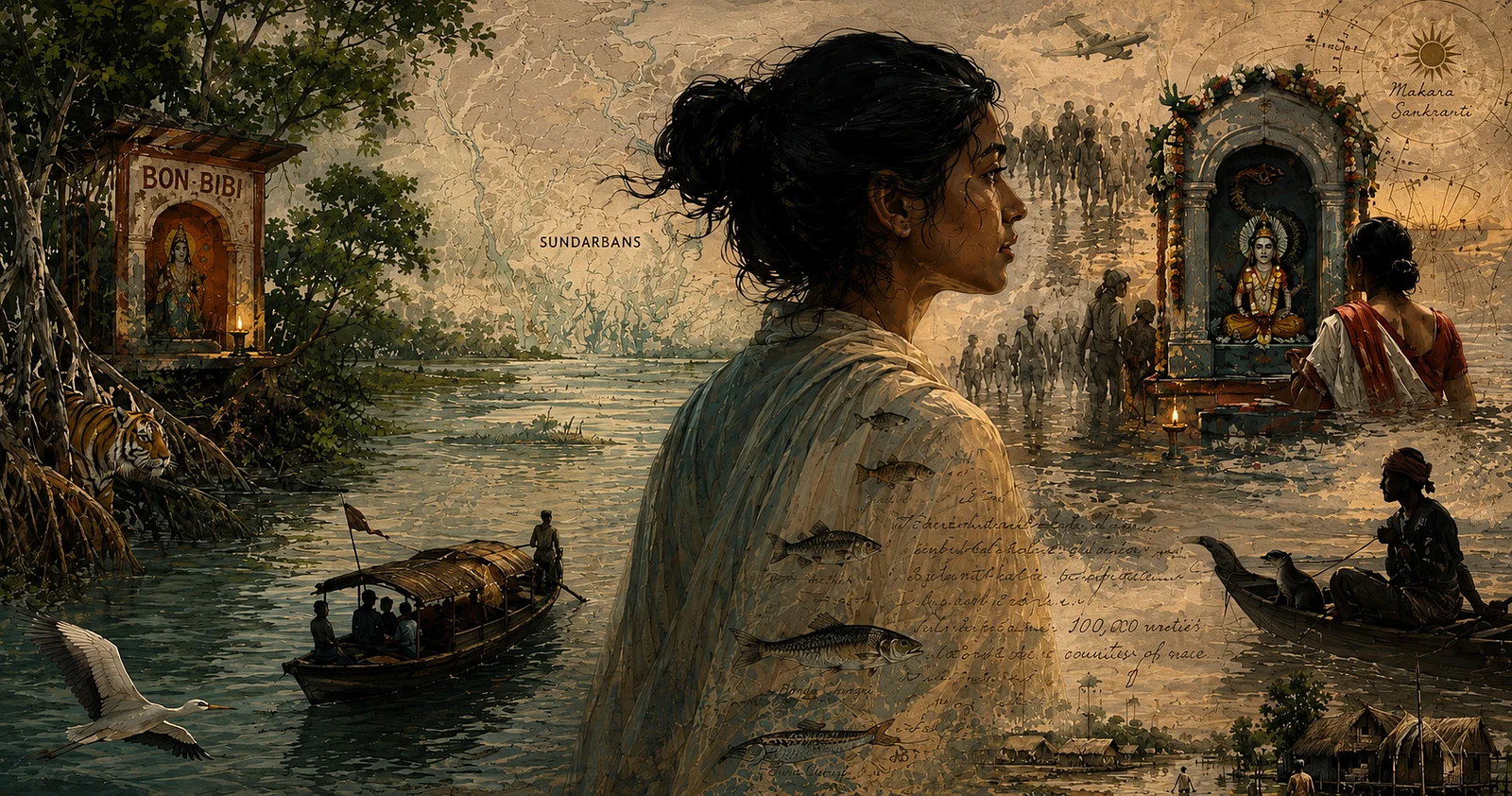
The first time I traveled to the Sundarbans, I was still young enough to believe that knowledge arrived neatly arranged. I had spent years inside classrooms where India appeared through the vocabulary of development: poverty ratios, literacy curves, demographic transitions, agricultural productivity, and migration flows. The nation unfolded in charts and tables, as though its immensities could be domesticated through statistical confidence. Those years had trained me to think of society as something measurable and therefore governable, like a river forced into embankments.
But the Sundarbans refused embankments. Even conceptual ones.
I remember the train toward Kakdwip first. The compartments were swollen with bodies and cargo: traders carrying sacks of vegetables, laborers returning home, schoolchildren in fading uniforms, women balancing steel containers, and conversations drifting in dialects I could only partially follow. The city loosened its grip gradually. Concrete gave way to marshland. Telephone towers thinned out. The horizon widened into something wetter, softer, and unstable.
Then came the ferries.
They moved through tidal waters the color of churned clay, their engines coughing against currents that seemed less like waterways than moods. Mangroves surfaced and dissolved in the haze like unfinished thoughts. Small shrines to Bon Bibi stood near riverbanks, their paint peeling under salt-heavy winds. Fishermen spoke about cyclones the way urban commuters discuss traffic. Tiger attacks entered conversation as occupational hazards, woven into the fabric of ordinary life with unnerving calm.
What unsettled me most was not danger, but impermanence.
The land itself appeared uncertain of its own existence. Islands vanished. Embankments surrendered to tides. Rivers altered their loyalties overnight. Maps felt temporary here. The geography did not belong to the modern imagination of territory, where borders aspire toward permanence and mastery. The Sundarbans felt amphibious, provisional, and tidal, a civilization living on the threshold between emergence and disappearance.
Slowly, almost without my noticing, the region ceased to be geography and became cosmology.
Tides. Mangroves. Tiger widows. River dolphins. Mudbanks. Snake worship. Fish lore. Ferries disappearing into fog. Fragile settlements breathing at the edge of land and sea.
Around that time, I first read The Hungry Tide. The experience felt less like encountering fiction than stumbling upon a language capable of describing realities I had already sensed but could not yet articulate. Since then, I have read nearly every novel written by Amitav Ghosh. What drew me toward him initially was not simply narrative brilliance, though few living writers possess his capacity for atmosphere. It was something rarer: his ability to braid fiction with ecology, migration, colonial history, sociology, and memory without flattening any of them into intellectual ornamentation.
Long before climate collapse became the preferred vocabulary of conferences and policy panels, Ghosh had already begun asking a disturbing question: why had modern fiction failed so profoundly in confronting planetary crisis?
Why did literary realism appear so comfortable describing bourgeois interiors while struggling to accommodate cyclones, rising seas, riverine violence, and ecological catastrophe? Why did modern novels remain tethered to individual psychology even as the planet itself entered instability? Why did realism find it easier to narrate adultery than a storm surge?
These questions have haunted Ghosh for decades. Ghost-Eye belongs unmistakably to that larger intellectual journey.
The novel is not merely about climate change. It is about the limits of modern consciousness itself.
Today, environmental catastrophe increasingly arrives wrapped in abstraction. Economists quantify vulnerability. Climate scientists model futures. Bureaucracies generate adaptation frameworks. Satellite imagery tracks melting coastlines from unimaginable distances. Necessary as these tools are, they often drain disaster of its texture. Catastrophe becomes informational.
Ghosh performs the opposite operation. He restores sensorial life to collapse.
In his fiction, ecological crisis arrives through smell, ritual, memory, superstition, tides, dreams, migration, grief, hunger, and stories told at dusk beside rivers. Climate change is not simply atmospheric transformation but a civilizational disturbance.
Part of what makes this possible is Ghosh’s sociological imagination. One senses throughout his fiction the discipline of someone trained not merely to narrate events but to perceive structures beneath them. Migration, caste, colonialism, empire, capitalism, displacement, and ecology move through his novels like subterranean currents. Villages, forests, ports, refugee routes, and shrines are rendered with ethnographic patience. Reading him often feels like moving through an archive assembled by an anthropologist possessed by lyricism.
Ghost-Eye demonstrates this power repeatedly.
When Dev escapes wartime Burma toward Kolkata during the Second World War, the narrative acquires the density of documentary memory. Roads thick with refugees. Hunger hanging over camps like weather. Military panic. Monsoon skies pressing downward upon exhausted bodies. Boats overloaded with fear. History here is not chronology but atmosphere. One can almost hear wet slippers scraping against mud, feel fever spreading through overcrowded passageways, and sense the empire collapsing not dramatically but through exhaustion.
The same precision shapes the Sundarbans sections. Ghosh understands the delta materially rather than romantically. Mudbanks, salinity, fish migration, estuarine rhythms, mangrove density, tiger territories, tidal patterns, and the ichthyology of the Bengal delta appear with startling specificity. The Sundarbans in Ghost-Eye are not wilderness in the colonial sense. They are an amphibious civilization suspended between erosion and endurance.
Even the “tiger widows” acquire philosophical depth in the novel. These women, whose husbands were taken by tigers while fishing or foraging, embody ecological uncertainty itself. Their existence reveals something developmental modernity often refuses to acknowledge: societies living in fragile ecologies historically survived not through fantasies of mastery over nature but through negotiated coexistence with dangerous nonhuman worlds.
Modernity dreams of control. Deltaic civilizations learned accommodation.
This distinction runs through the novel like an undercurrent.
In much contemporary discourse, nature appears either as scenery or as a resource. Forests become carbon sinks. Rivers become infrastructure. Mountains become mining potential. But in Ghosh’s fiction, nature acts.
His prose repeatedly animates matter itself.
Consider the sentence: “the ceiling fan lazily churned the air, making the netting billow and ripple like a windblown sail.”
Or another: “the pandemic came crashing down on them like the sword of an avenging angel.”
These metaphors do not merely decorate prose. They produce movement. Fans breathe. Nets ripple. Storms advance with intention. Rivers remember. Mangroves brood. Boats groan under history. Tides arrive almost as characters with moods and tempers.
Nature in Ghosh’s fiction is never a passive backdrop. It intervenes.
This becomes especially significant when Ghost-Eye turns toward ritual worlds and polytheistic traditions.
One of the novel’s deepest achievements lies in how it treats local deity traditions such as Manasa Devi and Bon Bibi. Modern secular discourse often relegates such traditions to the category of folklore, tolerated perhaps as cultural residue but stripped of epistemic seriousness. Ghosh refuses this condescension.
Instead, he reveals these traditions as ecological ethics embedded within everyday life.
Historically, relationships with forests, snakes, rivers, fish, wetlands, and tigers were regulated not through environmental legislation but through cosmological intimacy. Reverence, taboo, ritual obligation, fear, reciprocity, and sacred imagination functioned as ecological governance systems long before the arrival of modern conservation frameworks.
Bon Bibi was not simply a forest deity. She mediated the dangerous intimacy between humans and mangrove wilderness. Manasa Devi encoded a civilizational relationship with wetlands, monsoon ecologies, and serpentine life.
Reading these passages, I repeatedly found myself thinking of Ashis Nandy and his critique of hyper-rational developmental modernity. Colonial and postcolonial elites frequently dismissed vernacular cosmologies as irrational even while dismantling ecologies those cosmologies had helped preserve. Communities caricatured as “superstitious” often inhabited fragile landscapes with greater sustainability than technocratic states or extractive corporations.
What Ghost-Eye refuses is the arrogance of assuming that modernity alone possesses intelligence.
This becomes even sharper in the novel’s reflections on science and artificial intelligence. At one point, a character observes:
AI just mimics the brain, and that’s not where we get our forebodings and premonitions and all the other things we humans can feel- the stuff that gives us goosebumps and makes the backs of our necks prickle..all of that comes from the body, the flesh, and everything that gives us our humanity.
The sentence lingers because it is not anti-scientific but anti-reductionist.
It resists the fantasy that cognition can be separated from embodiment.
Here one inevitably recalls Byung-Chul Han and his writing on digital exhaustion, hyper-productivity, and the flattening of sensory life under technological capitalism. Han frequently describes contemporary existence as increasingly disembodied, trapped inside data streams, metrics, optimization systems, and informational overload.
Ghosh’s world moves in the opposite direction.
Knowledge in Ghost-Eye emerges through skin, smell, tides, memory, ritual, bodily intuition, and ecological immersion. Intelligence is tactile.
This becomes most visible in the figure of Varsha, formerly Isha.
Varsha’s extraordinary ability to identify fish species is not framed as detached prodigiousness. Her knowledge emerges from dwelling within an ecological culture. She was born into Lusibari, into a household where survival depended upon intimate understanding of rivers, tides, fish, snakes, mangroves, and monsoon rhythms.
Her father, Benoy Mondal, is among the novel’s most unforgettable creations. Ghosh describes him as a Bengali shapure, reputed to be the finest snake catcher in that region of the Sundarbans and among the last fishermen capable of training otters to drive fish into nets. He is also a devout follower of Manasa Devi, keeping an old stone protima of the goddess within his home, where devotees gathered and were fed fish from the family pond.
What is remarkable here is not exoticism but dignity.
Benoy’s ritual devotion, fishing expertise, ecological intelligence, and interspecies cooperation coexist seamlessly. Modern discourse fragments knowledge into compartments: science here, religion there, folklore elsewhere. Ghosh restores wholeness to forms of life modernity splintered apart.
Even more extraordinary is the portrayal of Jhorna, Isha’s mother from the Munda Adivasi community. Her knowledge of forests, rivers, fish species, crustaceans, molluscs, and jungle rhythms is described with reverence. Even ichthyologists, the novel suggests, found her understanding astonishing.
This may be among the deepest political arguments of Ghost-Eye.
What disappears when such people disappear?
Modern developmental discourse celebrates infrastructure, aquaculture, extraction, and industrial expansion while rarely mourning the destruction of civilizational memory. Jhorna’s knowledge is not quaint “traditional wisdom.” It is an archive accumulated across generations of inhabiting unstable ecological worlds.
Her husband is eventually murdered by Chhoto Sardar, a gangster attempting to expand tiger prawn cultivation after Benoy refuses to sell his land. The symbolism is devastatingly clear here. Shrimp monoculture becomes a metaphor for extractive capitalism itself: salinization, ecological simplification, displacement, biodiversity collapse, and commodification of wetlands.
At one point, the novel notes that India once possessed more than one hundred thousand varieties of rice. The sentence lands almost like grief.
Developmental modernity narrows plurality. Standardization replaces abundance.
And yet Ghost-Eye continually moves beyond political economy into stranger metaphysical territories.
The novel remains startlingly open to rebirth, synchronicity, haptic memory, and concurrent worlds without collapsing into sentimentality. Modern rationality often dismisses such experiences as superstition or delusion. Ghosh resists that reflex.
Reality in Ghost-Eye exceeds empirical reductionism.
Here the language of Carl Jung becomes relevant. Jung’s idea of synchronicity, meaningful coincidence beyond causal explanation, hovers over the narrative like invisible weather. Coincidences in the novel feel less accidental than patterned, as though unseen currents connect lives across temporal boundaries.
Varsha, born into a wealthy Marwari family in her present life, appears linked to Isha from a previous birth. Ghosh never forces rational closure upon these experiences. Multiple ontologies coexist without apology.
Shoma’s investigations into haptic memory and dissociative memory deepen this atmosphere further. Memory here is not merely neurological storage. It is bodily, sensory, and affective. Trauma survives in flesh, gesture, smell, and rhythm.
This openness places Ghost-Eye within a much older civilizational conversation around rebirth and layered realities. One thinks of metempsychosis in The Republic (by Plato), where transmigration of souls appears as a philosophically serious proposition rather than an irrational fantasy. Indic traditions, of course, have long treated rebirth as metaphysical continuity rather than superstition.
Modernity often mistakes its own epistemic narrowness for sophistication.
The novel’s engagement with Makara Sankranti, Sagar Island pilgrimages, Bon Bibi rituals, and Makara as the carrier of Ganga further expands this civilizational imagination. Traditional calendars emerge not as primitive timekeeping systems but as ecological architectures encoding astronomical movement, agricultural rhythms, tidal cycles, pilgrimage routes, and sacred geography together.
Even contemporary legal debates around rivers and mountains being recognized as sentient beings endowed with rights echo through the novel’s philosophical atmosphere. Across the world, indigenous cosmologies and ecological movements are beginning to challenge the assumption that nature exists merely as passive property awaiting extraction.
Ghosh’s fiction participates quietly but powerfully in this shift.
Yet what ultimately makes Ghost-Eye extraordinary is its refusal to become doctrinaire. It remains contemplative. Rivers interrupt theory. Ferries interrupt metaphysics. Mangroves interrupt politics. Rituals interrupt abstraction.
While reading the novel, I often found myself returning mentally to that first visit to the Sundarbans years ago. I remember standing near the river one evening, watching the tide rise so slowly it appeared motionless, swallowing edges of land with eerie patience. Someone nearby pointed casually toward a distant shrine to Bon Bibi. A fisherman spoke about fish migration. Another narrated a tiger story. A child identified bird calls I could barely hear.
At the time, I lacked the conceptual vocabulary to understand what I was witnessing.
Amitav Ghosh gave me part of that vocabulary.
Ghost-Eye is not merely a novel about climate catastrophe, folklore, reincarnation, ecology, or memory. It is about a deeper civilizational estrangement: humanity’s growing distance from rivers, rituals, nonhuman life, embodied intuition, and ecological humility.
Modern civilization increasingly imagines intelligence as computation, progress as extraction, and nature as infrastructure.
Ghosh asks whether something essential was lost when we began believing those things.





.png)