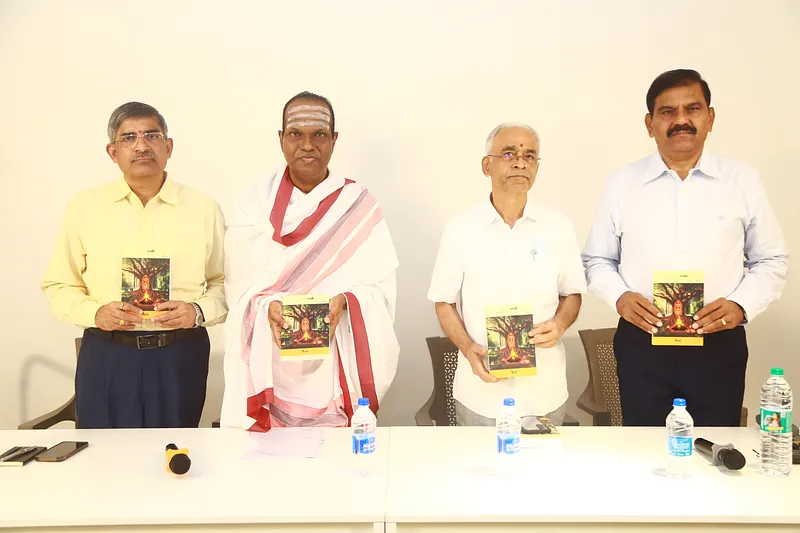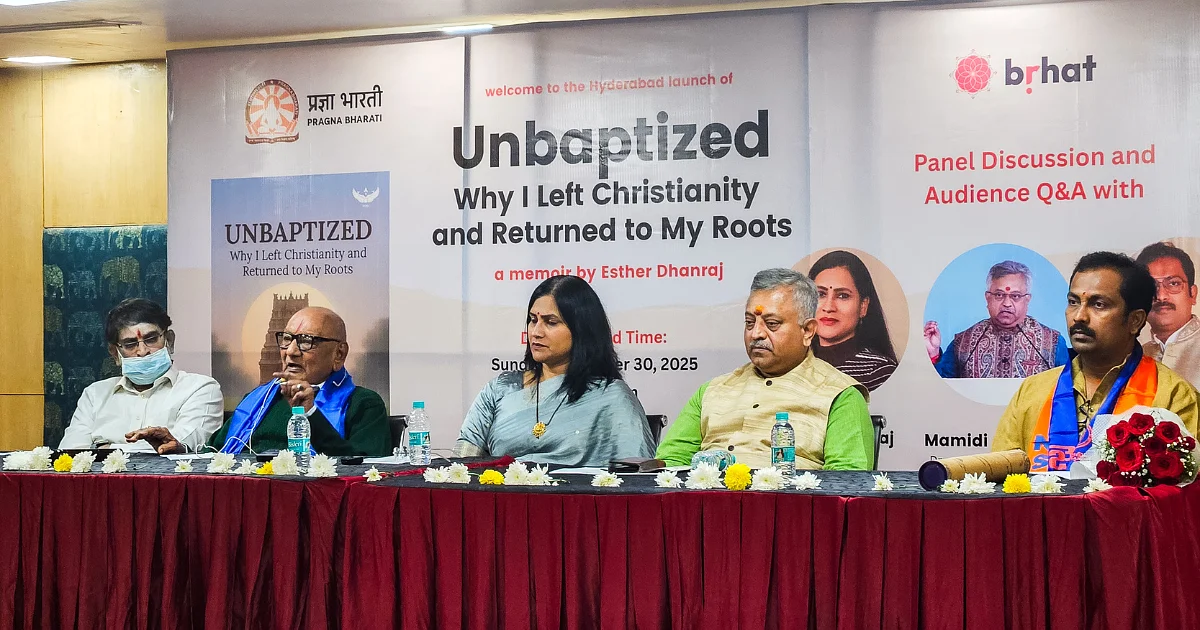
Pragna Bharati and Bṛhat jointly organized the Hyderabad launch of ‘Unbaptized: Why I Left Christianity and Returned to My Roots’, written by Smt. Kamakshi (Esther) Dhanraj, on Sunday, November 30, 2025, at Tourism Plaza (Paryatak Bhavan), Begumpet. The event was attended by scholars, students, community members, and others interested in civilizational identity and religious conversions.
The panellists were Padmasri Śrī Hanuman Chaudhary, Chairman of Pragna Bharati; Smt. Kamakshi (Esther) Dhanraj, author of the book; Śrī Mamidi Giridhar, a senior thinker known for his work on civilizational issues; Advocate Maredu Mohan, an SC/ST rights advocate with grassroots experience; and Śrī V Srinivas, President of Pragna Bharati. Their different backgrounds helped create a well-rounded discussion at the event.  The event began with the lighting of the lamp to invoke divine blessings, followed by a beautiful rendering of Vande Mataram, which set the tone for reflecting on the civilizational identity of Bhāratīyas.
 Vivek Rallabandi ji, the Master of Ceremonies (MC), introduced the session, and Śrī Hanuman Chaudhary spoke about the rising issue of religious conversions, stressing that Hindu society must learn to respond with confidence rather than retreat or blame external forces.
The powerful keynote address was given by Smt. Esther Dhanraj, Director of Advancement at the Hindu University of America (HUA). She shared her personal journey and the ideas that shaped her views, which was the major part of the evening’s discussion. She spoke about her early life in Bhubaneshwar, Odisha, where she grew up in a middle-class joint family that practiced Hindu rituals such as Gāyatrī japa and various vratas. When her family went through a crisis, they became emotionally vulnerable, and a Christian neighbor used this opportunity to lead her family toward conversion.
Esther ji raised an important question: “How does a Christian come to help a distressed Hindu family before fellow Hindus do?” She said that Hindus often avoid helping each other and blame the strength of the oppressor, instead of addressing their own weaknesses first. She also explained that she herself lived as a strict, fundamentalist Christian for twenty-five years. She believed ideas such as “your ancestors are burning in hell,” which she said many Indian converts are made to believe from childhood. This fear pushed her to study Christianity more deeply, and she completed a Master’s degree in Divinity and Apologetics (the branch of Christian theology concerned with the reasoned defence, explanation, and justification of Christianity and its doctrines against criticism or objection), in Georgia, USA, intending to return to India to plant churches and convert Hindus.
Over time, as the author studied Christianity academically, she started noticing contradictions, hypocrisy, and moral problems in the Bible. She discussed the Old Testament’s idea of dominion theology, where God gives humans the right to rule over and exploit everything on earth. She connected this idea to the history of imperialism, slavery, and the Doctrine of Discovery, which stated that any land not already ruled by Christians automatically belonged to Christians. She explained how Christianity divides the world into strict binaries such as saved/damned, heaven/hell, believer/other, and how this way of thinking has supported cultural and geopolitical domination without any thought.
Esther ji used a simple example—the story of a mother, a child, a nanny, and a candy jar—to question the logic of the Biblical Genesis narrative. In Genesis, God places the Tree of Knowledge in the Garden of Eden and forbids Adam and Eve from eating its fruit, warning of punishment. The serpent later tempts Eve to eat the fruit, promising knowledge, and when they do so, God expels them from Eden. Drawing a parallel, Esther ji compared God to a mother who places a forbidden candy before a child, the serpent to a nanny who encourages the child to taste it, and the candy to the apple itself. She said this analogy made her reflect on what she described as the “absurdity” of the nature of God, who creates temptation and then punishes curiosity.  She also critically analyzed both the Old and New Testaments, saying that they contain many inconsistencies, and pointed out that even after 2000 years, Christian scholars still cannot agree on whether Jesus really existed.
Books like Catherine Nixey’s The Darkening Age, which talk about violence in Church history, strengthened her doubts. Such experiences eventually led her to leave Christianity. After that, the author became an atheist for a brief period, then an agnostic, and slowly began looking back towards Sanātana Dharma, which she was born into. She said the journey back was not easy, mainly because Hindu society does not have a strong system or support structure for people who want to return to their roots.
In her talk, Esther ji said that Hindu society needs to accept that there is a civilizational battle going on and must respond with confidence instead of ignoring it. She also called for proper community structures so that people who want to return to Hinduism are not left wandering without support. She ended her speech with a powerful quote attributed to George Bernard Shaw, “He who knows not, and knows not that he knows not, is a fool — shun him. He who knows not, and knows that he knows not, is simple — teach him. He who knows, and knows not that he knows, is asleep — wake him. He who knows, and knows that he knows, is wise — follow him.”
 Śrī Mamidi Giridhar’s Speech
Congratulating Esther ji, in his words, “going through fires of hell and coming back pure”, Śrī Mamidi Giridhar placed the discussion in a larger cultural and policy context. He explained how many Indian laws and public systems continue to reflect Protestant and Abrahamic ideas due to colonial influence. He pointed out that words like “sin,” “martyr,” and even certain concepts of charity do not fit into Sanātana Dharma but continue to shape Indian thinking. He stated that Hindus today often engage with temples in a transactional way, expecting returns for offerings, which he described as an “Abrahamic” mindset rather than a Sanātana one. He called for reclaiming Indian concepts, vocabulary, and confidence.
Advocate Maredu Mohan spoke from his experience growing up in the slums. He explained how “rice bag conversions” happen when poor families receive immediate help from missionaries. He stressed that many Hindus convert not because Christianity is strong, but because they do not have access to simple and clear explanations of Hindu teachings. He described himself as a “Sanātanī Dalit” and said that his early exposure to simple Hindu teachings kept him rooted. He made a powerful statement saying how Dr B.R. Ambedkar should not be seen as an enemy of Hinduism. According to him, Ambedkar worked for the dignity and rights of oppressed communities, and his concerns should be understood in the right spirit. He said that using Ambedkar’s name to divide Hindu society helps only those who want to weaken Sanātana Dharma, and that Hindus should instead recognize Ambedkar’s role as part of a larger effort to uplift marginalized people within the community. He urged Hindu temples and communities to offer basic support and knowledge to every Hindu child so that vulnerable families later do not fall prey to manipulation.
Interaction With the Audience  During the discussion, the audience shared their own experiences and asked questions about reconversion, creating support systems, and working with young people. Esther ji mentioned that the appendix of her book outlines a possible structure for a Hindu ecosystem that can guide returnees. She also noted that many academic groups and organizations are working to bridge the gap between research and on-ground action, but more coordination is needed.
Questions about “unbaptizing,” ceremonies for return, and logical ways to engage with youth were raised, to which Esther ji responded that Arya Samaj’s ghar-vāpsī is one option, and that logical, evidence-based communication may help young people understand her book and ultimately Hinduism better.
The event ended with a vote of thanks by the Joint Secretary of Pragna Bharati, followed by the National Anthem. The launch served not only as a discussion about the book Unbaptized but also as a space to reflect on broader issues related to conversion, cultural identity, and the responsibilities of Hindu society in today’s modern environment. The conversations highlighted the need for collective awareness about these major issues at hand, creating supportive systems, and encouraging active community engagement to reclaim our civilizational identity.
Read Unbaptized book review by Vivek Rallabandi.
Watch the book launch of Unbaptized in Hyderabad.
Photo credits: Meghashyam

.png)