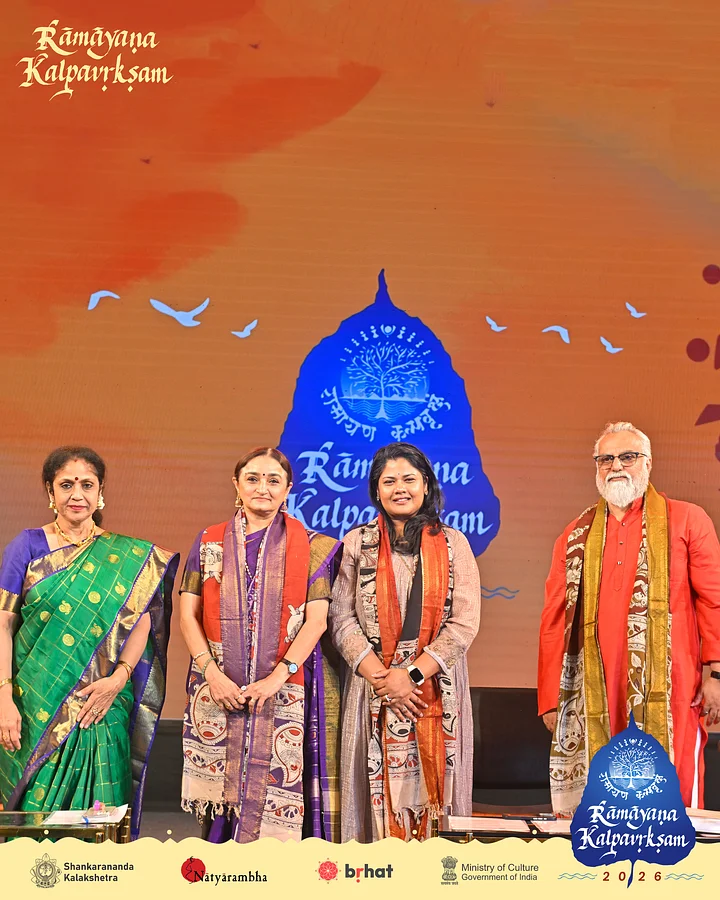
Ramayana Kalpavrksam 2026 unfolded as a deeply immersive cultural and intellectual experience, reaffirming the Rāmāyaṇa as a living civilizational presence rather than a distant epic. The event went beyond being a cultural festival to become an act of remembrance, reclamation and re-rooting.
Curated under the visionary leadership of Padma Shri Dr. Ananda Shankar Jayant, and assisted by Brhat Culture Creatives as a knowledge partner, the festival once again affirmed its place as a unique confluence of scholarship, performance, pedagogy and lived cultural experience, centred on the Rāmāyaṇa consciousness in Indian civilisational memory.
Spread across multiple days and thoughtfully structured sessions, the 2026 edition placed decolonisation at the heart of its inquiry. Through pravachanam, lecture-demonstations, performances and interactive engagements, the festival invited participants to experience and receive the Rāmāyaṇa as a living kalpavṛkṣa - a wish-fulfilling tree whose roots lie in dharma, rasa and collective memory.
Sacred Narratives and Scriptural Insight
One of the defining highlights of the festival was the early morning pravachanam by Śrī Chaganti Koteswara Rao, whose discourses on Sītā Rāma Kalyāṇam and Hanumat Darśanam transported listeners into the inner world of the Vālmīki Rāmāyaṇa. Moving beyond popular retellings and cinematic imagination, he carefully unpacked the canonical narrative, illuminating why Viśvāmitra’s silence, Janaka’s discernment and Rāma’s restraint are dharmic necessities.
Listeners were spellbound as he revealed the sāksātkāra vyākhyās - the unseen backstories, ethical reasoning, and inner motivations behind each moment. The audience assembled in the early morning hours to listen to him. Physical discomfort dissolved into aesthetic immersion, as audiences experienced the power of oral transmission of wisdom that has sustained this civilization for millennia. The session on Hanumān brought forth the ideal of Asādhya Sādhaka - the one who accomplishes the impossible through humility, discernment and unwavering bhakti, offering both inspiration and instruction for contemporary life.

Decolonisation as a Cultural and Aesthetic Process
A central intellectual arc of Ramayana Kalpavrksam 2026 was the exploration of decolonisation through the performing arts, knowledge systems and education. Several sessions examined how colonisation had fractured the Bharatiya ways of knowing. How the separation between science from spirituality, art from ethics and knowledge from lived wisdom had seeped into our consciousness and experience. Speakers also identified the erosion of attention, memory and restraint as key symptoms of this rupture, which is facilitated by exponential growth in modern technology.
The proposed response was finding an anchor in the integrative idea of Indian knowledge Systems. Drawing from Indic frameworks, the speakers articulated three interlinked levels of decolonisation: reclaiming integral knowledge systems, refining human desire through art and rasa, and enabling spiritual descent through aesthetic experience. The discussion also led to Dr. Ananda Shankar Jayant’s vision of creating spaces that fuse culture and academia. Thus, the idea of Vidya Kalākṣetras - institutions that seamlessly fuse disciplines such as mathematics, philosophy, language, and performing arts - emerged as a compelling civilizational model for the future.

Performances: When Art Becomes Dharma
Complementing the intellectual sessions were deeply moving cultural performances that embodied the very principles being discussed. The Rangasri Little Ballet troupe presented episodes from the Rāmāyaṇa with remarkable beauty and restraint. Despite visual limitations posed by the costume, the clarity of bhāva ensured the narrative’s impact. The Odissi performance of the mother-daughter duo, Sujata and Preetisha Mohapatra carried such emotional depth that it held the audience in complete silence during the depiction of Sītā Apaharaṇa.
The Manganiyar Magic ensemble brought alive the musical traditions of Rajasthan through bhajans and folk-classical compositions, creating moments of spontaneous audience participation. Sandeep Narayanan’s voice brought out the Ramayana experience through Carnatic music, and the young Carnatic 2.0 fusion band reimagined traditional music for a contemporary audience and reaffirmed their commitment to taking Indian classical music to the world. These performances show that Bharatiya arts are not performative embellishments, but vehicles of ethical training, emotional refinement and a collective memory.
Rāma Rasa, Kāvya and the Question of Authenticity
Another intellectually rich strand of the festival addressed the dilution of the Rāmāyaṇa in the modern era, particularly through fragmented retellings, over-simplified summaries, and digital distortions. The sessions on Rāma Rasa and Kāvya Paramparā returned attention to Vālmīki as a ṛṣi-kavi, whose vision transforms śoka into śloka and history into itihāsa through dharma-darśana.
Through detailed discussion of rasa theory - vibhāva, anubhāva, and āsvādana - participants were reminded that the purpose of Rāmāyaṇa engagement is not mere information, but inner transformation culminating in śānta rasa. This understanding positioned authentic engagement with the text as a powerful antidote to both colonial distortions and contemporary attention-harvesting economies.

History, Parenting and the Civilizational Future
Several sessions expanded the Rāmāyaṇa’s relevance into domains of history, governance, science, and parenting. Drawing upon inscriptions, temple architecture, ancient educational institutions, and judicial systems, speakers dismantled colonial myths of a fragmented or unscientific India. From merit-based democratic practices to advanced medical and astronomical knowledge, the continuity of dharma as a civilizational ethic was robustly demonstrated.
A particularly resonant segment focused on Parenting a Bharateeya Future, framing upbringing as a yajña guided by the puruṣārthas. Emphasising viveka as the core civilizational skill, these discussions highlighted the role of stories, arts, rituals, and home practices in shaping rooted yet discerning individuals capable of navigating modern challenges without cultural amnesia.

Participation, Dialogue, and Collective Memory
Interactive elements such as the Indiyatra Rāmāyaṇa quiz underscored the deeply personal relationship communities across Bhārat share with the epic. Participants enthusiastically traced their regions, landscapes, and cultural practices back to the Rāmāyaṇa, reinforcing the idea that it is not a single story but a shared civilizational memory, experienced locally yet unified by dharma. The Kalagrama stalls showcased the rich crafts of India, while giving the participants an opportunity to indulge in and buy the goodies.

Conclusion
Ramayana Kalpavrksam 2026 stood as a luminous example of how festivals can function as civilizational laboratories; as spaces where art, scholarship and lived experience converge to restore coherence in thought and practice. At a time when cultural narratives are increasingly fragmented, this edition reaffirmed that the Rāmāyaṇa remains a living force, capable of guiding ethical action, aesthetic sensitivity and spiritual clarity.
As the kalpavṛkṣa continues to grow, nourished by scholars, artistes, families, and seekers alike, Ramayana Kalpavṛkṣam 2026 leaves behind not just memories of performances and talks, but renewed confidence in the civilizational wisdom of Bhārat and its relevance for a global future.

.png)