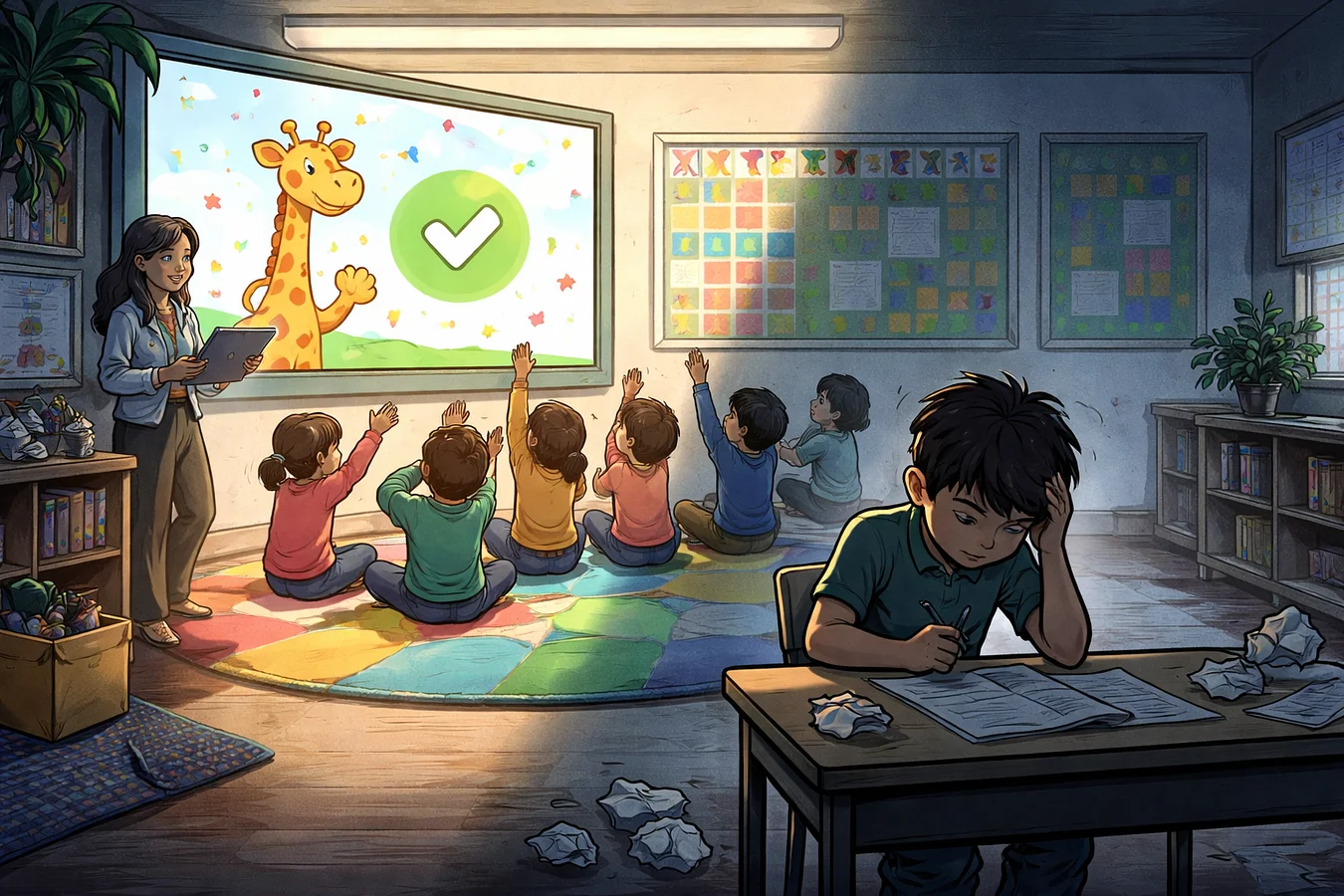
There is a certain look that has become familiar in classrooms across the world, especially in the early grades. Children sit on brightly coloured chairs. Music plays softly in the background. The teacher smiles often, sometimes excessively. A slide flashes on the screen: a cartoon giraffe claps as the correct answer appears. The room feels pleasant, frictionless, carefully padded against discomfort. No one seems anxious. No one seems bored. No one struggles for very long.
This, we are told, is joyful learning.
It would be foolish to argue against joy itself. Learning, at its best, has always contained moments of delight: the quiet satisfaction of solving a difficult problem, the sudden clarity when a concept clicks, the long afterglow of understanding something once opaque. Anyone who has watched a child teach themselves to read, or an adult finally grasp a stubborn mathematical idea, knows that learning can carry a deep, almost bodily pleasure.
The problem is not joy. The problem is what we have done to it.
Over the past two decades, “joyful learning” has hardened into a meaningless ritual. It has acquired props, scripts, and performance cues. It has been converted into a visible aesthetic that can be photographed, measured, and sold. In the process, learning itself has quietly receded. What remains is a simulation of happiness that often bypasses the very cognitive conditions that give rise to genuine joy in learning.
This essay is an inquiry into that transformation. It asks how joy came to be confused with ease, how struggle came to be treated as failure, and how technology, especially educational technology and now artificial intelligence, has accelerated this confusion. It is not an argument for grim classrooms or punitive instruction. It is a defence of something far more fragile and far more human: the productive struggle that precedes understanding.
When Joy Became a Performance
The contemporary emphasis on joyful learning did not emerge from nowhere. It grew partly in response to older models of schooling that were rigid, authoritarian, and indifferent to children’s inner lives. Progressive education, child-centred pedagogies, and constructivist theories all challenged the idea that learning must be silent, uniform, and fear-driven. These critiques were necessary and overdue.
But somewhere along the way, a subtle shift occurred. Joy stopped being an outcome of learning and became its prerequisite. If children were not visibly happy, something was assumed to be wrong. If learning did not look fun, it was considered suspect.
This shift had consequences. Teachers began to feel pressure not merely to teach well, but to demonstrate enthusiasm. Lesson plans were evaluated not only on clarity or depth, but on whether they appeared engaging. Classrooms became stages on which learning had to be constantly animated, lest attention wander.
The rituals followed predictable patterns. Every task was gamified. Every correct answer triggered applause, stars, badges, or digital fireworks. Mistakes were hurried past, softened, or reframed so quickly that students had little time to sit with them. Silence, once a sign of concentration, came to feel awkward, even threatening.
Yet anyone who has learned anything of substance knows that the moments before understanding are rarely joyful. They are often marked by confusion, irritation, and doubt. The mind strains. Patterns refuse to settle. The effort feels disproportionate to the reward. This is not failure. This is learning doing its work.
By banishing these moments from classrooms, we did not make learning kinder. We made it thinner.
What Cognitive Science Has Been Telling Us
Long before joyful learning became a slogan, cognitive science had been quietly mapping how durable learning actually occurs. One of its most consistent findings is that learning is strengthened not by ease, but by effort.
Declarative knowledge, facts, concepts, and principles that can be consciously articulated require repeated retrieval. Each time a learner struggles to recall information, neural pathways are reinforced. This process, known as retrieval practice, is effortful by design. It feels harder than re-reading or watching an explanation again. It is also far more effective.
Automaticity, the ability to perform tasks fluently without conscious effort, emerges only after extended periods of deliberate practice. Whether it is reading, arithmetic, or musical performance, fluency is built on thousands of small, often unglamorous repetitions. There is little spectacle in this work. There is also no shortcut.
Productive struggle plays a crucial role here. When learners are challenged just beyond their current competence, they must actively grapple with ideas. They make errors. They revise mental models. Over time, understanding deepens. Remove the struggle, and learning becomes brittle, easily forgotten, easily confused.
Flashcards offer a useful example. A student who hesitates before answering, who feels the discomfort of not quite knowing, is engaging precisely the mechanisms that strengthen memory. If the answer appears too quickly, if hints are layered in before effort has a chance to occur, the opportunity is lost. The learner feels good, but learns less.
The irony is stark. In the name of joy, we have engineered classrooms that minimize the very conditions that foster deep satisfaction in learning.
The Infantilization of Learning
One of the less-discussed consequences of ritualized joyful learning is how it infantilizes learners, even as they grow older. University students now expect the same gamified interfaces they encountered in primary school. Professional development workshops are designed with icebreakers and stickers. Serious intellectual work is packaged with emojis.
This is not because adults cannot handle difficulty. It is because they have been trained to associate learning with constant affirmation. When affirmation is absent, motivation collapses. The learner, no longer propped up by external rewards, struggles to persist.
There is a quiet cruelty in this. By shielding learners from discomfort early on, we deprive them of the resilience required later. The capacity to sit with confusion, to tolerate not knowing, to persist without immediate validation, these are not personality traits. They are learned dispositions. They must be practiced.
Joyful learning rituals often claim to build confidence. In reality, they often build dependence.
Enter EdTech
Educational technology arrived with promises of scale, personalization, and engagement. Many of these promises were sincere. Some were even partially realized. But the structural incentives of the EdTech industry skewed its priorities from the start.
Technology is expensive to build and easy to demonstrate. Pedagogy is slow to develop and difficult to showcase. Investors prefer dashboards to lesson plans. Sales teams prefer engagement metrics to cognitive outcomes. The result is predictable: platforms that optimise for visible activity rather than invisible understanding.
Joyful learning rituals proved to be an ideal companion. Animated characters, points, streaks, and leaderboards translated easily into software features. Productive struggle did not. Confusion could not be easily logged. Silence looked like disengagement. Hesitation registered as a drop-off.
As a result, many platforms began aggressively smoothing the learning path. Hints appeared quickly. Answers were scaffolded heavily. Difficulty adapted downward at the first sign of error. The learner moved forward, but often without consolidation.
This design logic rests on a fragile assumption: that frustration drives learners away. In reality, what drives learners away is confusion without meaning. A struggle that is structured, purposeful, and bounded is not discouraging. It is motivating. It signals that learning is happening.
EdTech rarely distinguishes between the two.
AI and the Acceleration of the Problem
Artificial intelligence has intensified these trends. AI tutors can explain endlessly, rephrase infinitely, and generate examples on demand. This seems, at first glance, like a triumph of access. Why struggle when help is always available?
The answer lies in what struggle does. When AI intervenes too early, it short-circuits retrieval. When it fills every gap, it prevents consolidation. When it answers before the learner has formulated a question, it replaces thinking with consumption.
There is also a subtler risk. AI systems are optimized to be agreeable. They respond politely, affirm frequently, and rarely allow silence. The learner is never left alone with uncertainty. The machine is always there, smiling, ready to help.
This creates a form of cognitive dependency. The learner becomes skilled at prompting, not at reasoning. Understanding is outsourced. Joy is immediate. Mastery is delayed indefinitely.
The danger is not that AI will make learning unpleasant. The danger is that it will make learning shallow while feeling satisfying.
What We Lost Along the Way
In traditional classrooms, for all their flaws, there were moments of shared struggle. A difficult proof was worked through slowly on the board. A text read and reread until meaning emerged. A teacher who waited, uncomfortably, for students to think.
These moments were not always kind. But they were real.
The new rituals of joyful learning have replaced them with motion. Something is always happening. Something is always flashing. The classroom is busy, but the mind is often passive.
Joy, in its deeper sense, has less to do with pleasure than with meaning. It arises when effort is rewarded with insight. When time spent wrestling with an idea yields clarity. When understanding feels earned.
By confusing joy with entertainment, we have made learning lighter, but not richer.
A Different Kind of Joy
What would it mean to reclaim joy without ritualizing it?
It would mean designing classrooms where struggle is normalized rather than hidden. Where silence is permitted. Where errors are examined, not rushed past. Where explanations are clear, but not exhaustive. Where learners are expected to think before being helped.
It would mean using technology not to remove difficulty, but to sequence it thoughtfully. Not to replace effort, but to support it. Not to entertain, but to extend practice.
It would mean teaching students that discomfort is not a sign of inadequacy, but a signal of growth. That learning is not supposed to feel easy all the time. That joy often arrives late.
This vision is harder to sell. It produces fewer screenshots. It resists slogans. It demands trust in learners and patience from teachers.
But it is closer to the truth.
Learning has always been a slow, uneven, deeply human process. No amount of animation can change that. No algorithm can automate understanding. The joy we seek is already there, waiting, just beyond the struggle we have been so eager to remove.
The task before us is not to make learning happier. It is to make it honest again.