What is ‘Saṅgīta’?
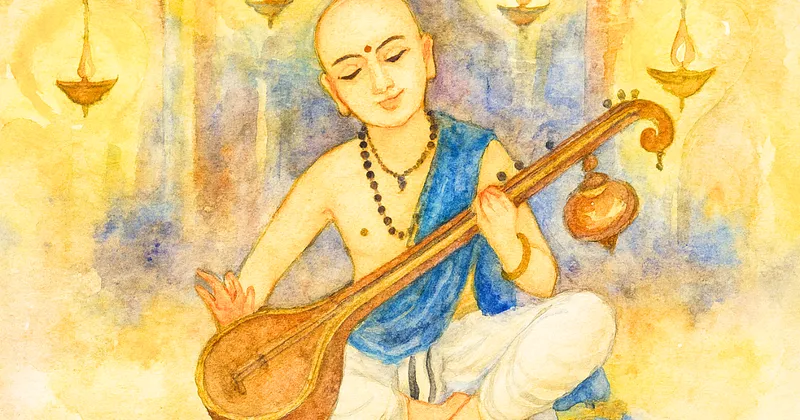
The word saṅgīta comes from saṃ and gīta, meaning that which is ‘harmoniously sung’. saṅgīta represents a complete performance of vocals, instruments, rhythm, movement, and inner experience. All are inherent and sacred to it.
गीतं वाद्यं तथा नृत्तं त्रयं सङ्गीतमुच्यते॥
gītaṃ vādyaṃ tathā nṛttaṃ trayaṃ saṅgītam ucyate
“Song, instrumental music, and dance, these three are called saṅgīta.”- Saṃgītaratnākara of Śārṅgadeva and Amarakośa 1.6.11
The Sāmaveda shaped sound into a disciplined spiritual practice. Saṅgīta isn’t entertainment but nāda - sacred sound. Pitch, breath, accent, rhythm, and vibration were connected with ritual order, inner refinement, and spiritual experience. Through nāda, music could awaken devotion, deepen emotion, and lead the listener toward rasa, the spiritual and aesthetic experience central to Indian art.
The Nāṭyaśāstra, one of the earliest and most important texts on Indian performance traditions, also treats music as part of a larger artistic system. It discusses drama, dance, music, musical scales, instruments, song structure, rasa, and the relationship between music and movement. Later texts such as the Saṅgītaratnākara, Saṅgītadāmodara, and Viṣṇudharmottarapurāṇa continued this tradition by explaining music in both theoretical and practical terms.
Musical Instruments: Importance And Classification in the Texts
The Saṅgītadāmodara explains gīta as a union of dhātu and mātu:
धातुमातुसमायुक्तं गीतमित्युच्यते बुधैः ।
तत्र नादात्मको धातुर्मातुरक्षरसञ्चयः ॥
dhātumātusamāyuktaṃ gītam ity ucyate budhaiḥ |
tatra nādātmako dhātur mātur akṣarasañcayaḥ ||
“Wise people say that gīta is composed of dhātu and mātu. In this, dhātu is of the nature of sound, while mātu is a collection of letters or syllables.”— Saṅgītadāmodara of Śubhaṅkara
Here, dhātu may be understood as the sound element of music, especially the sound produced through instruments. The same text also recognizes two kinds of gīta: yantra and gātra. Yantra refers to music produced through instruments such as the veṇu and vīṇā.
In the Viṣṇudharmottarapurāṇa, both vocal and instrumental music are discussed elaborately.
References to music and instruments are also found throughout Saṃskṛta literature. In Māgha’s Śiśupālavadha, the flute appears as an important instrument. Kālidāsa’s Meghadūta describes the Yakṣa’s wife sitting with a vīṇā, longing to sing for her absent husband. In the same poem, the rumbling of clouds is compared to the sound of a drum. Such examples show that instruments were always a part of musical imagery and, in fact, formed the backbone of it.
According to the Mīmāṃsaka Jaimini, music is also connected with inner effort:
गीतिर्नाम क्रिया ह्याभ्यन्तरप्रयत्नजनितस्वरः ॥
gītir nāma kriyā hy ābhyantara-prayatna-janita-svaraḥ
— Śiśupālavadha Kāvya Samīkṣā, p. 184
This means that music arises from an inner act or effort that produces sound. In this sense, music is not only an external performance; it begins within the performer and becomes audible through voice or instrument.
Music, or saṅgīta, is also found in early Saṃskṛta literature such as the Rāmāyaṇa and the Mahābhārata. In the Kiṣkindhā Kāṇḍa of the Rāmāyaṇa, music is described through natural sounds:
षट्पादतन्त्रीमधुराभिधानं प्लवङ्गमोदीरितकाष्ठतालम् ।
आविष्कृतं मेघमृदङ्गनादै र्वनेषु सङ्गीतमिव प्रवृत्तम् ॥
ṣaḍpādatantrīmadhurābhidhānaṃ plavaṅgamodīritakaṣṭhatālam |
āviṣkṛtaṃ meghamṛdaṅganādair vaneṣu saṅgītam iva pravṛttam ||
— Śiśupālavadha Kāvya Samīkṣā, p. 184
This verse presents the forest as if it were filled with music, where the sounds of nature resemble musical instruments and rhythm.
In the Virāṭaparva of the Mahābhārata, Arjuna is shown teaching dance, song, and musical instruments in the palace of King Virāṭa:
गीतं नृत्यं विचित्रं वादित्रं विविधं तथा ।
शिक्षयिष्याम्यहं राजन् विराटभवने स्त्रियः ॥
gītaṃ nṛtyaṃ vicitraṃ vāditraṃ vividhaṃ tathā |
śikṣayiṣyāmy ahaṃ rājan virāṭabhavane striyaḥ ||
— Mahābhārata, 4.2.29
“O king, I shall teach the women in Virāṭa’s palace song, dance, and various kinds of instrumental music.”
This reference clearly shows that music, dance, and instrumental performance were the trinity of music, and one could never be replaced with the other, or nothing could be removed from this trinity.
The tradition of music goes back even further to the Vedic period, where instruments such as vāṇa, āghāti, kāṇḍī, and others were used. Later, during the period of the Mahābhārata, instruments like the vīṇā, veṇu or flute, and mādala or drum became common.
Māgha mentions instruments such as the vīṇā and veṇu, along with rhythm or tāla:
गतम् अनुगतवीणैरेकतां वेणुनादैः कलमविकलतालं नायकैर्बोधहेतोः ।
आसकृदनवगीतं गीतमाकर्णयन्तः सुखमुकुलितनेत्रा यान्ति निद्रां नरेन्द्राः ॥
gatam anugatavīṇair ekatāṃ veṇunādaiḥ
kalam avikalatālaṃ nāyakair bodhahetoḥ |
āsakṛd anavagītaṃ gītam ākarṇayantaḥ
sukhamukulitanetrā yānti nidrāṃ narendrāḥ ||
- Śiśupālavadha, 11.10
This verse presents a refined musical scene where the sounds of the vīṇā and flute accompany song and rhythm, creating a peaceful atmosphere in which kings fall asleep with joy.
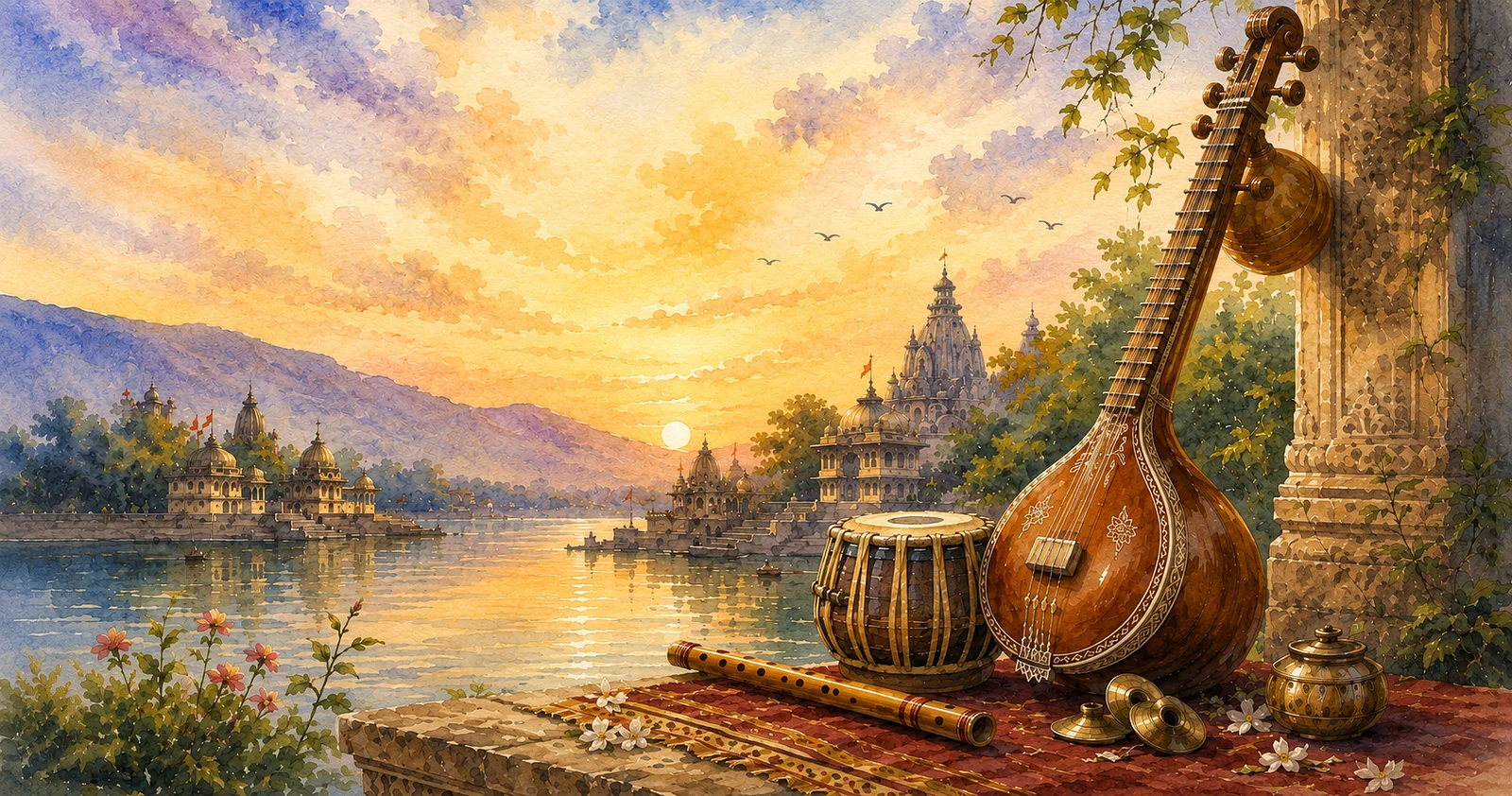
Instrumental music, in Saṃskṛta, is connected with the term ātodya, meaning musical instrument. Texts such as the Nāṭyaśāstra, Saṅgītaratnākara, and Viṣṇudharmottarapurāṇa classify instruments into four major types: tata, suṣira, ghana, and avanaddha. Tata refers to stringed instruments such as the vīṇā. Suṣira refers to hollow or wind instruments such as the flute. Ghana includes solid instruments that produce sound when struck, such as cymbals and bells. Avanaddha refers to instruments covered with leather, such as drums.
The Viṣṇudharmottarapurāṇa gives a highly technical discussion of instrumental music. It explains that the notes used in instrumental music are the same as those used in vocal music, though their arrangement may differ in instruments such as the vīṇā and flute. It also discusses rhythmic measures, styles of playing, drum syllables, hand strokes, and methods of performance according to different rasas. The text even describes how musicians should be seated during a performance, suggesting that music was treated as a carefully organized and refined art.
Why Indian Classical Instruments Must Be Handmade
Indian music also differs significantly from the Western system of fixed-pitch frequencies and equal temperament. In Indian classical music, svaras are not rigid notes. They are fluid, relative, and shaped by the rāga in which they appear. A note such as “Re” may not sound exactly the same in every rāga. Its character depends on how it is approached, held, bent, ornamented, and released. The seven basic notes - Sa, Re, Ga, Ma, Pa, Dha, and Ni- are only the foundation. Their true life comes through subtle movements, curves, oscillations, and microtonal shades known as śrutis.
Because of this, Indian classical instruments cannot be treated as ordinary factory-made objects. They are not merely tools for producing fixed notes. They must be capable of carrying the subtle emotional movement, depth, and flexibility of Indian music. This is one of the main reasons why traditional Indian instruments have remained largely handmade. A machine can produce uniformity, but Indian classical music often requires individuality. A handmade instrument can be adjusted according to the musician, the tonic, the rāga, and the style of playing.
The sitar is a good example. Its high, curved, movable frets allow the player to pull the string sideways and create long expressive bends known as meend. Its bridge, called the jawārī, gives the instrument its distinctive buzzing resonance and long sustain. This sound cannot be produced by measurement alone. It has to be shaped, filed, tested, heard, and adjusted by a skilled craftsperson. Similarly, the Saraswati veena has a special design that supports deep gamakas. Its scalloped fingerboard, wax-fixed frets, and resonant bridge all contribute to the long, singing quality required in Carnatic music.
Lack of State Support
In earlier times, musicians and instrument-makers were closely connected. Musicians often understood the body of the instrument, and artisans understood the soul of the music. Today, that relationship is weakening. Traditional materials have also changed. Earlier, materials such as ivory, stag horn, red sandalwood, Burmese teak, jackwood, gourds, camel bone, and natural waxes were used according to the needs of different instruments. Many of these materials are now restricted, banned, or difficult to obtain because of environmental and wildlife protection laws. These protections are necessary, but they have also changed the sound, appearance, and construction of traditional instruments.
For example, sitar and vīṇā bridges were once made from ivory or horn. Today, makers often use camel bone, synthetic materials, Teflon, Delrin, or other substitutes. These newer materials may be more durable and consistent, but many musicians feel that older natural materials produce a warmer and more vocal tone. Decorative inlays, once made from ivory or mother-of-pearl, are now often replaced with plastic or celluloid. Even when these changes do not directly affect the sound, they mark a major shift in the material culture of Indian instrument-making.
Wood is another major concern. The Saraswati veena is traditionally associated with jackwood, especially in regions such as Thanjavur and Bobbili. The quality of the wood is crucial. It must be selected, seasoned, carved, and tuned with great care. A good instrument is not simply assembled; it is slowly brought to life.
Government schemes such as the Guru-Shishya Parampara and PM Vishwakarma Yojana can also support traditional crafts if they are implemented seriously for instrument-makers. Revival efforts, such as attempts to bring back ancient instruments like the yazh, show that there is still hope.
Some efforts are being made. The Miraj sitar and tanpura have received Geographical Indication recognition, which helps protect their regional identity.
However, much more needs to be done. Many government support programs focus broadly on preserving tribal and folk music, but they do not always give specific attention to the craft of instrument-making. In a 2019 Lok Sabha reply, the Government of India stated that it did not have verifiable data on how many Indian musical instruments are extinct or close to extinction. At the same time, it acknowledged that traditional instruments are important parts of India’s cultural heritage and mentioned preservation efforts through the Sangeet Natak Akademi, including galleries and training programmes for instruments such as the pakhawaj, sarangi, sundri, shehnai, rabab, khartal, and singhi sarangi.
The govt. needs to devise policies which allow the sourcing of such authentic materials through a special clause in these Acts and policies in order to preserve these musical and cultural traditions that are unique to India.
No Institutional Support
Despite these challenges, India still has important centers of traditional instrument-making via these alternative materials mentioned above. Miraj in Maharashtra is known for sitars and tanpuras, while Thanjavur in Tamil Nadu is famous for the Saraswati veena. These places are not merely production centers; they are living craft traditions where families of artisans have preserved knowledge for generations. However, the craft is under serious pressure. Royal patronage has disappeared, electronic substitutes have become common, and many young people from artisan families are leaving the profession because it no longer offers financial security.
Another serious problem is the lack of formal training. India has very few dedicated courses in traditional instrument-making or luthiery. Most knowledge is still passed down through family workshops, informal apprenticeships, and the guru-śiṣya tradition. Institutions such as the National Institute of Design may offer training in design and materials, but there are still not enough specialized programs for classical instrument-making. This is worrying because once such knowledge disappears, it cannot be easily recreated. A machine can copy the shape of an instrument, but it cannot inherit the listening tradition of an artisan.
People-led Grassroots Initiatives
Some artisans are using websites and social media to reach buyers directly. Grassroots efforts also show the urgency of the issue. The “Save Akhra” campaign in Jharkhand, led by folk artist Nandlal Nayak, aims to preserve traditional musical instruments and support the artisans who make them. The campaign encourages people to adopt folk and tribal instruments, helping create livelihoods for poor Adivasi instrument-makers while preventing these traditions from becoming mere museum pieces. Instruments such as the Tohila, Kendra, Adivasi Shehnai, and Sarangi are reported to be close to extinction because both players and makers are disappearing.
What Needs To Be Done
To protect this heritage, India needs dedicated instrument-making schools, craft clusters, raw material banks, scholarships for young artisans, export support, and direct grants for musicians who buy handmade instruments. There must also be better documentation of endangered instruments and the people who still know how to make them. Towns such as Miraj, Thanjavur, Bobbili, and other craft centers should be treated as cultural heritage sites, not merely as local markets.
The issue is not only economic; it is civilizational. Indian instruments are not just objects that make music entertaining. At their highest level, they are vehicles of inner refinement. They carry the listener toward silence, devotion, rasa, and even samādhi. They awaken a sense of devatva, or divinity, within the listener. When an instrument disappears, an entire sound-world disappears with it. When instruments such as the rudra veena, vichitra veena, surbahar, dilruba, esraj, pakhawaj, or shehnai fade from living practice, we do not merely lose objects. We lose ways of hearing, feeling, remembering, and approaching the sacred.
We are rightly concerned when animals become extinct, but we rarely show the same concern when musical instruments, craft lineages, and sound traditions disappear. Yet these instruments are also living carriers of memory. They are part of the backbone of Indian civilization. The question, therefore, is not only whether traditional instruments will survive. The deeper question is: what will happen to Indian classical music if the instruments that shaped its soul disappear?
To preserve Indian music, we must preserve not only compositions, rāgas, and performers, but also the hands that build the instruments. The future of saṅgīta depends as much on the artisan as on the artist. And lastly, we need to ensure that our coming generations are introduced to and made interested in śāstrīya saṅgīta so that the demand and supply for this craft is maintained and this tradition and important part of our culture does not become extinct.
References
[1] https://www.youtube.com/watch?v=STP14c_1nsw
[2] https://youtu.be/NY6zb4XgdYs?si=EUOatkpPSmJu5UaU
[3] https://www.britannica.com/topic/Samaveda
[4] https://en.wikipedia.org/wiki/Natya_Shastra
[5] https://en.wikipedia.org/wiki/Sangita_Ratnakara
[6] https://www.pib.gov.in/PressReleseDetailm.aspx?PRID=2248306®=3&lang=2
[7] https://www.pib.gov.in/PressReleasePage.aspx?PRID=2223737®=3&lang=2
[9] https://sansad.in/getFile/loksabhaquestions/annex/172/AU1189.pdf?source=pqals
[10] https://culture.gov.in/musical-instruments-india
[11] https://sansad.in/getFile/loksabhaquestions/annex/16/AS199.pdf?source=pqals
[12] https://www.wisdomlib.org/hinduism/essay/shishupala-vadha-study/d/doc1150129.html
[16] https://www.wisdomlib.org/hinduism/essay/shishupala-vadha-study/d/doc1150129.html
The author can be reached on X/Twitter - https://x.com/TanyaBrahmvadni

.png)