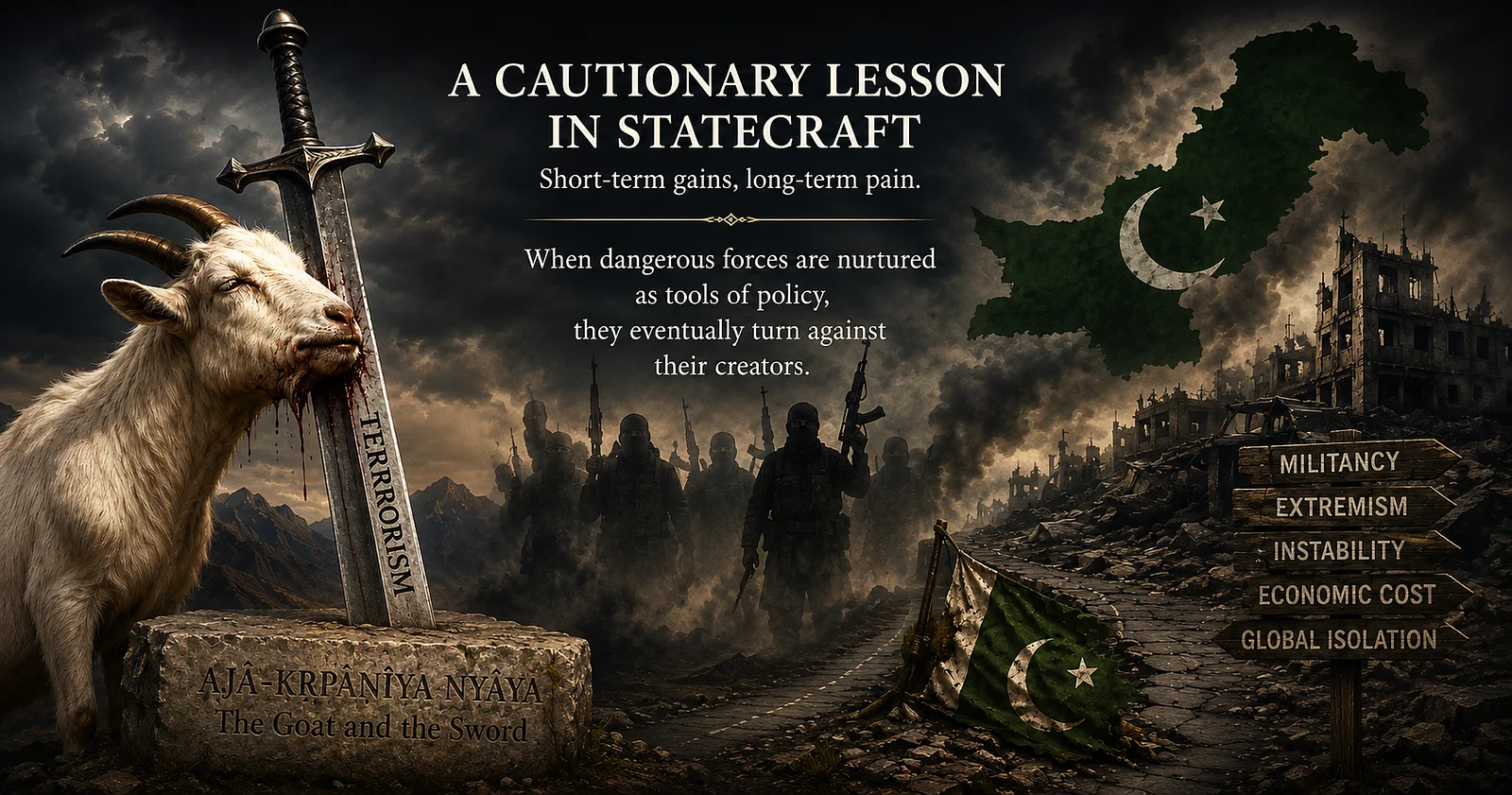
The Indian Knowledge System provides a rich set of conceptual perspectives on the understanding of politics, statecraft, ethics and strategic behaviour. The discipline of international relations today is grounded in ideas and theories of the West, but the study of policy choices and the behaviour of states can also be informed by indigenous Indian approaches. The maxim “Goat and the Sword” is one such framework, known as Ajā-kṛpāṇīya Nyāya. The nyāya comes from the analogy of a goat rubbing its neck against a sharp sword and hurting itself. What is the lesson to be learned from this proverb? That people or organizations may end up being fooled by their own foolishness, and by getting involved with some forces that can be harmful in the long term, and that they often do not appreciate.
From the perspective of statecraft, Ajā-kṛpāṇīya Nyāya is a cautionary tale about misjudgments of strategy that lead to self-destruction. It emphasizes instances in which political actors act in short-term interest, but forget the long-term costs of their actions. These activities may seem positive at first, but over time they set a scene that is detrimental to the security, stability and success of the actor themselves. Read from this angle, Pakistan's strategic course since the latter half of the last century has made a very interesting case study. The reliance on the militants as a means of foreign and security policy, as well as the country's quest for strategic depth in Afghanistan and its adoption of asymmetric warfare against India, has come at a cost that is growing more threatening to the stability of Pakistan. The Ajā-kṛpāṇīya Nyāya thus offers a very helpful indigenous analytical framework for understanding Pakistan's policies and their unintended consequences. The main responsibility of a ruler, according to the Arthaśāstra tradition, is for the maintenance and enhancement of the state. Practical sense, common sense, and carefully weighing the consequences of political action are important factors that Kauṭilya emphasizes repeatedly. A ruler who undermines his own country is wrong to do so. This wisdom is reflected in Ajā-kṛpāṇīya Nyāya, which cautions against interaction with forces that are not completely controllable by the individual. The policies adopted in order to improve the national security in Pakistan in the last four decades show the creation of long-term insecurity where the long-term consequences have not been taken into account.
The Afghan invasion by the Soviets in 1979 was a turning point in Pakistan's strategic orientation. With Gen. Zia-ul-Haq at the helm, Pakistan was to become the main playground for the anti-Soviet jihad. The United States and Saudi Arabia funded Pakistan to recruit, train, arm and mobilise thousands of fighters. This plan seemed to be a great success at the time. The Soviet withdrawal from Afghanistan in 1989 was hailed as a geopolitical triumph and the security establishment in Pakistan saw in the Jihadi infrastructure an effective tool of geopolitical influence.
The infrastructure built up during the Afghan jihad, however, didn't end with the conflict. Militant groups, training camps, religious seminaries, the arms trade and extremist ideology continued to be well entrenched in Pakistani society. The initial perception of the plan as a useful strategic asset slowly morphed into a major domestic security problem. The notion that a particular group could be used as a militia without its control was found to be incorrect. Those very forces that were developed for pursuing outside goals started to have their own agendas, capabilities, and constituencies. In the terms of Ajā-kṛpāṇīya Nyāya, Pakistan had decided to use a weapon it knew could kill, and without even seriously contemplating that it might be able to kill its maker. The pursuit of the doctrine of strategic depth in Afghanistan was even more pronounced in this regard in Pakistan. Pakistani policymakers hoped to get a friendly government in Kabul that would give them geopolitical leverage and make Pakistan less vulnerable than it was with the previous government. Over this goal, successive governments helped various militant groups in Afghanistan. Many Pakistanis in the security establishment welcomed the Taliban's rise in the 1990s as a positive development to gain influence in Afghan affairs.
But the impacts of this policy were far from what was intended. Instead of establishing a stable and friendly strategic set-up in Afghanistan, it has been a cause of continuous instability which often found its way to Pakistan's borders again and again. Militant groups got their arms, extremist ideologies got social acceptance and armed networks grew more and more unmanageable. The notion that the non-state could be co-opted as a tool of state policy was a false one. Pakistan's strategic thinking underestimated the ability of these actors to develop a capacity to transcend their sponsors and become autonomous. This is one of the main cautions found in Ajā-kṛpāṇīya Nyāya, that those who play with dangerous forces often find that the forces have a life of their own.
The most spectacular illustration of this is the formation of the Tehrik-i-Taliban Pakistan (TTP). Founded in 2007, TTP was a militant group that was on the periphery of Pakistan and has now become a direct threat to the Pakistani state. It attacked military facilities, government offices, educational institutions, religious buildings and civilian populations. The gruesome December 2014 Army Public School attack that killed over 150 people, including more than 150 children, is one of the worst events in Pakistan's recent history. This tragedy is not just a loss-of-life issue. It represented the shift from a strategic breeding ground for a militant bando to what it had become - an existential threat to the state. The goat had not only been touched by the sword, but had been injured by the very sword which it had thought would benefit it. A policy of Pakistan on Kashmir is another example of this principle of Ajā-kṛpāṇīya Nyāya. Over the years, certain elements of the Pakistani state security services saw the militants from Kashmir as cheap weapons of pressure against India. These groups were seen as assets that could help further national goals without raising the possibility of traditional military conflict. But there was a high diplomatic and political price to pay for this. There has been a high level of international concern against the use of Pakistan by militant groups since the country's role in facilitating the Mumbai attack on 26/11/2008. Pakistan's image suffered due to the fear of terrorism funding and militancy which affected its foreign policy with big powers. Frequent interactions with the Financial Action Task Force (FATF) pointed to the economic and financial burden these policies had on the state of Pakistan. A policy designed to strengthen geopolitical position-led to diplomatic isolation and economic restrictions.
In addition to security policy, Pakistan's own experience also brings to light the social costs of radical ideologies in political agendas. In the Afghan jihad, there was a strong emphasis on religious mobilization as a key element of the state's strategy. The discourses of education, religious seminaries and public discourse were increasingly dominated by militant interpretations of religion. In the beginning these stories were used for geopolitical purposes, but they slowly transformed social attitudes in a manner that was not easily reversed. The level of sectarian violence rose, minority communities became increasingly insecure and extremist organisations gained greater influence in society. The state's attempt to use ideology has resulted in social polarization and polarization of ideology which has impacted the internal unity of Pakistan. This too is an application of Ajā-kṛpāṇīya Nyāya, which is the logic of the "useful" in the short run that produces "harm" in the long run.
The economic consequences of these policies have also been great. Militancy and terrorism, along with counterterrorism efforts over the past several decades, placed huge financial demands on Pakistan. Funds that might have been spent on education, health care, infrastructure, and economic development were allocated to security spending. Economic instability kept foreign investment from flowing in, and slowed down economic growth. Arthaśāstra’s view of such outcomes is a failure in statecraft. Kauṭilya always stated that the power of a state is in the well-being of its citizens and the security of its institutions. Security is an endeavor that has to be built upon economic bases, otherwise it is not going to protect the state it is supposed to protect. A wider strategic lesson is also pointed out in the context of the state's boundaries in the Ajā-kṛpāṇīya Nyāya. Policymakers have the tendency of assuming that they can use non-state actors as tools whose actions are predictable and manageable. History has shown us over and over again that this assumption is false. Armed groups form their own interests, leadership, sources of legitimacy and ideology. These groups often have goals that are different from their sponsors' goals, and once they have become entrenched, they tend to go against their sponsors. The history of Pakistan with the militants shows how dangerous the use of proxies as tools of statecraft can be. The shifting of strategic assets to strategic liabilities is one of the most obvious examples of the Ajā-kṛpāṇīya principle.
To sum up, Ajā-kṛpāṇīya Nyāya offers a strong indigenous tool to analyze the strategic trajectory of Pakistan over the last few decades. The lesson here is that it is important to think before acting on a force that might be harmful, or to act on a force when the repercussions are not fully understood. The dynamics of strategic self-harm are evident in Pakistan's policy of backing militant groups, strategic depth policy in Afghanistan, use of proxy warfare, and encouragement of ideological mobilization. Many of the most serious problems confronting the country now; such as terrorism, insurgency, social radicalization, economic pressures and diplomatic challenges, have not just come from external forces but rather policies which produced self-destructive and unintended consequences. From the perspective of the Indian Knowledge System, Pakistan's situation is a modern scenario of the wisdom and knowledge that has been embedded in Ajā-kṛpāṇīya Nyāya. The lesson is not only for Pakistan but it's a universal lesson of statecraft. States refuse to accede not only because of what their enemies do, but because they don't see the danger in what they do.

.png)