Note: Read Articles One, Three, Four, and Five Here.
III. The Prasthānabheda: Purpose, Occasion, and Opening Statement

The Prasthānabheda opens with a statement of remarkable philosophical concentration. All the śāstras — directly or by way of succession (paramparā) — have their ultimate purport in Bhagavān alone. The diversity of the knowledge system is not, therefore, a sign of intellectual fragmentation. It is a sign of the many-sided way in which the supreme reality reveals itself to different kinds of human inquirers, at different stages of preparation, through different means and methods.
atra sarveṣāṃ śāstrāṇāṃ bhagavaty- eva tātparyaṃ sākṣāt-paramparayā vartate | samāsena teṣāṃ prasthāna-bhedo 'troddiśyate ||
The text states: 'Here, all the śāstras have their purport in Bhagavān alone, either directly or indirectly. The differentiation of their approaches (prasthānabheda) is briefly indicated here.' The phrase sākṣāt (directly) and paramparā (by succession or indirectly) is crucial: not every śāstra directly teaches brahman, but even those that deal with grammar, medicine, or politics indirectly serve the human being's journey toward the four puruṣārthas — dharma, artha, kāma, and mokṣa — and thus ultimately toward Bhagavān.
The text was composed for the education of beginners (bālānāṃ vyutpattaye), as Śrī Madhusūdana Sarasvatī himself states. This is significant pedagogically: the work is not a text for advanced practitioners of a single tradition; it is a comprehensive orientation to the landscape of learning for those entering the śāstrīya world. In its conciseness and clarity, it fulfills this purpose admirably. Despite being a short text it covers an astonishing range of knowledge traditions with precision and balance.
IV. The Framework of Fourteen Vidyās
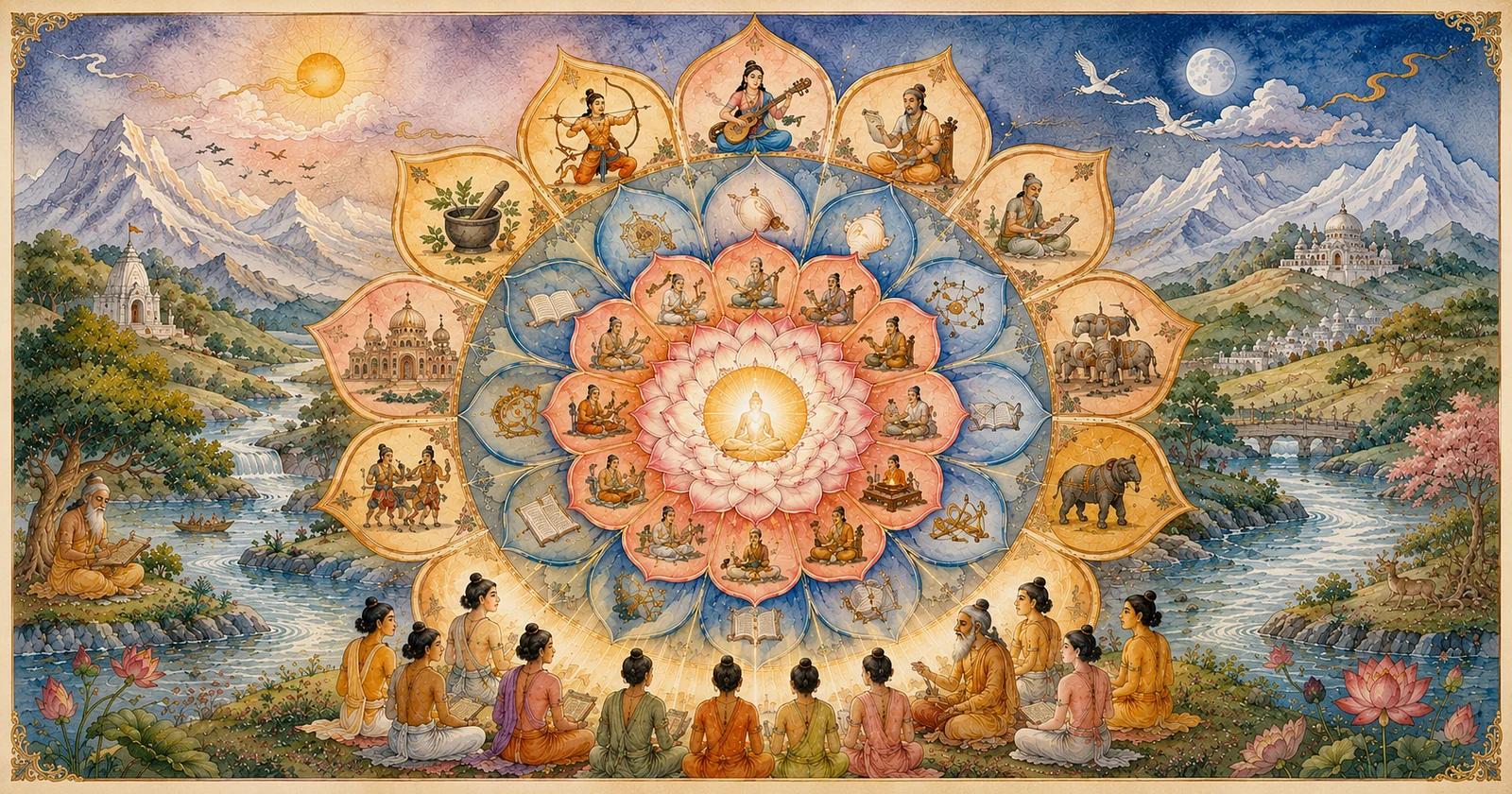
The primary classificatory structure of the Prasthānabheda is the enumeration of the fourteen vidyās. These consist of the four Vedas, the six Vedāṅgas, and the four Upāṅgas. Together they form what the tradition — citing Yājñavalkya — calls the fourteen seats (sthānāni) of knowledge and dharma. The word sthāna is important here: these are not merely 'subjects' in the modern curricular sense, but established foundations or stations where knowledge stands, is preserved, transmitted, and from which it functions.
ṛgvedo yajurvedaḥ sāmavedo 'tharvaveda iti vedāś catvāraḥ | śikṣā vyākaraṇaṃ niruktaṃ chando jyautiṣaṃ kalpa iti vedāṅgāni ṣaṭ | purāṇa-nyāya-mīmāṃsā-dharmaśāstrāṇi ceti catvāry upāṅgāni |
The four Vedas — Ṛgveda, Yajurveda, Sāmaveda, and Atharvaveda — form the primary revelatory base. The six Vedāṅgas — śikṣā (phonetics and pronunciation), vyākaraṇa (grammar), nirukta (etymology and lexicology), chandas (prosody and metre), jyotiṣa (astronomy and the science of time), and kalpa (ritual procedural manuals) — are the auxiliary disciplines that protect, interpret, pronounce, measure, time, and enact vaidika knowledge. The four Upāṅgas — Purāṇa, Nyāya, Mīmāṃsā, and Dharmaśāstra — extend the vaidika world into narrative memory, formal reasoning, hermeneutical analysis, and social-ethical normativity.
Śrī Madhusūdana Sarasvatī is careful to clarify which traditions are subsumed under which broader heading, since many traditions have their own names and are known by those names. Upapurāṇas are included under Purāṇa. Vaiśeṣika — the analytical ontology of Kaṇāda, which deals with the categories of substance, quality, action, generality, particularity, inherence, and non-existence — is included under Nyāya. Vedānta is included under Mīmāṃsā. The Mahābhārata, Rāmāyaṇa, and the Sāṅkhya, Yoga, Pāśupata, and Vaiṣṇava traditions are all included under Dharmaśāstra. This inclusion does not deny the distinctiveness of these traditions; it organizes them within a coherent architectural scheme.
purāṇa-nyāya-mīmāṃsā-dharmaśāstrāṅga-miśritāḥ | vedāḥ sthānāni vidyānāṃ dharmasya ca caturdaśa ||
This verse attributed to Yājñavalkya confirms: 'The Vedas, mixed with Purāṇa, Nyāya, Mīmāṃsā, Dharmaśāstra, and the Vedāṅgas, are the fourteen seats of the vidyās and of dharma.' These fourteen comprise the intellectual and spiritual inheritance of the āstika tradition — the tradition that accepts the authority of the Veda.
A. The Question of Nāstika Traditions
At this point in the text, Śrī Madhusūdana Sarasvatī addresses an important objection: what about the knowledge traditions of the nāstikas — those who do not accept the authority of the Veda? Should not the four Buddhist prasthānas (the Mādhyamika Śūnyavāda, the Yogācāra Vijñānavāda, the Sautrāntika view of momentary external objects known by inference, and the Vaibhāṣika view of momentary external objects known by perception), as well as the Cārvāka doctrine of the body as the self and the Digambara Jain view of an ātmā of the size of the body — should not these six nāstika prasthānas also be included?
Śrī Madhusūdana Sarasvatī's answer is decisive and principled: since these traditions lie outside the Vedas, they are — even indirectly — not useful for the attainment of the puruṣārthas in the way that vaidika knowledge is. They are comparable to the approaches of mlecchas (those outside the vaidika cultural sphere). The text states:
satyam; veda-bāhyatvāt teṣāṃ mlecchādi-prasthānavat paramparayāpi puruṣārthānupayogitvāt upekṣaṇīyatvam eva |
'True — but since they lie outside the pale of the Vedas and are even indirectly not useful for the attainment of the puruṣārthas (they are like the approaches of mlecchas and such), they are simply to be disregarded here.' The discussion here is circumscribed to those knowledge systems which, directly or indirectly, serve human ends as understood within the āstika framework. This is not a dismissal of these traditions from a broader philosophical conversation; it is a principled delimitation of the scope of the āstika framework.
V. From Fourteen to Eighteen: The Four Upavedas
The fourteen vidyās expand to eighteen with the addition of the four Upavedas: Āyurveda (medicine), Dhanurveda (martial arts), Gāndharvaveda (music and performing arts), and Arthaśāstra (polity, economics, and practical sciences). The Prasthānabheda states:
etā eva caturbhir upavedaiḥ sahitā aṣṭādaśa vidyā bhavanti | āyurvedo dhanurvedo gāndharvavedo 'rthaśāstraṃ ceti catvāra upavedāḥ |
This expansion is philosophically significant. It demonstrates that the Indic knowledge landscape is not narrowly concerned with philosophical speculation or ritual performance alone. Medicine, martial training, aesthetics, and governance are given equal standing as vidyās — as forms of knowledge with their own authority, lineage, purpose, and systematic articulation. The eighteen-vidyā frame, as Śrī Madhusūdana Sarasvatī presents it, is a civilizational curriculum: it holds together the theoretical and practical, the sacred and the applied, the transcendent and the immediately worldly.
It is worth noting the text's final statement about the eighteen vidyās: they are all subsumed under the word trayī (the triple Veda). This is not meant to collapse their differences; it is an affirmation that they all belong to — or are connected with — the vaidika universe of knowledge. 'Otherwise there would be deficiency in the number,' the text adds — meaning that the word trayī, when broadly interpreted, must cover the full range of disciplines that constitute the complete knowledge landscape.
evam aṣṭādaśa vidyās trayī-śabdenoktāḥ; anyathā nyūnatā-prasaṅgāt ||
VI. The Veda: Structure, Authority, and Purpose

A. The Veda as Apauruṣeya Pramāṇa
The Prasthānabheda next turns to a detailed explanation of each vidyā, beginning — as is proper — with the Veda itself. The Veda is defined as an apauruṣeya pramāṇa-vākya: an authoritative sentence or set of sentences not composed by any human author, which reveals dharma and brahman. The significance of this definition can hardly be overstated. In the Indian philosophical tradition, the non-human origin of the Veda is what gives it its unique epistemic standing. Ordinary human composition is subject to error, interest, limited perception, and limitation of time. The Veda, being beyond human authorship, is also beyond these limitations. As Śrī Madhusūdana Sarasvatī states:
tatra dharma-brahma-pratipādakam apauruṣeyaṃ pramāṇa-vākyaṃ vedaḥ | sa ca mantra-brāhmaṇātmakaḥ |
'The Veda is the authoritative text of non-human composition which reveals dharma and Brahman. It consists of mantras and brāhmaṇas.' The Veda thus has a dual function: revealing the ritual order (dharma) and revealing ultimate reality (brahman). These are not two unrelated functions; they represent the path from action and duty to knowledge and liberation.
B. The Twofold Division: Mantra and Brāhmaṇa
Mantras are the core ritual utterances. They illuminate the materials (dravya), the deities (devatā), and the actions involved in ritual performance. Śrī Madhusūdana Sarasvatī classifies mantras into three categories according to their form: Ṛc (metrical hymns, such as the Gāyatrī metre), Sāman (the same hymns when sung, with their distinctive musical elaboration), and Yajus (prose formulas used in ritual address, including the nirgada mantras such as 'agnīd-agnīn-vihara'). The triple division corresponds to the threefold ritual use of the three Vedas — Ṛgveda for the hotā priest, Yajurveda for the adhvaryu, and Sāmaveda for the udgātā.
Brāhmaṇas are the explanatory and prescriptive prose portions of the Veda. Śrī Madhusūdana Sarasvatī distinguishes three types with great philosophical care. Vidhi (injunction) is the portion that prescribes action. He reviews three competing accounts of what a vidhi is: the Bhāṭṭa Mīmāṃsaka account (vidhi as śabda-bhāvanā — a sentence that generates the inclination to act through its verbal power), the Prābhākara account (vidhi as niyoga — a direct command that binds the agent), and the Tārkika account (vidhi as iṣṭa-sādhanatā — the means to a desired end). He then classifies vidhi into four subtypes: utpatti-vidhi (the injunction that reveals the bare form of a rite), adhikāra-vidhi (the injunction that connects the rite to a qualified performer and a fruit), viniyoga-vidhi (the injunction that connects a subsidiary element to its principal), and prayoga-vidhi (the procedural injunction that combines all the preceding into a complete method of performance).
Arthavāda is the explanatory or laudatory portion that accompanies and supports a vidhi. It praises what is enjoined, censures what is forbidden, or simply narrates related facts. Śrī Madhusūdana Sarasvatī classifies arthavāda into three subtypes: guṇavāda (where the statement contradicts other means of knowledge and functions as a figurative praise, as in 'the sacrificial post is the sun'), anuvāda (where the statement repeats what is already known through other means of knowledge), and bhūtārthavāda (where the statement conveys a real fact not otherwise contradicted or already established, such as 'Indra raised the thunderbolt to strike Vṛtra'). He notes that while all three types function as support for the vidhi they accompany, the bhūtārthavāda has independent epistemic standing by the principle established in the devatādhikaraṇa section of the Brahmasūtras.
C. Vedānta Sentences as a Third Category
The most philosophically sophisticated moment in the Veda section is Śrī Madhusūdana Sarasvatī's treatment of Vedānta sentences — the Upaniṣadic statements about brahman. He argues that these are different in kind from both vidhi and arthavāda:
vidhy-arthavādoubhaya-vilakṣaṇaṃ tu vedānta-vākyam |
Vedānta sentences are not vidhi because, although they reveal something previously unknown, they do not enjoin any action. They reveal brahman — the supreme bliss, consciousness, and the ultimate human goal — and they do so self-luminously, establishing their own validity by the sixfold signs of intention (the six marks of purport: commencement, conclusion, repetition, result, praise, and demonstration). They are also not arthavāda, because they are not subservient to any vidhi; indeed, all vidhis ultimately serve them by purifying the mind through regulated action. In Śrī Madhusūdana Sarasvatī's own words, these sentences 'are intrinsically valid, having their purport in Brahman which is the human goal, supreme bliss, and consciousness.' This classification directly reflects the Advaita Vedāntika hermeneutical position that the Upaniṣads are a direct pramāṇa (means of knowledge) for the nature of brahman and ātman.
evaṃ ca karma-kāṇḍa-brahma-kāṇḍātmako vedo dharmārtha-kāma-mokṣa-hetuḥ ||
'Thus the Veda, constituted of the karma-kāṇḍa and the brahma-kāṇḍa, is the means for dharma, artha, kāma, and mokṣa.' The statement is a master stroke of synthesis: one text, two sections, four human aims, one comprehensive scope.

.png)