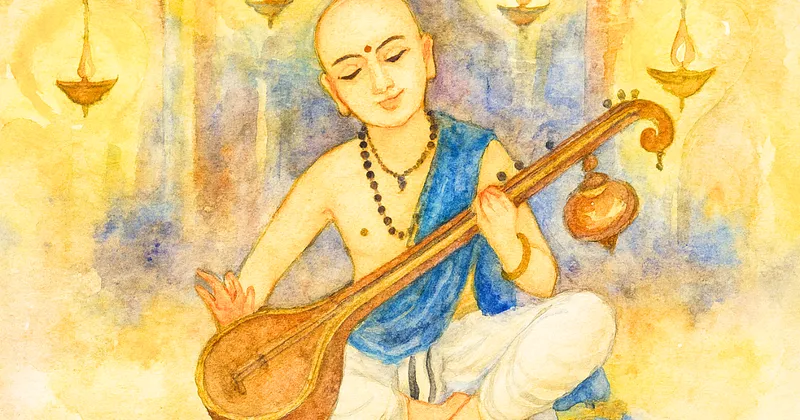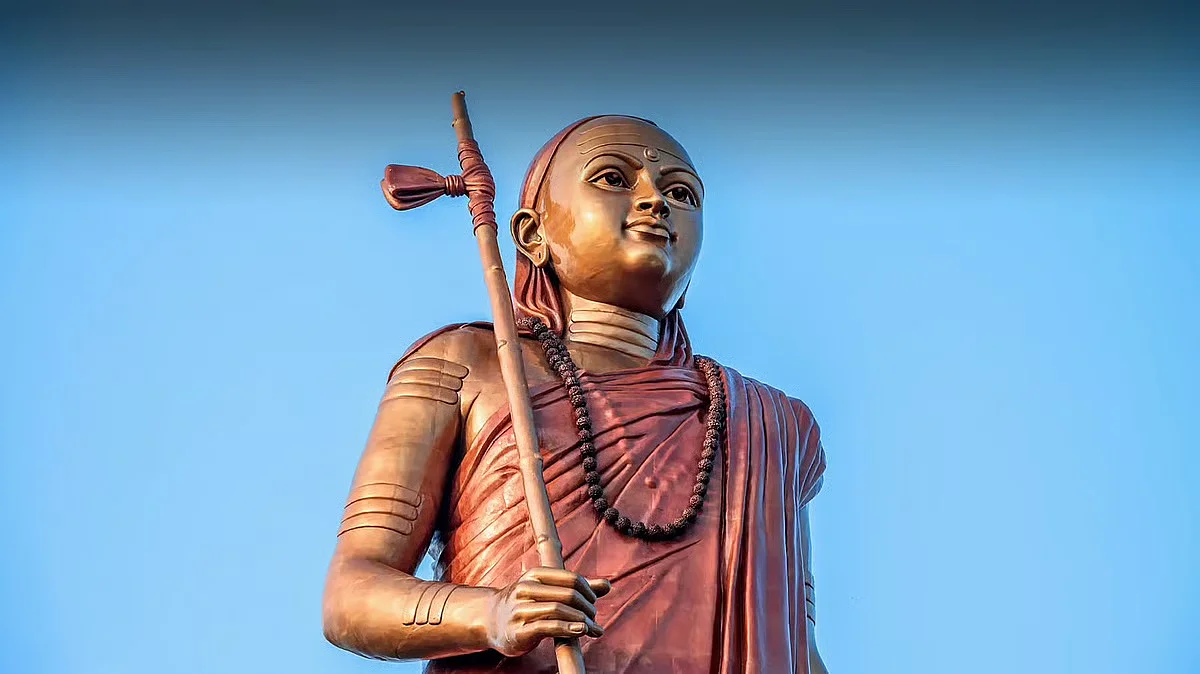
Start with the numbers, because the numbers are almost unbelievable. Śaṅkara was born in Kaladi, Kerala, around 788 CE. He left home at eight. He had renounced the world, not as an escape, but as a direction. By sixteen, he had written his commentary on the Brahmasūtras, a text so precise and so vast that scholars still argue over its implications today. He then walked the length of Bhārata, on foot, debating and composing and building. By thirty-two, he was gone. In between, he changed everything.
He wrote the Brahmasūtra Bhāṣya, the Upaniṣad commentaries, and the Bhagavad-Gītā Bhāṣya. He composed the Vivekacūḍāmaṇi, the Saundaryalaharī, and the Bhaja Govindam. He established four Maṭhas at Sringeri, Dwaraka, Puri and Jyotirmatha, one at each corner of the subcontinent, that still function today. He held debates with the finest philosophical minds of his age and won them not by force of personality but by the sheer quality of his thinking. And through all of this, he was young. Young in the way a river is young near its source: fast, clear, completely sure of where it is going.
The question worth sitting with is not just what he did. It is how a person becomes capable of doing it.
The Problem He Walked Into
Bhārata in the eighth century was not in political ruins, but it was fragmenting culturally and philosophically. The great unifying currents of the Upaniṣadic tradition had broken into competing streams. Ritual had been elevated as the whole of the spiritual life. The living philosophy behind the ritual was being forgotten. And something more subtle was happening too: a civilization was beginning to lose its confidence in its own depth.
This is a particular kind of crisis, different from war or famine, and in some ways more dangerous because it is harder to name. A people can be materially prosperous and still be internally adrift, held together by nothing deeper than habit and proximity. History has shown, repeatedly, that when the philosophical subsoil of a culture erodes, everything built on it eventually tilts. What holds a civilization together is not its institutions or its economy alone. It is the quality of understanding that runs through ordinary people as they make ordinary decisions, day after day.
Śaṅkara saw this. He was barely twenty, and he saw it with diagnostic clarity. And what he did next was not write a manifesto or gather an army. He simply began. He walked. He debated. He wrote. He taught. He was one person, with the full force of his own clarity, attempting to give a civilization its memory back.
What Advaita Actually Is
People sometimes hear "Advaita Vedānta" and imagine it as a retreat from the world. A philosophy for monks in caves, disconnected from the texture of ordinary life. Śaṅkara would have found this amusing, and perhaps a little sad.
Advaita means non-dual. Not "everything is one" in some vague, feel-good sense, but a precise philosophical claim: the Awareness in which your experience arises is not separate from the ground of all existence. The word the Upaniṣads use is Brahman, the one undivided reality. And the Mahāvākyas, the great utterances of the Upaniṣads, are simply pointing at the nature of what you already are.
Ahaṁ Brahmāsmi.
I am Brahman.
Bṛhadāraṇyaka Upaniṣad 1.4.10
This is not a statement of arrogance. It is the most quietly radical claim a human being can make: that the deepest nature of this person, sitting here, reading this, is not the bundle of anxieties and ambitions and memories we ordinarily take ourselves to be. Śaṅkara's Advaita is an inquiry into what actually remains when you stop assuming you already know what you are.
And what makes him worth studying beyond the philosophy is that he lived this without contradiction. The Saundaryalaharī, his luminous hymn to the Devī, was not a departure from his non-dual position. It was an expression of it. If one undivided reality is everywhere, then devotion is not a lesser path, it is the same recognition wearing a different form. The Bhaja Govindam, composed in a moment of urgency on the banks of the Gaṅgā when he overheard a scholar drilling Saṃskṛta grammar with no felt sense of what it was for, is not a dismissal of learning. It is a reminder that knowledge which does not touch life is a lamp that has run out of oil. Though the structure remains, the light is gone.
A Youth Icon, in the Truest Sense
We use the phrase "youth icon" carelessly, attaching it to whoever is currently visible and celebrated. But there is a rarer kind of icon: not someone who is famous among the young, but someone whose very life is an argument for what youth can actually be.
Śaṅkara was that.
The Vivekacūḍāmaṇi opens with a verse that names three rare gifts: a human birth, the longing for liberation, and the guidance of a genuine teacher. Śaṅkara had all three, and he spent thirty-two years demonstrating what becomes possible when you do not waste them.
durlabhaṃ trayamevaitaddevānugrahahetukam
manuṣyatvaṃ mumukṣutvaṃ mahāpuruṣasaṃśrayaḥ
These three are rare indeed, and are attained only by the grace of the divine: a human birth, the longing to be free, and the company of the wise.
Vivekacūḍāmaṇi, v. 3
He was not a prodigy in the way we often use that word, a person whose gifts set them apart from the rest of us, someone we admire at a safe distance. His gifts were of a kind that is, in principle, available to any human being who is willing to take their own life seriously. The capacity to ask genuine questions. The willingness to go deep rather than wide. The refusal to settle for secondhand answers to firsthand problems.
He did not wait for permission, for the right conditions, for a sufficient body of work behind him before he began. He moved at eight. He wrote at sixteen. He debated at twenty. Every instinct that tells a young person to wait a little longer, to gather a little more, to be a little more ready, Śaṅkara simply did not have that instinct, or had burned through it very early. He understood, in a way that most people take a lifetime to learn, that readiness is a quality you carry into action and not a state you arrive at.
He also refused to be only one thing. He was a logician of the highest order and a poet of extraordinary tenderness. He was a wandering monk who built lasting institutions. He debated with precision and wept at his mother's deathbed. When she was dying, he returned to Kaladi, technically breaking the sannyāsin's vow, and performed her last rites himself. He was not an abstraction in a saffron robe. He was a person who loved deeply, thought clearly, and did not let either one diminish the other.
This is the dimension of Śaṅkara that is rarely emphasised and most worth holding: he showed that full intellectual seriousness and full emotional aliveness are not in competition. The young person who is trying to be both rigorous and humane, both grounded in something real and open to the full range of human experience, can find in Śaṅkara a genuine precedent.
What He Built, and Why It Lasted: The Śaṅkara Technology
Here is something that does not get said often enough about Śaṅkara: he was not only a philosopher. He was an architect. He understood that ideas without institutions decay, that understanding without transmission dies with the person who holds it. So he built structures designed to outlast him.
The four Maṭhas he built were not passive retreats. They are living systems, places where the philosophy is studied, argued over, refined and handed forward continuously, regardless of what was happening in the political world outside their walls. Each served a different region, a different tradition, a different thread of the subcontinent's vast cultural life. The design was resilient. If one burned, three remained. If one generation faltered, the others carried forward. In short, the institution was designed to outlast any individual, including Śaṅkara himself.
This is what Swami Chinmayananda, who spent decades studying and transmitting this very tradition, called the Śaṅkara Technology. The word is deliberate. A technology is not just an idea. It is an idea made operational, repeatable, transmissible across conditions its creator never anticipated. And at the heart of this one was a simple but demanding principle: each generation must not only receive the torch of understanding that was lit in the past and handed to them. They must, with their own lives, nurse and nourish its glow and hand it forward. The institution matters. But the living person within the institution matters more. Because a torch does not carry itself. And this is what Śaṅkara actually built, a model for how a civilization keeps its depth alive across time.
Why He is Still Speaking
There is a particular hunger in this generation that Śaṅkara would have recognized immediately. Youth today are saturated with information and starving for understanding. We have more access to ideas than any civilization in history, and a deeper uncertainty about who we are than perhaps any generation before us. The question that sits underneath most of the anxiety is not about career or money or relationships, though it presents itself in those forms. It is the older question: Who am I, really? Does what I do matter? Is there a ground beneath the anxiety?
These are not spiritual questions as opposed to practical ones. They are the oldest human questions wearing new clothes. And Śaṅkara addressed them at their root, through the method the Upaniṣads gave him and that he sharpened into something precise: the willingness to look directly at the one who is asking. The direction was not to accumulate more answers, but to question the questioner.
Neti, neti.
Not this, not this.
Bṛhadāraṇyaka Upaniṣad 3.9.26, the Upaniṣadic method of negation
Strip away what you are not. Not the body, not the breath, not the thoughts, not the moods that come and go. What remains is not nothing. It is the Awareness that was there before the first thought this morning and will be there after the last. It is called Cit, Pure Consciousness, identical with Sat, being, and Ānanda, a fullness that needs nothing added to it to be complete. This is not a consoling idea. It is a hypothesis, and the Advaita tradition's invitation is to test it honestly, in your own experience, by actually looking.
However, in a world that profits from insecurity, that is a genuinely subversive proposal.
What the Śaṅkara Technology means for now is to apply this spirit in today’s context. It is to sit with a text long enough for it to change you, not just inform you. It is to find a teacher who has actually walked further than you. And then give it forward, not when you feel ready, but now, with whatever you have, to whoever is near.
"An exquisite thinker, a brilliant intellect, a personality scintillating with the vision of truth, a heart throbbing with industrious faith and ardent desire to serve humanity, sweetly emotional and relentlessly logical, in whom the Upaniṣads discovered the fittest spiritual general."
-Swami Chinmayananda on Ādi Śaṅkarācārya
Śaṅkara Jayantī is a reminder of a recurring question addressed to whoever is alive right now: what have you done with the torch you were handed?
Śaṅkara was handed a fragmenting civilization and a philosophy that was losing itself. He was barely twenty. He spent the rest of his short life answering the question. By thirty-two, he had written everything worth writing, built everything worth building, walked every road that needed walking. He lived what he taught, that the Self which underlies all action was never touched by any of it. The Awareness in which his whole life arose was the same at thirty-two as it was at eight. Unchanged. Undiminished. Undivided.
That is Advaita. That is Śaṅkara. And that, for anyone paying attention, is the invitation.
Ācārya Śaṅkara shows what becomes possible when a human life is lived from the inside out.

.png)