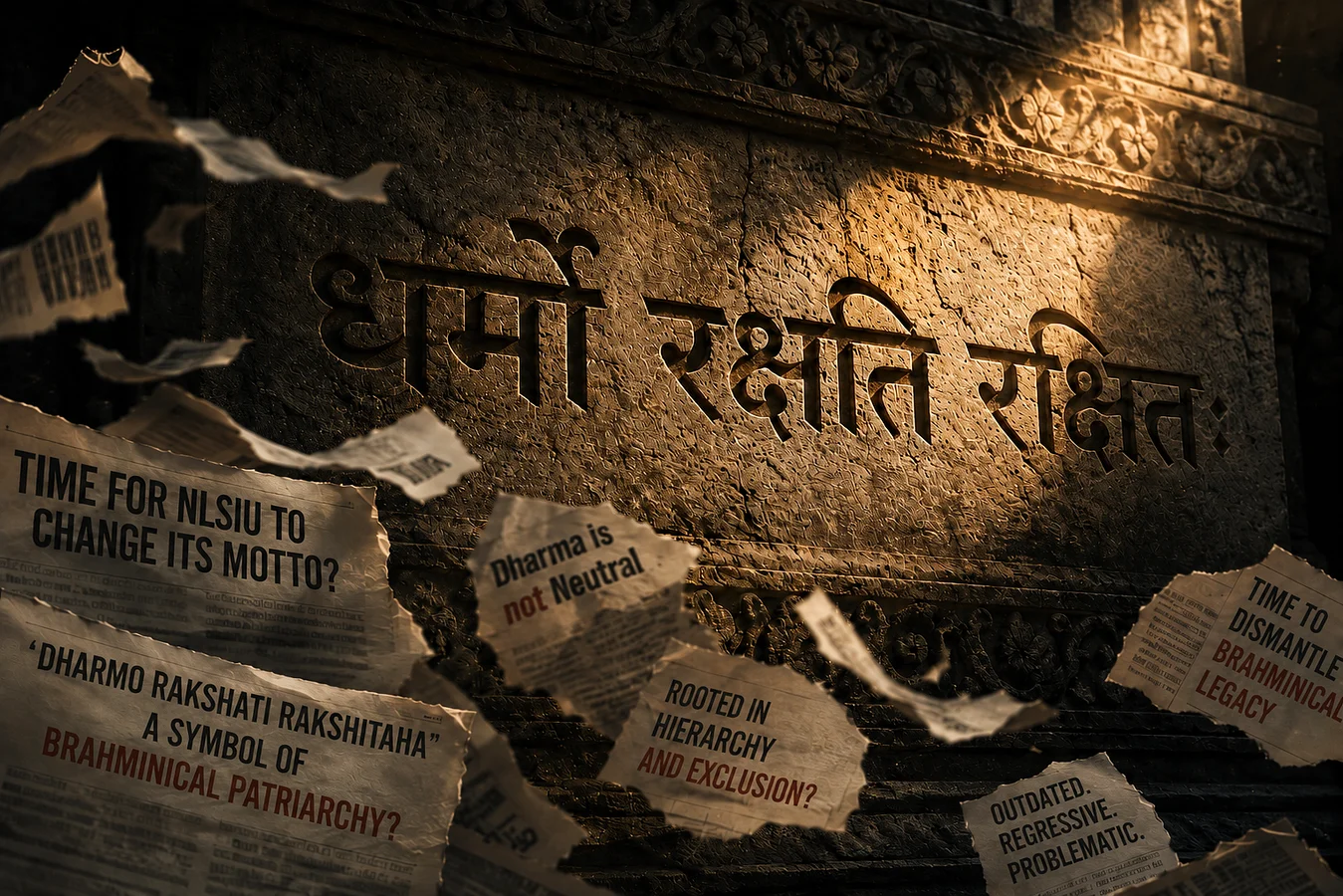
This is in response to Sumit Baudh’s ‘Time For NLSIU to Change Its 'Dharma Rakshati Rakshataha' Motto published in The Wire. The article opens with the following lines, stating its premise: “The Twisha Sharma case has made a long-deferred jurisprudential reckoning impossible to ignore: what does it mean for a leading law school to carry a motto drawn from Brahminical patriarchy and who does dharma protect?”
The entire piece proceeds along the same lines, making one non sequitur claim after another. It is egregious, reductionistic and defamatory for many reasons, the primary one being that it takes a civilizational concept like Dharma, which carries multiple indescribable connotations across different contexts and time periods, and reduces it to a single political reading derived from one text, one social critique, and funnily, one contemporary criminal case. It proceeds as though Dharma is synonymous with the Manusmṛti; the Manusmṛti with Brahmanism; and Brahmanism is synonymous with rigid, hierarchical patriarchy that of course, must be “dismantled”. Such a chain of equivalences is neither historically defensible nor philosophically rigorous. Dharma has been debated, interpreted, and reimagined across centuries by numerous schools of thought—including Mīmāṃsā, Vedānta, Nyāya, and in itihāsa —often arriving at markedly different understandings of the term. Reducing Dharma to a single text or a single social critique is therefore an act of intellectual flattening and frankly, plain ignorance that is peddled not just by the author in question but in the mainstream at large.
First and foremost, it is important to address the author’s lack of empathy for the victim, Twisha Sharma. Sumit opportunistically uses a tragic criminal case to make sweeping claims about Dharma, Brahmanism, and the suitability of NLSIU's motto for a legal institution of its stature. What is particularly troubling is that he seems far more interested in extracting ideological meaning from the incident than in grappling with the tragedy itself. The death of Twisha Sharma is an immensely distressing case involving allegations of dowry harassment, domestic abuse, a forced abortion, and sustained psychological torment. Twisha, a recently married young woman and former beauty queen, reportedly communicated her suffering repeatedly to her mother through text messages, pleading to be taken away because she could no longer endure her circumstances. Those pleas, according to reports, went unanswered—an aspect of the case that raises painful questions about parental pressures, social attitudes toward divorce, and the burdens placed upon women within contemporary Indian society. These are all serious social issues deserving of careful attention and moral urgency. Yet, rather than exploring these immediate and deeply human dimensions of the tragedy, the article abruptly elevates the incident into an indictment of Dharma. If I have ever seen an instance of an ideological agenda being inserted into an unrelated tragedy, this is it. When the husband — the primary accused — who is a lawyer and a graduate of NLSIU, Bangalore, appears on national television wearing a T-shirt bearing the logo of his alma mater, Sumit can only think of one thing that is not empathy for the girl; it is that NLSIU’s motto is a symbol of “Brahmanical patriarchy” and must be dropped like a hot potato.
‘Dharmo rakṣati rakṣitaḥ’ (धर्मो रक्षति रक्षितः) is a Saṃskṛta phrase that can be translated to "Dharma protects those who protect it”, and recurs not only in the Manusmṛti, but also in the Mahābhārata, where it is a much broader cosmological and philosophical principle. Interestingly, apart from NLSIU, the phrase is also a motto for India’s Research and Analysis Wing (R&AW). Sumit translates the phrase to “the law protects those who protect the law”; however, Dharma and law are not equivalent. The Saṃskṛta word for law is actually nīti, and Dharma can (inadequately) be translated to a code of righteousness/morality, ethics, or duty (and more accurately, a blend of all three). He later cites B.R. Ambedkar’s Annihilation of Caste, which derives the meaning of Dharma from injunctive Vedic passages as religious ordinance, ritual obligation, and cosmological order — not a neutral “law”. Sumit writes, “To strip dharma of this content, to say that NLSIU means only “righteous conduct” or “ethical obligation”, is to ignore that words carry their genealogies with them. Intention does not cleanse etymology.” This is the only occasion when the author is correct — Dharma indeed has Hindu religious connotations and is not just a Saṃskṛta word for “law”.
Traditionally understood, the phrase ‘Dharmo rakṣati rakṣitaḥ’ expresses a normative civilizational proposition: societies that preserve justice, ethical conduct, and moral order are sustained by them, while societies that undermine these principles ultimately suffer the consequences. The article makes a classic strawman argument by constructing a meaning for the phrase that is neither self-evident nor universally accepted, and then proceeds to criticize that construction. It replaces a rich and historically layered conception of Dharma with a narrow sociological reading, only to indict Dharma on the basis of that reduction. This is not an engagement with the tradition in good faith. It is the substitution of an interpretive caricature for the thing being interpreted.
The allegations advanced by Sumit are sweeping, poorly substantiated, and ultimately, self-defeating. He asks whether a law school committed to “critical thinking” should continue to stand behind a motto centered on Dharma, implying that the two are somehow incompatible. This is a ludicrous proposition. Dharma has been debated and interpreted for millennia across schools as diverse as Mīmāṃsā, Vedānta, Nyāya, Buddhism, and Jainism, producing vast traditions of logic, ethics, jurisprudence, and metaphysics. To insinuate that engagement with Dharma is antithetical to critical inquiry is not skepticism, but an act of irrational prejudice. It is difficult to imagine Biblical ethics or Islamic jurisprudence being dismissed as inherently irrational merely because they are rooted in religious or civilizational frameworks.
He writes, “NLSIU has built its reputation, at least in part, on a commitment to critical legal thinking, on training lawyers and scholars who do not accept law’s claims about itself at face value. The motto asks something different. It demands that law be protected in order to receive protection. This is compliance rather than critical thinking.” Suggesting that a law school “dedicated to critical thinking” must necessarily abandon a Saṃskṛta motto rooted in the Hindu tradition is to demand the erasure of civilizational memory and identification with one’s heritage. India is home to numerous institutions whose mottos draw upon Sanskritic and Dharmic thought, and those institutions neither profess patriarchal tenets, nor are they opposed to critical thinking. Many nations incorporate religious or civilizational ideas into their public life without compromising their “rational” character. Indonesia is the world's largest Muslim-majority nation, yet, its institutions employ Saṃskṛta mottos: the motto of the Air Force commando unit, called Paksha Commandos, is a portion of a śloka from the Bhagvadgīta “Karmanye Vadikaraste Mafalesu Kadatjana”. The motto of Indonesia’s Police Academy is “Dharma-Bijakshana-Ksatria”. The Indonesian Supreme Court holds itself to “Dharmmayukti”. Will Sumit criticize the proclamation of the “Brahmanical” construct of Dharma in Indonesian institutions’ mottos? What about the Indonesian police academy's use of the word “Kṣatriya” in their motto, which is clearly indicative of a patriarchal, gender-role-affirming, caste system, clearly the opposite of their protective role? Are these institutions rendered illiberal or irrational or unthinking by such choices? If not, why should NLSIU be held to a different standard? By this logic, one would also have to object to the motto of the Supreme Court of India—Yato Dharmastato Jayaḥ ("Where there is Dharma, there is victory")—a demand that has indeed been publicly made by the former Supreme Court Justice Joseph Kurien, who is a Syro-Malabar Roman Catholic from Kerala, and whose “guiding force” was the Bible. That apart, the deeper issue, however, is the glee in treating Dharma as a repository of every social evil. Sumit's assertion that dowry is embedded within the tradition of Dharma is fallacious and inaccurate. There is no scriptural basis for treating dowry as a Dharmic obligation across the Dharmaśāstra or smṛti tradition. To conflate historical social practices (or evils), regional customs, and warped criminal behaviour with Dharma is to transform it into a convenient target for ideology-driven criticism: an old missionary tactic.
Sumit writes, “The subordination of women is not incidental to the Brahmanical order; it is one of its primary mechanisms of reproduction.” This is once again a deliberately offensive claim, which rests on embarassingly flimsy grounds. An isolated crime, allegedly carried out by the husband Samarth Singh, is not proof of any “Brahmanical” dictum. The argument becomes even more tenuous when the author invokes another commentator’s (from the Quint, no less) assumption that Twisha Sharma's death and the systemic violence faced by Dalit women are simply two manifestations of the same "Brahmanical patriarchal structure." One may agree that violence against women across caste and community lines is a serious and enduring social problem. But throughout the article, he insists that Dharma is nothing but an instrument of oppression which embodies inherited social roles for domination and violence. The inferential leap here is so large that one is tempted to admire its audacity before questioning its logic. Twisha Sharma was indeed a Brāhmaṇa woman who died in her matrimonial home. But the marriage itself was reportedly inter-caste, and the matrimonial household was not Brāhmaṇa. On what grounds, then, is this tragedy being classified as an instance of Brahmanical patriarchy rather than patriarchy simpliciter, domestic violence or violence at large, or familial dysfunction? The answer appears to be that "Brahmanical patriarchy" is being used as a catch-all explanation into which every social tragedy and/or crime can be force-fitted, irrespective of the facts.
Further, the author insists that an individual accused of a heinous crime is entitled to the presumption of innocence and criticizes the Bar Council for prioritizing institutional reputation over due process. Not shockingly, he is unwilling to extend a comparable standard of evidentiary caution when discussing Dharma and “Brahmanical” traditions. Clearly, his skepticism is reserved for alleged criminals, and sweeping indictments about Hindu principles raise no doubts.
The concluding lines of the article are revealing of the author’s profound and likely incurable biases. His most astonishing logical leap comes in the following lines: “The motto is now operating at three sites simultaneously: in the household where Twisha Sharma died, in the media appearances of the retired judge who was her mother-in-law and in the Bar Council order that prioritised professional reputation over due process. At each site, the logic is the same. Protection is conditional. It flows to those who perform and uphold the order: dharmic, professional and institutional. It is withdrawn from, or never extended to, those who fail to perform it or who embarrass it.” A tragic crime, a criminal investigation, a Bar Council order, the sociology of power, and the motto of a national law school are all collapsed into a single explanatory framework whose central villain is Dharma.
On what basis is this claim being made? Is there evidence that the victim, the Singh household, or the mother-in-law consciously organized themselves around the motto of Dharmo Rakṣati Rakṣitaḥ? Did they invoke it in their conduct, cite it in their reasoning, or profess allegiance to it? At the very least, did the Singh family profess or practice Brahminism? They did nothing of the sort, yet Dharma is blamed for not protecting the victim? This is once again, circuitous, or more plainly, misguided and fraudulent.
The author invokes critical legal studies to argue that law is shaped by structures of power, yet he remains remarkably uncritical of his own avowed framework. Every institution, every tradition, every social evil is made to converge upon the same conclusion. Dharma is patriarchy, oppression, and injustice. Once one is convinced of such an idea, evidence becomes unnecessary and because every fact, however remote, is simply folded into the same ideological narrative. A law school committed to critical thinking ought to resist precisely this temptation and condemn this defamatory polemic.