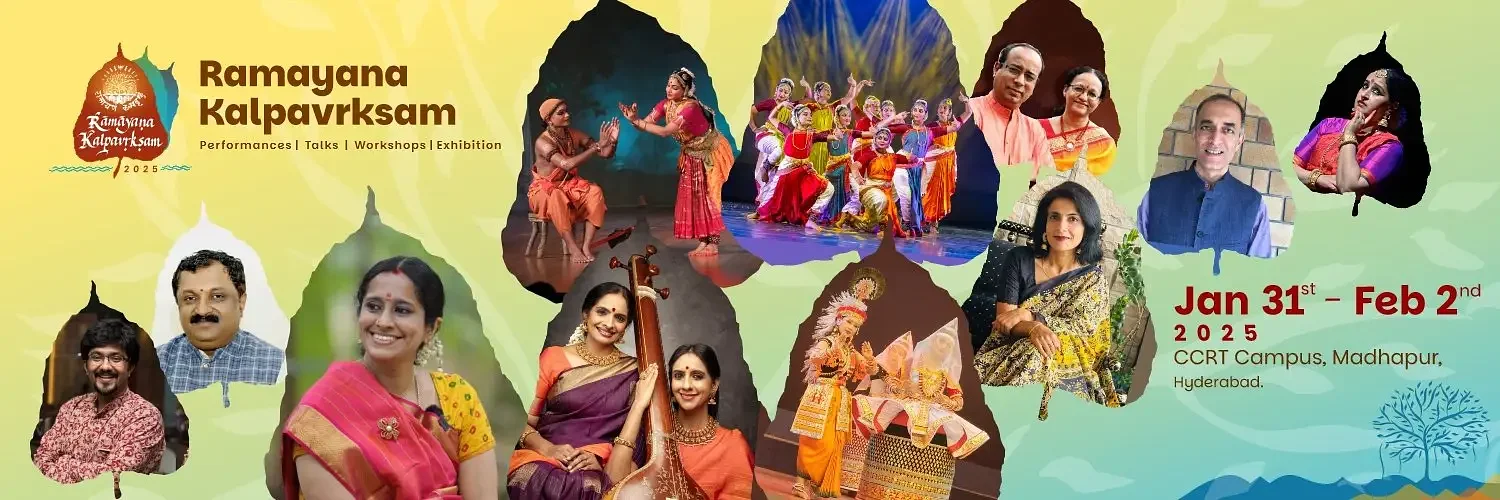
The third edition of Ramayana Kalpavrksam, curated by Padma Shri, Guru (Dr.) Ananda Shankar Jayant, was held from January 31st 2025 to February 2nd 2025, with performances, talks, workshops, and exhibitions, at the Centre for Cultural Resources and Training (CCRT) at Kondapur, Hyderabad. This arts, crafts, and scholarship festival, named after a renowned Telugu literary work of Jnanapeetha awardee Kavi Samrat late Śrī Vishwanatha Satyanarayana garu, brings to the culturally eager public, celebrated works on stage connected to Lord Rāma and the Rāmāyaṇa. From storytellers to singers, from dramatists to dancers, from historians to artistes, from scholars to academics, the people of Bhagyanagar of all ages were treated to a bevy of classical fare.
 Classical dance performance by Shankarananda Kalakshetra
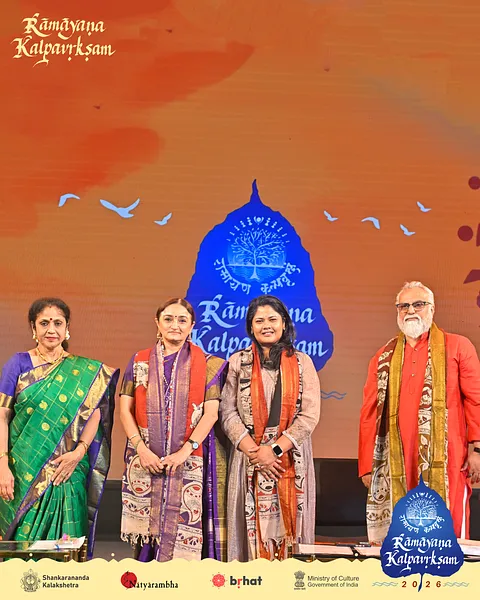
It was indeed a cultural immersion that the city looks forward to eagerly each year. Hyderabad has been fortunate to host such a festival three years in a row, and if the turnout this year is anything to go by, we will see many more such in the future too. Shankarananda Kalakshetra, and Natyarambha collaborating with the Ministry of Culture (GoI), Brhat.in, and Kalakshetra Foundation, brought together this year’s vibrant line up. The energetic inaugural address by Śrī Tejaswi Surya, MP (BJP), Bengaluru South, who lit the lamp to open the festival, beckoning a new and welcome era of culturally literate youth leadership, spoke evocatively of R.K. Narayan’s Retelling of the Ramayana, and recommended reading the thirty lectures on the Rāmāyaṇa delivered by the late Right Honorable V.S. Srinivasa Sastri (under the auspices of the Madras Sanskrit Academy, from 5th April, 1944 to 8th November, 1944), now available as a book, and also made a valid point when he said nothing touched his heart more than reading literature in his mother tongue Kannada, especially Parva, by the great litterateur of our times Padma Bhushan S.L. Bhyrappa avare.
Classical dance performance by Shankarananda Kalakshetra
It was indeed a cultural immersion that the city looks forward to eagerly each year. Hyderabad has been fortunate to host such a festival three years in a row, and if the turnout this year is anything to go by, we will see many more such in the future too. Shankarananda Kalakshetra, and Natyarambha collaborating with the Ministry of Culture (GoI), Brhat.in, and Kalakshetra Foundation, brought together this year’s vibrant line up. The energetic inaugural address by Śrī Tejaswi Surya, MP (BJP), Bengaluru South, who lit the lamp to open the festival, beckoning a new and welcome era of culturally literate youth leadership, spoke evocatively of R.K. Narayan’s Retelling of the Ramayana, and recommended reading the thirty lectures on the Rāmāyaṇa delivered by the late Right Honorable V.S. Srinivasa Sastri (under the auspices of the Madras Sanskrit Academy, from 5th April, 1944 to 8th November, 1944), now available as a book, and also made a valid point when he said nothing touched his heart more than reading literature in his mother tongue Kannada, especially Parva, by the great litterateur of our times Padma Bhushan S.L. Bhyrappa avare.
 inaugural ceremony
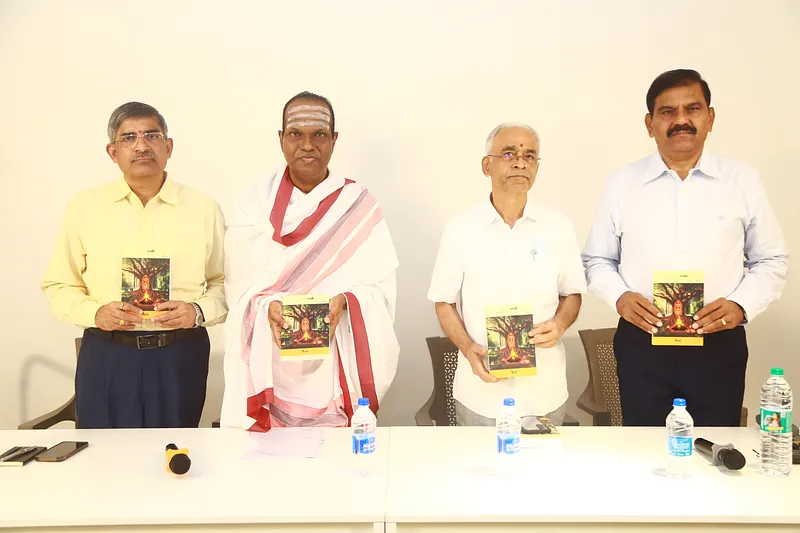
The festival commenced on 31st January evening with a short dance recital of Bhakta Ramadasa’s takkuvemi manaku by Shankarananda Kalakshetra. A kriti which speaks of contentment that comes from having Lord Rāma in our lives, showcased perfectly via the daśāvatāra set the tone and tenor for the rest of the festival. This was followed by Smt. Vishaka Hari’s Harikathā on Rāmāyaṇa - The Life Giving Tree, wherein she recited with elan and eloquence the glories of Śrī Rāma from a variety of local, regional, and global versions, across India and Southeast Asia. She had the audience riveted with her singing and recitations in Telugu, Tamil, Malayalam, Thai, Bengali, Sanskrit, Avadhi, and more. Her book ‘Sangita Soujanya - A Musical Harmony - Inclusivity in Karnatik Music’, was also released on the dias by the dignitaries. A much needed work by a scholar-practitioner given the controversial take by many modern performers who may think otherwise.
inaugural ceremony
The festival commenced on 31st January evening with a short dance recital of Bhakta Ramadasa’s takkuvemi manaku by Shankarananda Kalakshetra. A kriti which speaks of contentment that comes from having Lord Rāma in our lives, showcased perfectly via the daśāvatāra set the tone and tenor for the rest of the festival. This was followed by Smt. Vishaka Hari’s Harikathā on Rāmāyaṇa - The Life Giving Tree, wherein she recited with elan and eloquence the glories of Śrī Rāma from a variety of local, regional, and global versions, across India and Southeast Asia. She had the audience riveted with her singing and recitations in Telugu, Tamil, Malayalam, Thai, Bengali, Sanskrit, Avadhi, and more. Her book ‘Sangita Soujanya - A Musical Harmony - Inclusivity in Karnatik Music’, was also released on the dias by the dignitaries. A much needed work by a scholar-practitioner given the controversial take by many modern performers who may think otherwise.
 Book release of Sangita Soujanya - A Musical Harmony - Inclusivity in Karnatik Music
The second day, which was a Saturday, saw participation from early morning onwards for the slated session on Śrī Udaya Shreyas’s Kathasvadanam - Exploring and learning the story of Vālmīki Rāmāyaṇa via ślokas. This was an interactive and fun workshop where the audience took part as competing teams. He asked questions based on what he taught and the teams had to apply their learnings to answer correctly. His ability to teach Sanskrit with ease had the participants engaged and excited throughout the session. In the afternoon, post lunch, a hands on crafts workshop on Cherial Paintings was on offer by Śrī Madhu Merugoju. It was a treat for all ages, with kids as well as elderly folk, all eagerly learning this stylized Telangana art of scroll and mask painting with local motifs. Many such local art and craft forms are disappearing from public life, and festivals such as the Ramayana Kalpavrksham keep them close and connected to their patrons, i.e., the everyday public.
Book release of Sangita Soujanya - A Musical Harmony - Inclusivity in Karnatik Music
The second day, which was a Saturday, saw participation from early morning onwards for the slated session on Śrī Udaya Shreyas’s Kathasvadanam - Exploring and learning the story of Vālmīki Rāmāyaṇa via ślokas. This was an interactive and fun workshop where the audience took part as competing teams. He asked questions based on what he taught and the teams had to apply their learnings to answer correctly. His ability to teach Sanskrit with ease had the participants engaged and excited throughout the session. In the afternoon, post lunch, a hands on crafts workshop on Cherial Paintings was on offer by Śrī Madhu Merugoju. It was a treat for all ages, with kids as well as elderly folk, all eagerly learning this stylized Telangana art of scroll and mask painting with local motifs. Many such local art and craft forms are disappearing from public life, and festivals such as the Ramayana Kalpavrksham keep them close and connected to their patrons, i.e., the everyday public.
 Yashodeep Deodhar on 'Adi-Ananta' - The eternal relevance of Valmiki's Adikavya
The three talks on the second day running from 9.30 am to 1.30 pm were by Śrī Yashodeep Deodhar on ‘Adi-Ananta - The eternal relevance of Valmiki’s Adikavya’, a unique presentation with two video offerings taking up the source text in detail, followed by Dr. D.K. Hari and Dr. D.K. Hema on the ‘Rama Setu - An Engineering Marvel Across Millennia’, wherein they covered the engineering aspect of this architectural wonder for the lay people among the audience. These two sessions were followed by a dance demonstration by Dr. Anupama Kylash on talachina ramune talacheda - Explorations in Śrī Vishwanatha Sathyanarayana’s Ramayana Kalpavrksam. It was a beautiful examination of the text, including the detailing of the entire Ramayana Kalpvarksam theme song, indeed a very deep and beautiful composition.
Yashodeep Deodhar on 'Adi-Ananta' - The eternal relevance of Valmiki's Adikavya
The three talks on the second day running from 9.30 am to 1.30 pm were by Śrī Yashodeep Deodhar on ‘Adi-Ananta - The eternal relevance of Valmiki’s Adikavya’, a unique presentation with two video offerings taking up the source text in detail, followed by Dr. D.K. Hari and Dr. D.K. Hema on the ‘Rama Setu - An Engineering Marvel Across Millennia’, wherein they covered the engineering aspect of this architectural wonder for the lay people among the audience. These two sessions were followed by a dance demonstration by Dr. Anupama Kylash on talachina ramune talacheda - Explorations in Śrī Vishwanatha Sathyanarayana’s Ramayana Kalpavrksam. It was a beautiful examination of the text, including the detailing of the entire Ramayana Kalpvarksam theme song, indeed a very deep and beautiful composition.
On the same evening of 1st February, Hyderabad after decades, was witness to Kalakshetra Foundation’s iconic ‘Sabari Moksham’, a three hour long bharatanāṭyam dance production, which was choreographed by Smt. Rukmini Devi Arundale herself in the 60s! Śūrpaṇakhā stole the show, even as the masculine characters such as Rāvaṇa or Marīca portrayed their roles with grace and beauty. Many young ones in the audience must have promised to themselves to pursue classical dance as their passion and vocation after such an aesthetically and technically pleasing performance!
 Kathasvadanam by Udaya Shreyas
The third and concluding day of this festival once again started with Śrī Udaya Shreyas’s popular Kathasvadanam at 8.00am, with the afternoon hands on workshop being ‘Vastra Varnam’ by Anusha Namburi teaching wearable art via her Fabric Painting Workshop. For the connoisseurs of Indian art, especially wearable art, where most can identify prints such as ikat, bandhani, kalamkari, etc., she brought out lesser known aspects of fabric painting to the audience.
Kathasvadanam by Udaya Shreyas
The third and concluding day of this festival once again started with Śrī Udaya Shreyas’s popular Kathasvadanam at 8.00am, with the afternoon hands on workshop being ‘Vastra Varnam’ by Anusha Namburi teaching wearable art via her Fabric Painting Workshop. For the connoisseurs of Indian art, especially wearable art, where most can identify prints such as ikat, bandhani, kalamkari, etc., she brought out lesser known aspects of fabric painting to the audience.
The morning talks commenced with Śrī Vikram Sridhar’s storytelling session of the ecological dimensions of the Rāmāyaṇa - ‘Krauncha to Ashoka Vana’. Here he covered the concepts of heritage, folklore, and ecology. Opening with a song, he had the participants sing along with him. Our heritage integrated with everything around us, and taught via folklore, is in itself ecological and sustainable, he said. Unfortunately, urban life downplays this thanks to the modern education system. Our literary texts are the ones which provide the real education, and it is our duty to learn from them, he urged. This was followed by a talk on ‘Rajadharmas of the Ikshvakus’ by Śrī Amritanshu Pandey (CEO, Bṛhat). As memories are to consciousness history is to civilization - with this powerful sentence as a peg, he detailed the Sūryavanśī (Ikṣvākus) dynasty, emphasizing the disciple and the rule of law that these cakravartins adhered to. Making a key point that even though other emperors conquered more lands they were not termed cakravartins as they did not follow dharma. The rājadharma of Ikṣvākus was following dharma even in battle and in extreme circumstances as evidenced by the life of Lord Rāma in the Rāmāyaṇa, this aspect was emphasized throughout his session. Using stunning Artificial Intelligence (AI) imagery, with a watercolor theme first presented in black and white, and in the final slides a collage and burst of color, he deftly brought research and scholarship together making the session highly relevant to the participants. The talks concluded with Smt. Ami Ganatra’s lessons from the Rāmāyaṇa - ‘Dharma and Dharma Sankata. Here she beautifully explored Chapter 19 from the book Ramayana Unravelled, authored by her, bringing out points that are not covered in the text but which she has gleaned over time with patient research and reflection.
 Ami Ganatra on 'Dharma and Dharma Sankata - Lessons from the Ramayana
Unfortunately, the evening’s slated performance, a Manipuri raas dance ballet by JNMDA, Imphal, could not take place due to travel exigencies. But the grand culmination was a thrilling musical production by Smt. Ranjani and Smt. Gayatri called ‘RAMA by RaGa’, which had the attendees dancing in the aisles. Their recital in Tamizh, Telugu, Sanskrit on Śrī Rāma took the rasikas to various Rāma kṣetras in India effortlessly. The sisters duo even composed a medley on Śrī Rāma just for this weekend and presented it to their ever grateful audience. Their renditions were made even more effective with the exquisite digital art complementing their music as the backdrop. Along with their accompanists and co-artistes, Śrī Vittal Rangan, Śrī Delhi Sairam, and Śrī S. Krishna, they brought the 3 day festival to a fitting finale.
Ami Ganatra on 'Dharma and Dharma Sankata - Lessons from the Ramayana
Unfortunately, the evening’s slated performance, a Manipuri raas dance ballet by JNMDA, Imphal, could not take place due to travel exigencies. But the grand culmination was a thrilling musical production by Smt. Ranjani and Smt. Gayatri called ‘RAMA by RaGa’, which had the attendees dancing in the aisles. Their recital in Tamizh, Telugu, Sanskrit on Śrī Rāma took the rasikas to various Rāma kṣetras in India effortlessly. The sisters duo even composed a medley on Śrī Rāma just for this weekend and presented it to their ever grateful audience. Their renditions were made even more effective with the exquisite digital art complementing their music as the backdrop. Along with their accompanists and co-artistes, Śrī Vittal Rangan, Śrī Delhi Sairam, and Śrī S. Krishna, they brought the 3 day festival to a fitting finale.
 a musical production by Smt. Ranjani and Smt. Gayatri
A permanent bommala koluvu which was locally sourced welcomed the guests at the entrance. All through the three days of the festival, attendees had access to the Exhibition of Vintage Lithographs from the collection of Smt. Pratima Sagar and Śrī M.C. Mohan titled ‘Framing Divinity - Devas in Our Homes’, as well as shops with artistic and attractive merchandise (books, clothes, jewellery) from local artisans at the Artisan Corner. The way our culture permeates seamlessly into various aspects of our life was perfectly exemplified by the lithographs as well as the merchandise.
All in all, this year’s festival too kept up the promise of bringing to the city and its residents world class performances, talks, and workshops, all centered on the eternal theme of Rāmāyaṇa. Many people travelled to Hyderabad from across India to participate and revel in this heady atmosphere. Despite hiccups and ill health, despite travel troubles and unforeseen hurdles, under the able curatorship of Ananda akka, another edition of Ramayana Kalpavrksam has been successfully wrapped up, bringing joy, verve, and inspiration to young and old alike.
The video playlist of the first edition of Ramayana Kalpavrksam 2023 may be accessed here and the second edition of 2024, here. Our previous event reports may be accessed here and here.
See you at the next edition!
 the organizing and volunteer team members
.png)