Legends and Narrative
i’s meanings are shaped by multiple strands of sacred memory and regional storytelling:
1. Holikā–Prahlāda (popular tradition): Holikā, associated in later folklore with Hiraṇyakaśipu’s household, attempts to kill the child devotee Prahlāda and is herself consumed by fire which is an emblematic victory of devotion and moral order over tyranny.
2. Kāma Dahana (Śaiva tradition): Kāmadeva, the deity of desire and spring, is burned by Śiva’s third eye when he disrupts Śiva’s meditation; later traditions emphasize Kāma’s restoration, linking springtime to cycles of dissolution and renewal.
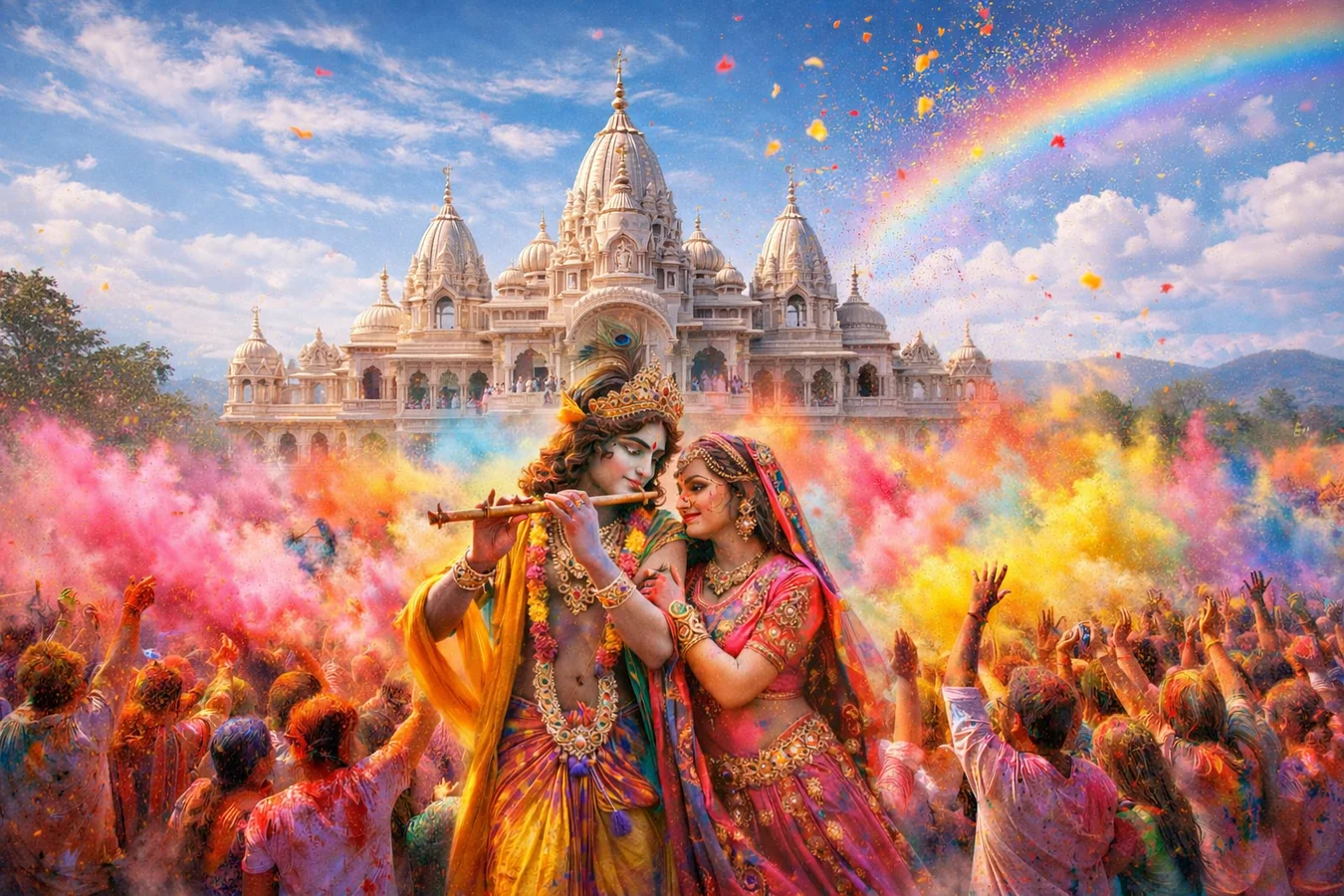
3. Rādhā–Kṛṣṇa līlā (Vaiṣṇava tradition): In Braj-centered devotional culture, Holī becomes a ritualization of divine play, love, and communal joy, expressed through color, music, and social intimacy.
Rather than a single origin narrative, Holī is best understood as a layered festival in which diverse theological and local traditions converge on shared themes of purification, renewal, and community.
Scriptural References and Ritual Logic
Bhaviṣya Purāṇa (Uttara Parva, Chapter 132): The Dhoṇḍhā Episode and Community Protection
The Bhaviṣya Purāṇa presents Holī as a community-wide rite aimed at neutralizing a harmful demoness, Dhoṇḍhā, who troubles children and resists ordinary remedies. In the narrative, King Raghu consults Vasiṣṭha, who explains that Dhoṇḍhā received boons from Lord Śiva that make her largely invulnerable, yet she remains vulnerable to the disruptive energy of children.
The text outlines a practical ritual program:
* Collecting fuel (wood, leaves, cow-dung cakes) for a communal fire,
* Kindling a bonfire with protective (rakṣā) mantras and homa,
* Noise, laughter, song, and circling the fire,
* Children carrying wooden swords, dramatizing collective defense,
* Emphasis on children’s well-being and protective household rites,
* Veneration of Holikā-vibhūti (sacred ash) and its application to the body as a purifier and safeguard.
Here, Holī is framed less as spectacle and more as public ritual technology: fire + mantra + communal performance as the means to restore safety and social order.
Nārada Purāṇa (Part 4, Chapter 124): Holikā Worship and Plural Interpretations
The Nārada Purāṇa prescribes Holikā-pūjā on Phālguna Pūrṇimā and describes building and intensifying the bonfire through mantra-recitation, circumambulation, song, and instrumentation. Notably, it acknowledges multiple explanatory traditions, including:
* the burning of Holikā associated with Prahlāda, and
* the burning of Kāma signaling another interpretive axis for the same rite.
* Mantra recitation:
असृक्पाभयसंत्रस्तै: कृता त्वं होलि बालिशै:
अतस्त्वां पूजयिष्यामि भूते भूतिप्रदा भव:॥
"O, Holi, you have been made by people of childish traits who are afraid of blood-sucking Ogresses. Hence, I shall worship you. Be the bestower of prosperity on the living beings.”
This shows Holī as a festival with recognized interpretive diversity even within Paurāṇika discourse.
The “Holikā as Hiraṇyakaśipu’s Sister” Question: Text and Folklore
A number of popular retellings identify Holikā as Prahlāda’s paternal aunt. However, when read against certain Paurāṇika references, the picture becomes more complex. Some sources mention Siṃhikā as a sister figure connected to Hiraṇyakaśipu, while the name “Holikā” is not consistently foregrounded in the earliest strata of these narratives. Additionally, Viṣṇu purāṇa-Ch: 18, describes an unnamed fiery female form produced through priestly incantations to harm Prahlāda, which is repelled by his devotion and turns upon its creators.
Taken together, this suggests that “Holikā” may, in some contexts, reflect later crystallization of folklore around older narrative motifs, especially motifs involving fire, protection, and the failure of hostile ritual power against devotion.
Śaiva Traditions: Kāma, Vasanta, and Ash
The Śiva purāṇa’s linking Holī to Kāma Dahana interprets the bonfire as a symbolic enactment of desire’s burning and subsequent refinement. The reanimation of Kāma through Rati’s devotion (Skanda purāṇa) and the return of spring are often read as a theological statement: love and desire are not annihilated but transformed, becoming compatible with cosmic order. In this setting, the post-bonfire use of ash functions as purificatory residue is a ritual sign that the destructive aspect of fire yields auspicious protection.
Contemporary and Regional Observances
Holāṣṭaka (North India)
In many North Indian regions, Holi’s ritual build-up begins with Holāṣṭaka, the eight-day period preceding Holikā Dahana. It is often treated as a time when auspicious ceremonies are avoided, and devotional restraint is emphasized, alongside the communal gathering of fuel for the bonfire. Popular belief sometimes connects these days to the intensification of Prahlāda’s ordeals under Hiraṇyakaśipu.
Holikā Dahana
Holikā Dahana is typically performed in the evening window after sunset, with attention to ritual timing conventions that seek to avoid inauspicious intervals. The bonfire remains the festival’s most explicit act of ritual purification, followed by social celebration.
Color-Play and Local Names
The day of color-play is known by different names across India and is embedded in distinct ritual ecologies:
* Dol Yātrā (Bengal/Assam/Odisha): swing-festival devotion centered on Kṛṣṇa, often with fragrant powders and temple performance.
* Ukuli / Manjal Kuli (Kerala): turmeric-centered celebrations among particular communities, with strong goddess devotion in local memory. The Nārada Purāṇa states that Durgā is to be worshipped on Phālguna Śukla Chaturdaśī (the day before Holī). Therefore, we see the worship of the Goddess as well.
* Sigmo (Goa/Maharashtra/Karnataka): processional folk culture, dance, and village-deity worship.
* Yaosang (Manipur): burning of a straw structure followed by dance, music, and community color-play.
* Kāma Vilāsa / Kāma Pandigai (The Lambadi tribe (banjaras)/ found in Maharashtra, Karnataka, Tamil Nadu, Andhra Pradesh, Telangana & Rajasthan): explicit worship of Kāma and Rati alongside bonfire, feasting, and performance. In the Bhagavad Gīta, Śrī Krṣṇa says that he is Kandarpa (another name of Kāma), the God of love and seasons, he is the Spring.
Uttarakhand and Braj: Two Highly Developed HolīCultures
Kumaoni Holī(Uttarakhand) is distinguished by its musical forms: Khadi Holi, Baithaki Holi(begins during Basant Pañcamī and is celebrated till Dulhendi), and Mahilā Holī(celebrated by women only 15 days before Dulhendi) where classical rāgas, temple performance, and community singing become central rather than secondary.
In Himachal Pradesh, it is celebrated as ‘Faguli’, the ‘Festival of Masks’.
Braj Holī(Uttar Pradesh)—associated with Barsana, Nandgaon, Vrindavan, and Mathura. It features famous localized events such as Lathmar Holi, Phul Holi, Huranga, and other forms of ritualized play. Vaiṣnava textual traditions (including those associated with Braj devotion) emphasize Holīas an enactment of Rādhā–Kṛṣṇa līlā, where joy becomes a mode of devotion.
References to this festival/celebration can also be found in the Garg Saṃhitā (Chapter 12), which is a Saṃskṛta-language Vaiṣnava scripture, said to be authored by Sage Garga (Yādava clan Head priest).
Narasiṃha Dwādaśīi (as per Brahma Purāṇa) vrata and pūjā vidhi, which culminates in a Holikā/Havana (Bonfire) on the third day, which is Chaturdaśī (the day before Holi).
From Vasanta Pañcamī to Raṅga Pañcamī: A Seasonal Arc
It is also said that the word Holīcomes from the Hindi word ‘hola’, which means to offer sacrifices or prayer as thanksgiving for a good harvest.
Holī can also be placed within a wider springtime arc beginning with Vasanta Pañcamī, a festival associated with learning, creativity, and spring’s invocation and culminating in Raṅga Pañcamī/Deva Pañcamī in some regions, interpreted as a “divine” continuation of color celebration. In this broader cycle, spring is not only a meteorological event but a religio-cultural season: a time for worship, social renewal, and public festivity.
Underlying Theme
Across its many forms, Holī consistently revolves around a shared grammar of symbols:
* Fire as purification and protection,
* Color as social intimacy, equality, and shared joy,
* Noise and play as ritualized reversal and release,
* Community as the primary medium through which renewal becomes real.
Whether interpreted through devotion (bhakti), conflict, or seasonal cosmology, Holī articulates the same fundamental message: the old must be released, the social world must be renewed, and spring must be welcomed together.
References:
https://archive.org/details/bhavishya-puran-gita-press-gorakhpur/page/n551/mode/2up?view=theater
https://archive.org/details/dli.bengal.10689.12976/page/n202/mode/1up
76b-81 deal with Holikā-worship. The NP. says that it is the celebration of burning Kāma or the ogress Holikā. There is a little obscenity attended with this celebration, only Bengal is free from it, as they celebrate the Dol-yatra of KrSna on this day, and engage a priest to perform worship before the bon-fire. This religious element persisted since the period of the NP. (or even before) in Bengal.
* It is a very ancient festival and was called Holikā in east India (Śabara on Purvamimamsa 1. 3. 15-23). Hemādri calls this Hutāśani as we do now.
The Vishnu Purana: Book I: Chapter XVIII | Internet Sacred Text Archive
Chapter 8 - The description of the form and features of Vasanta
https://www.wisdomlib.org/hinduism/book/the-skanda-purana/d/doc627215.html
https://archive.org/details/narada-puran-gita-press-gorakhpur/page/n597/mode/2up?view=theater
Chapter 43 - The Festival of the Swing
verse 226 - Sanatkumara Samhita
https://www.wisdomlib.org/hinduism/book/brahma-purana-english/d/doc216125.html
Chapter 13 - The World of Creation Begins: the Birth of Madhu and Kaitabha
Opler, Marvin, ed. 1959, Culture and Mental Health, Macmillan & Co. New York, p. 287
HolīCelebration in Uttrakhand, Holifestival.org
Faguli - The Festival of Masks | Welcoming Spring in Himachal Pradesh
The author can be reached on X/Twitter - https://x.com/TanyaBrahmvadni