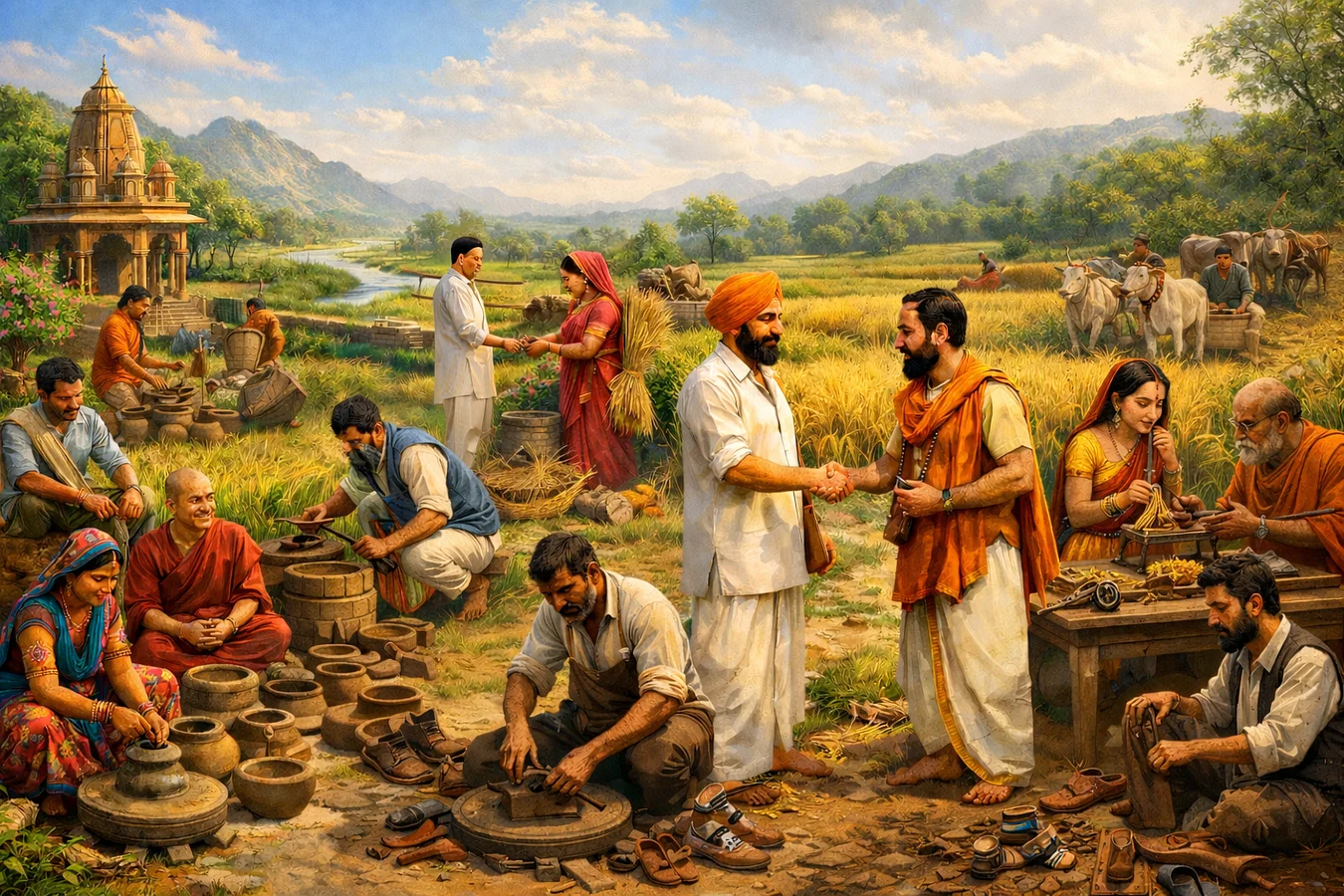
Introduction: Why Bharat Jati/Gyati Vyavastha Matters
Part 7 of the Bharat Gatha series challenges colonial narratives that reduce jāti to rigid hierarchy, offering an Indic re-reading of jāti, gyāti, and varṇa as knowledge-based, interdependent systems. Drawing on etymology, history, and village ethnography, it reconstructs gyāti as vocational mastery rooted in jñāna. It argues that restoring the authentic meanings of jāti and gyāti is essential to reclaiming India’s civilizational self-understanding.
Ashish Gupta ji raises a profoundly important issue, one that speaks not merely to history, but to the civilizational memory of Bhārata itself. For centuries, India has endured repeated upheavals: dynastic changes, invasions, and shifting regimes. During these turbulent phases, India’s knowledge systems, sciences, and historical narratives were deeply distorted. The authentic roots of Indian civilization—its organic social structures, indigenous sciences, and lived wisdom were gradually obscured and pushed into darkness.
As a result, the original context of India’s societal organization including the jāti/gyāti and varṇa systems was displaced by externally imposed interpretations, often cast in a deeply negative light. This distortion becomes particularly untenable when one reflects on how remarkably India flourished during earlier periods precisely when these systems were fully functional and culturally embedded. This volume seeks to correct that narrative and present historical realities with intellectual honesty and cultural sensitivity.
The Lineage of Lived Knowledge: Guruji and the Bharat Gatha Series
The entire Bharat Gatha series is dedicated by Ashish Gupta ji to his Guruji, Śrī Ravindra Sharma ji of Kalashram, Adilabad. The insights, observations, and lived experiences accumulated by Guruji over a lifetime have been thoughtfully distilled into these volumes. The subject itself is complex and profound, demanding sensitivity, wisdom, and experiential understanding qualities that this work consciously strives to embody.
Society as a Moral Ecosystem: The Foundation of Social Order
It is well understood that human beings are inherently social creatures. Societies arise to ensure dignity, sustenance, and security conditions essential for the prosperity of any civilization. Keeping this foundational truth in mind, Ashish Gupta ji emphasizes two critical distinctions that form the backbone of his argument.
Gyāti/Jāti Vyavasthā and Varṇa Vyavasthā: Two Systems, Two Logics
First, the gyāti (or jāti) vyavasthā is eternal and indestructible. It has always existed and will continue to exist. In contrast, the varṇa vyavasthā is not eternal; it is fluid, adaptable, and subject to change over time. These two principles must be clearly understood and never conflated.
Jāti or gyāti relates fundamentally to birth and identity. Just as one born in India is Indian, one born in Bengal is Bengali, and one born in Maharashtra is Marathi, jāti signifies an inherent classification. One cannot change one’s jāti any more than one can change one’s birthplace or biological identity; it remains constant throughout life.
Etymology and Meaning: From Jñā to Gyāti to Jāti
The term gyāti originates from the Saṃskṛta root jñā (to know). It is related to jñāta (that which is known) and jñāna(knowledge or wisdom). Over time, gyāti linguistically evolved into jāti. A gyāti, therefore, denotes a community recognized for mastery in a specific field of expertise. For instance, those skilled in ironwork came to be known as lohārs; those proficient in gold craftsmanship as sonars or goldsmiths. Their identity was inseparable from their specialized knowledge and lifelong vocation.
Thus, gyāti reflects not only one’s place of birth but also one’s skillset, expertise, and mode of livelihood. It signifies how one generates income across a lifetime through a particular craft or discipline. Within every gyāti, multiple sub-classifications exist, reflecting diversity and specialization within broader communities.
The Need for Varṇa: A Fourfold Structure for Civilizational Stability
A central theme of the book is the necessity of a well-defined varṇa system. The ṛṣis of ancient India believed that for a society to remain skilled, capable, brave, and industrious and not slide into despair or decline there had to be an orderly structure that preserved these virtues. To safeguard prosperity and social harmony, they envisioned a fourfold system designed to prevent the erosion of ethical and functional balance.
First, society needed a structured framework to cultivate and preserve knowledge and wisdom. Second, it required bravery and industriousness to ensure protection and disciplined action. Third, there had to be people dedicated to sustaining prosperity, managing economic activity, and fostering material growth. Finally, a system was needed to ensure that society continued to work diligently and progress steadily. Together, these four functions formed the foundation of a stable and flourishing civilization.
Vṛtti Frameworks: Karma, Bhikṣā, and Vaiśya
Traditionally, three major livelihood patterns were maintained: karma vṛtti (work-based livelihood), bhikṣā vṛtti(sustenance through voluntary offerings or alms), and vaiśya vṛtti (trade and commerce). Under karma vṛtti, for instance, we find professions such as the kumbhāra (potter) working with clay, the sūtāra (carpenter) working with wood, the weaver producing textiles, and many others. Ashish Gupta ji systematically lists such examples to explain the jāti or gyāti vyavasthā in a clear and well-articulated manner.
The Jāti as a Complete World: Arts, Sciences, Justice, and Memory
Ashish Gupta ji makes a compelling case that each jāti constituted an entire world in itself, complete with its own principles, disciplines, arts, and crafts. Every jāti had its own design traditions, internal discussions, and distinctive forms of dance and music. They also possessed their own systems of knowledge viz. Jyotiṣa, Āyurveda, historical traditions in the form of Jāti Purāṇas, economic treatises, and social philosophies.
In addition, each jāti maintained institutions to deliver justice, uphold law and order, regulate crime and punishment, and distribute work fairly. These structures ensured that there was no encroachment on another’s livelihood and that every member earned with dignity.
Craft as Science: Guṇa–Doṣa Knowledge and Local Technologies
This self-contained and holistic organization was unique to each gyāti or jāti, or to clusters of closely related jātis. Ashish Gupta ji illustrates this with practical examples. A bamboo craftsman, for instance, would possess detailed knowledge of different bamboo varieties like their guṇas and doṣas, their durability, and their suitability for specific products. Using precise local technologies refined over generations, such artisans worked with scientific accuracy.
Similarly, carmakāras, those who worked with hides and leather understood the significance of nakṣatras in relation to the death of animals and knew exactly how to process skins accordingly. They were aware of what medicines could be derived from an animal’s skin, bones, flesh, and horns, and they worked in close coordination with local vaidyas. These examples reveal how deeply interconnected the systems were.
Oral Archives: Jāti Purāṇas in Folk Song and Story
He also notes that the histories of jātis, their Jāti Purāṇas were preserved in folktales, folk music, and community songs. If one listens closely to these oral traditions, they often describe the origins of each jāti, frequently linking them to divine or cosmic beginnings.
The 360-Jāti Village: Self-Sufficiency Through Plurality
Guruji further explains that for a village to be fully self-sufficient and complete, it needed a minimum of 360 jātis. This meant 360 kinds of artisans, technologies, bodies of knowledge, and areas of expertise covering everything from clothing and jewelry to utensils and tools. The plurality, diversity, and vibrancy of knowledge embedded in such a village were extraordinary. These communities lived harmoniously, complementing one another’s work, remaining interdependent, and never usurping each other’s livelihoods.
There was even a time when a single weaver or goldsmith might possess 360 distinct design patterns of their own—an index of specialization, creativity, and cultural sophistication.
Debunking Modern Myths: Untouchability, “Purity,” and Misreading
In his book, Ashish Gupta ji addresses the many myths propagated around untouchability, purity and impurity, and other misconceptions that arise whenever jātis or gyātis are discussed. He argues that these distortions can be countered if Jāti Purāṇas are properly documented, mainstreamed, and read widely. Through them, people would come to understand the deep interdependence and mutual exchange that once existed among all jātis and varṇas in every village or social system.
He also explains that designated spaces were created for different communities so they could carry out their work without disturbance, in surroundings populated by people of their own craft and culture. Such arrangements were not meant to isolate communities but to enable harmony, efficiency, and mutual respect.
The Jajmani System and the Ritual of Maan: Reciprocity in Everyday Life
Guruji highlights the jajmani system, a well-documented institution of reciprocal obligations and services. He recounts an incident from one of his village visits that vividly illustrates how it functioned in everyday life.
While visiting a kumbhāra’s home, he witnessed a ritual known as the Maan system. A brāhmaṇa family, celebrating a wedding, came to the kumbhāra’s house. They paid obeisance to his tools, made an offering, and took earthen pots used later in wedding rituals.
Shortly afterward, a carmakāra arrived for the same purpose. He offered far more generously than the brāhmaṇa. When Guruji asked the kumbhāra about this difference especially given popular narratives of hierarchy, like the kumbhāra responded simply: brāhmaṇas traditionally lived by bhikṣā vṛtti. Even if they offered little, it was understandable. The carmakāra, on the other hand, had a thriving demand for his goods; if anyone could afford to give more, it would naturally be him. In lived village reality, reciprocity often followed livelihood patterns—not ideological caricatures.
Everyday Ethics: The Village Sense of Karma
Guruji shares further observations drawn from conversations with rickshaw pullers. He asked whether customers ever cheated them by refusing to pay after reaching their destination. They consistently replied that such incidents were rare. People might negotiate fares before the ride, but after it ended, they paid.
To Guruji, this reflected a moral consciousness shaped by an intuitive sense of karma: an inner understanding that right and wrong actions carry consequences. Even when opportunities for dishonesty arise, many ordinary people voluntarily choose the ethical path.
A Farmer and His Bullock: Compassion Beyond Self-Interest
Guruji recounts a poignant incident he witnessed during a visit to a mandi. One farmer purchased a gona—a large sack used to carry produce for 200 rupees and placed it on his bullock cart. When he returned from another task, the gona had gone missing. The farmer began to cry, holding the bullock’s shoulder, speaking to the animal in grief.
What moved Guruji was the content of the farmer’s lament. He was not mourning his own loss. He was apologizing to the bullock saying that through his carelessness, he had harmed the animal’s “earnings,” the income that would have supported its care and well-being. The bond here was not of owner and property, but of kinship, an ethic of responsibility and tenderness that modern narratives rarely acknowledge.
The Bullock Deal That Was Cancelled: A Lesson in Care
Another memorable scene involves a seller and buyer negotiating the sale of bullocks. After striking a deal, the seller invited the buyer for tea. The buyer declined. The seller offered a bidi; again, the buyer refused. Then tobacco, also refused.
Suddenly, the seller called off the sale and returned the buyer’s money. When asked why, he replied with quiet certainty: a man who allows himself no leisure will work himself to exhaustion and will work the bullocks to exhaustion too. He would rather entrust them to someone who understands rest and will allow the animals rest as well.
Here, commerce yields to conscience. The exchange becomes not a transaction, but a transfer of guardianship evidence of a moral world in which care can outweigh profit.
Conclusion: Reading India Through an Indic Lens
Throughout Bharat Jati/Gyati Vyavastha, drawing upon Guruji Ravindra Sharma ji’s lived wisdom and Ashish Gupta ji’s careful articulation, the book powerfully challenges distorted narratives surrounding untouchability, alleged atrocities, and sweeping generalizations about jātis, varṇas, and village life. It argues that indigenous systems were not merely “structures,” but living ecologies mutually supportive, ethically anchored, and functionally integrated.
Even today, though many villages have been shaken by modern disruptions and their internal institutions weakened, the moral core still persists. Values of dignity, reciprocity, and restraint remain visible in everyday interactions in speech, in conduct, and in the quiet ethics of ordinary people.
This book is therefore essential for anyone seeking to move beyond superficial translations and externally imposed frames especially the careless conflation of jāti with “caste” and gyāti with rigid hierarchy. It offers a corrective worldview: one that invites readers to understand India’s traditional systems from an authentic Indic perspective.
What gives the work its deepest strength is Guruji’s grounding in lived reality. He does not speak from abstraction or ideology, but from empathy, observation, and decades of intimate engagement with village life. That authenticity, more than argument alone is the book’s enduring beauty.
For readers who wish to expand their understanding of Bhārata’s civilizational fabric, this is a worthy addition to any library one that informs, provokes, and deepens.
This book can be purchased here.
Other Dhiti articles on the 'Bharat Gatha' series:
1. The Forgotten Threshold - Bhikṣāvṛtti and the The Vanished Wisdom of India’s Wanderers by Dr. Anurag Shukla.
2. The Empire of Threads and Silver - How Colonialism Unraveled India’s Trade Legacy by Dr. Anurag Shukla.
The author can be reached on X/Twitter - https://x.com/TanyaBrahmvadni





.png)