Introduction
Let’s start chronologically by first revisiting one of the most contentious inheritances of India’s colonial legal framework: Section 295A of the Indian Penal Code - the Indian version of a Blasphemy law.
This is not merely a legal question, but a civilizational one.
Where does genuine criticism end and hate speech begin?
Should the State protect people from genuine incitement and targeted hatred, or should it become an instrument through which fragile sentiments, street pressure, and organized outrage silence responsible discussion?
Can a civilization such as Bhārata, with its deep traditions of debate, metaphysical inquiry, śāstrārtha, reform, and self-regulation, afford to retain a colonial legal structure that was born out of panic rather than principle?
To answer these questions, we must return to the historical origins of Section 295A, its continuation in the Bharatiya Nyaya Sanhita, 2023, and the wider problem of how “hate speech” is understood and applied in India.
The Present Context
What exactly constitutes hate speech? Does offensive speech automatically become criminal speech? Should the threshold be hurt sentiment, deliberate insult, malicious intent, or actual incitement? And should the State respond to speech according to the intensity of public pressure?
India has repeatedly witnessed a troubling pattern. When religious outrage is accompanied by mobilization, threat, or street pressure, the State often appears more eager to placate the loudest voices than to uphold the rule of law with balance and courage.
This is dangerous.
If the rule of law bends before the threat of disorder, then it incentivizes it. If street pressure determines legal action, then the most intolerant group gains the greatest veto power over public discourse.
It is in this context that Section 295A must be studied historically and critically.
From IPC Section 295A to the BNS Framework
A historical inquiry, academic criticism, theological disagreement based on sound logic, intelligent and reformative satire, or reformist argument should not fall within the scope of such a law.
The Bharatiya Nyaya Sanhita, 2023, which replaced the IPC framework, did not fundamentally break from this colonial inheritance. The closest successor to IPC Section 295A is BNS Section 299. It continues to perform the same way and even brings in its ambit now electronic means, in the age of social media.
BNS Section 302, on the other hand, deals with uttering words, making sounds, gestures, or placing objects in sight of a person with deliberate intent to wound that person’s religious feelings. Its structure is closer to the old IPC Section 298.
This distinction is important because public commentary often conflates all “religious sentiment” offences. But legal precision matters. The threshold, target, mode, and punishment vary across these provisions.
Yet the broader concern remains: India has carried forward the architecture of colonial religious-offence law with only limited reconfiguration.
The Colonial Birth of Section 295A
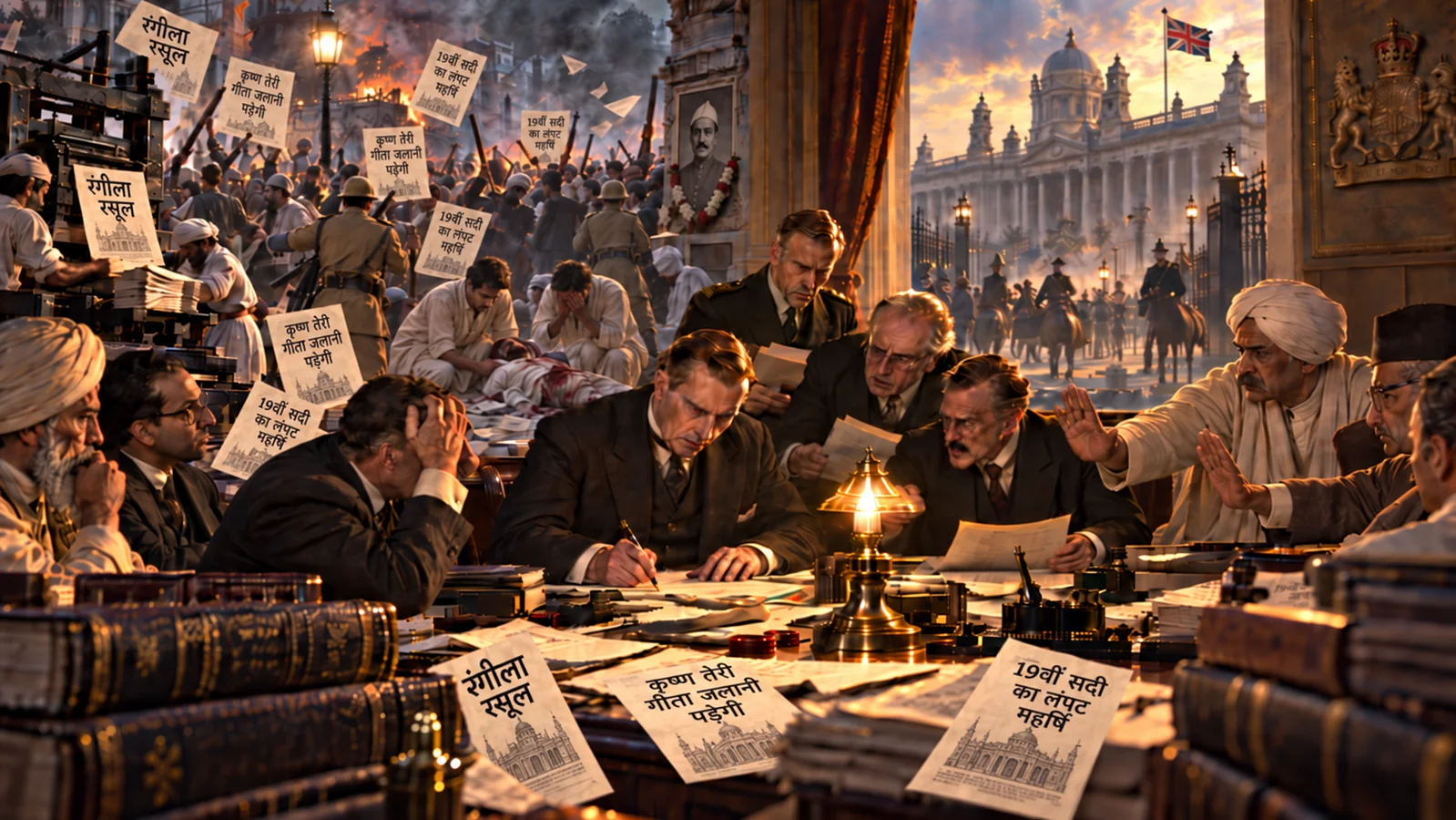
Section 295A did not emerge from a calm and principled reflection on free speech, religious reform, and social harmony. It arose in the intensely charged environment of 1920s Punjab, in the aftermath of the Rangila Rasool controversy.
The pamphlet Rangila Rasool was written as a response to earlier vulgar and provocative pamphlets attacking Hindū deities and traditions. This detail is crucial because the colonial legal machinery did not respond symmetrically. The publisher of Rangila Rasool, Mahashay Rajpal, became the central target of prosecution and public fury.
Initially, Section 153A of the IPC was invoked which dealt with promoting enmity or disharmony between different groups on grounds such as religion, race, language, caste, place of birth, or community. Rajpal argued that the pamphlet was based on historical material and research, and that similar claims had been made earlier by European writers, and also that his intention was social and religious reform rather than communal hatred. He also argued that the language used was restrained compared to the material to which it responded.
The Lahore High Court ultimately acquitted him, holding that the publication did not fall within the scope of Section 153A as it then stood.
But that legal acquittal did not end the matter. Instead, it triggered an eruption of public outrage, inflammatory speeches, threats, and demands for Rajpal’s death. The judge’s credibility was attacked. His religious identity became a matter of accusation. The legal question was overtaken by public agitation.
Here we see a recurring pattern that has haunted India for a century: when courts do not satisfy religious outrage, outrage begins to target the court itself.
Law as a Concession to Intolerance
The British colonial administration, faced with law-and-order pressure, sought a legislative quick fix. Rather than defend the principle that criticism, even sharp criticism, could not automatically become criminal, the State moved toward creating a new offence.
This is the context in which Section 295A was born.
Its critics, however, saw the danger clearly. They understood that the law was seen as a concession to intolerance, rewarding those who threatened unrest.
Lala Lajpat Rai famously criticized the proposed provision as retrograde. His concern was that religious reform requires criticism of inherited doctrines, practices, texts, and institutions. If such criticism is stalled by criminal law, social reform becomes impossible, because religious reform is a prerequisite to social reform.
This was not an abstract concern. Many major reform movements all over the world involved critique of religious customs and social practices.
If every strong criticism of religion is treated as an outrage to religious feeling, then reform dies.
M.A. Jinnah, at that time, agreed in principle with the concern that bona fide criticism and reformist discourse should not be criminalized. Hari Singh Gour warned that the proposed law resembled a law of blasphemy and could stifle free discussion. Others argued that there were already sufficient legal provisions to deal with communal disturbance and defamation, and that a new religion-specific offence would put a premium on intolerance.
The fear was clear: a law meant to preserve order might end up empowering the most easily offended.
Rangila Rasool and the Violence That Followed
The fate of Mahashay Rajpal shows the tragic failure of such legal appeasement. Despite prosecution, litigation, public debate, and the eventual passage of Section 295A, Rajpal became a marked man. Multiple attempts were made on his life. Eventually, he was assassinated.
His murderer was celebrated by sections of society as a ‘ghazi’. The case gained political and symbolic significance far beyond the immediate crime. The funeral of the assassin became a public event. The murder demonstrated that the creation of a religious-offence law had not solved the problem of intolerance. If anything, it showed that once the State concedes that outrage can define law, the appetite of outrage only grows.
This is one of the central lessons of the 295A story.
A law introduced to prevent religious violence did not prevent violence.
A law introduced to manage religious offence did not reduce offence.
A law introduced to preserve public order did not build a principled culture of lawful disagreement.
Instead, it created a new lever through which religious groups could demand punishment, censorship, and submission.
The Dissenters Were Right
Looking back over a century, the dissenters to Section 295A appear remarkably farsighted.
They warned that the law would become a concession to fanaticism.
They warned that it would stall religious and historical research.
They warned that social reform would be made vulnerable to criminal complaint.
They warned that scholarly and genuine criticism of doctrine, scripture, or practice could be misinterpreted as insult.
They warned that the law would be prone to misuse.
They warned that the State already had enough tools to deal with actual violence and public disorder.
All these fears have repeatedly come true.
The question is whether “hurt sentiment” should become the guiding principle of criminal law.
The answer must be no.
What Constitutes Hate Speech?
Indian law does not contain a single, comprehensive statutory definition of ‘hate speech’. Courts have therefore approached the subject through existing provisions dealing with public order, enmity between groups, religious offence, incitement, and constitutional restrictions on free speech.
Broadly, hate speech must be distinguished from three other categories:
First, religious criticism.
A doctrine, religious figure, scripture, historical claim, or practice may be examined, questioned, criticized, or satirized. Such criticism may be sharp, but unless it is maliciously designed to outrage or incite hostility, it should remain protected.
Second, social reform.
Reform often begins by naming what is wrong. If criticism of religiously sanctioned unsustainable social practices becomes criminal merely because it offends some, then society becomes frozen.
Third, hate speech proper.
Hate speech is not merely speech that hurts. It is speech that targets a group as a group, seeks to marginalize or delegitimize its members, exposes them to hatred, or creates conditions for discrimination, exclusion, intimidation, or violence.
This distinction is vital.
A society that cannot distinguish between offence and hate will become censorious. A society that cannot punish genuine incitement will become unsafe. A dhārmika legal culture must do both: protect robust speech and restrain destructive speech.
The Reasonable Person Standard
The Supreme Court has emphasized that speech must not be judged by the standards of hypersensitive or weak minds. The effect of words must be considered from the standpoint of reasonable, strong-minded, firm, and courageous persons, not those who detect danger in every hostile point of view.
If the most fragile listener becomes the legal standard, then freedom of speech collapses.
The standard must therefore be objective and robust. Courts and law enforcement must ask: Was there deliberate and malicious intent? Was there incitement? Was there a real tendency toward public disorder? Was the speech directed at exposing a group to hatred or violence? Or was it genuine criticism, reformative satire, historical inquiry, or social commentary, however sharp?
A mature legal system must not confuse public anger with legal injury.
The Civilizational Contrast: Vāk and Karma
The Indic view of speech is not libertine. It does not say that one may say anything without consequence. On the contrary, Hindu thought treats vāk as sacred.
Speech is creative. Speech carries karma. Speech can heal, reveal, distort, wound, or uplift. From mantra to śāstra, from vācika tapas in the Bhagavad Gītā to the discipline of satya and ahiṃsā, the Indic tradition repeatedly teaches that speech must be truthful, beneficial, measured, and anchored in dharma.
But this is precisely why the Indic framework is self-regulating.
It places responsibility upon the speaker. It teaches that words produce consequences. It cultivates inner restraint, not merely external censorship. It recognizes that speech is not only a legal act but a karmic act.
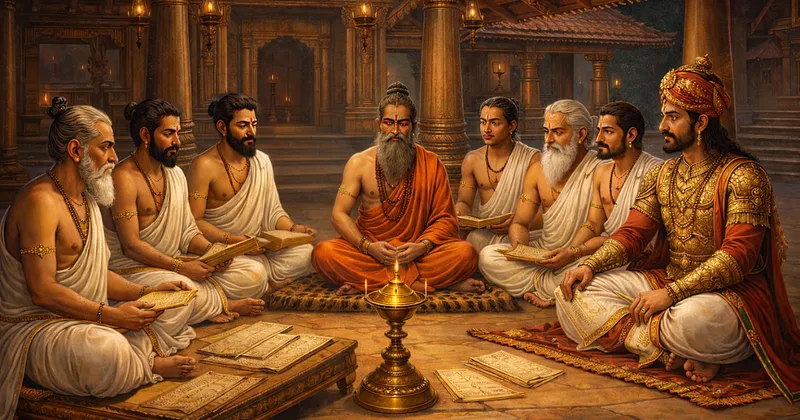
At the same time, Hindū metaphysics also allows profound freedom of inquiry. Darśanas debate one another. Pūrvapakṣa and siddhānta require one to present the opponent’s position rigorously before refuting it. Śāstrārtha allows contestation. Philosophical disagreement is not treated as violence. Even the denial of Īśvara, the critique of ritual, the questioning of Vedic authority, and multiple models of liberation have existed within the vast arena of Indian thought.
This is a civilizational strength.
A culture that holds vāk as sacred need not be fragile. It can insist on responsibility without criminalizing inquiry.
The Problem of Asymmetry
One of the deeper anxieties in the Indian debate around religious offence is asymmetry.
Some religious traditions have historically normalized strong theological denunciation of other deities, paths, or forms of worship. Exclusivist truth-claims often treat rival sacred forms not merely as different, but as false, demonic, idolatrous, or illegitimate. Such theological language has sometimes been defended as freedom of religion or freedom of expression.
At the same time, criticism directed toward those same traditions can attract demands for censorship, prosecution, or punishment.
This asymmetry creates resentment. It makes free expression appear selective. It allows some communities to disparage others under the cover of doctrine, while demanding legal protection from reciprocal critique.
A fair legal order cannot operate this way.
If criticism is permitted, it must be permitted broadly.
If incitement is punished, it must be punished uniformly.
If religious feelings are protected, they cannot be protected selectively.
And if the State claims neutrality, it must not reward those who threaten disorder.
The State and the Street
The most dangerous element in religious-offence law is not the text alone. It is the political psychology that surrounds it.
When the State acts because crowds threaten unrest, a different message is sent: mobilize enough anger, and the law will follow.
This turns criminal law into an instrument of pressure.
Instead of protecting public order, the State begins to negotiate with disorder. Instead of deterring violence, it indirectly incentivizes it. Instead of defending lawful process, it communicates that intimidation works.
This is precisely what the colonial State did in the 1920s. It did not build a principled jurisprudence of free speech and public order. It legislated under pressure. It sought a quick fix. It gave legal form to a political panic.
A century later, India must ask whether it wants to continue this pattern.
The Bharatiya Nyaya Sanhita and the Missed Opportunity
The Bharatiya Nyaya Sanhita, 2023 was presented as a move away from colonial criminal law. Yet in the area of religious-offence provisions, the continuity is striking.
BNS Section 299 retains the essential structure of IPC Section 295A. BNS Section 302 preserves the offence of deliberately wounding religious feelings through words, gestures, sounds, or objects.
The language has been rearranged. Electronic means have been explicitly included. But the deeper legal philosophy remains largely intact.
This was a missed opportunity.
A truly decolonial legal reform would have revisited the historical anxieties that produced Section 295A. It would have asked whether the law has actually reduced religious violence or merely normalized complaint-driven censorship. It would have clarified stronger safeguards for bona fide criticism, historical research, satire, religious reform, and comparative theology. It would have sharply distinguished between offensive speech and speech that incites violence or targeted hatred.
Without such clarity, the same colonial problems continue under a new statutory name.
What Should Be Protected?
A healthy legal framework must explicitly protect certain forms of expression, even when they offend.
Bona fide criticism of religious doctrines must be protected.
Historical research must be protected.
Textual interpretation must be protected.
Comparative religion must be protected.
Social reform critique must be protected.
Reformative Satire and parody, within reasonable limits, must be protected.
Responses to religious polemic must be protected, provided they do not cross into incitement or targeted dehumanization.
The State must not become an arbiter of theological truth. Nor should courts be turned into guardians of fragile sentiment. The role of law should be narrow: prevent violence, punish incitement, restrain targeted hatred, and maintain public order without suppressing legitimate debate.
What Should Be Punished?
At the same time, genuine hate speech cannot be ignored.
Speech that calls for violence against a community must be punished.
Speech that directly incites discrimination, boycott, expulsion, or targeted intimidation must be examined seriously.
Speech that dehumanizes a group and creates conditions for attack must not be casually dismissed.
Speech that deliberately and maliciously seeks to outrage religious feelings with a tendency to disturb public order may fall within the legal threshold.
The point is not to create absolute freedom without responsibility. The point is to ensure that criminal law is used only where the harm is real, not where offence is merely asserted.
A Dhārmika Standard for Speech
The Indic civilizational framework offers a richer standard than both reckless expression and punitive censorship.
It asks the speaker to uphold satya, but not cruelty.
It asks for clarity, but not malice.
It permits debate, but not dehumanization.
It values śāstrārtha, but not mob intimidation.
It treats vāk as sacred, but does not confuse sacredness with fragility.
It recognizes karma as self-agency, meaning the speaker must bear moral responsibility for speech. But it also recognizes viveka, meaning the listener, State, and society must distinguish between criticism and hatred.
This dhārmika standard is far superior to a colonial blasphemy-style framework that criminalizes based on outrage.
Conclusion: A Century of Repetition
For over a century, the fears expressed by the dissenters to Section 295A have repeatedly come true.
The law has not ended religious offence.
It has not prevented violent mobilization.
It has not created a mature culture of debate.
It has not protected reformers, scholars, or critics from harassment.
It has not prevented the State from bending before street pressure.
Instead, it has often produced the very outcome its critics warned against: a premium on intolerance.
The law was born under conditions of acute political pressure, yet legislators themselves were acutely conscious of the danger of suppressing research and reform and tried to narrow the offence through the requirements of deliberateness and malice.
Why, a century later, despite the original safeguards, constitutional jurisprudence, and repeated judicial warnings against hypersensitivity and the hostile-audience veto, does Indian law still struggle to distinguish injury from offence, criticism from hatred, and public order from capitulation to outrage?
India must therefore rethink the way it approaches religious speech. A civilization as old and philosophically confident as Bhārata does not need fragile censorship. It needs lawful order, robust debate, civilizational self-confidence, and a clear distinction between criticism and incitement.
The question is not whether speech should have consequences. It should.
The question is whether the consequence should arise from dharma, reason, and law, or from intimidation, selective outrage, and colonial-era panic.
If India is serious about decolonizing criminal law, it must go beyond renaming statutes. It must recover a deeper civilizational jurisprudence: one that honours vāk, protects inquiry, punishes genuine incitement, and refuses to reward fanaticism.
Only then can the rule of law stand above the rule of outrage.
References
- Bhagavad Gītā (17.15).
- Legislative Assembly debates: Criminal Law Amendment Bill. (1927, September 5 & 16).
- Nair, N. (2013). Beyond the “communal” 1920s: The problem of intention, legislative pragmatism, and the making of Section 295A of the Indian Penal Code. Indian Economic & Social History Review, 50(3), 317–340. https://doi.org/10.1177/0019464613494622
- Nyāya Sūtra (1.2.1–3).
- Raj Paul v. Emperor, AIR 1927 Lah 590.
- Ramji Lal Modi v. State of U.P., AIR 1957 SC 620; 1957 SCR 860.
- Ramesh v. Union of India, (1988) 1 SCC 668.
- Ṛgveda (10.71).
- S. Rangarajan v. P. Jagjivan Ram, (1989) 2 SCC 574.
- Scott, J. B. (2023). Slandering the sacred: Blasphemy law and religious affect in colonial India. University of Chicago Press.
- Taittirīya Upaniṣad (1.11.1).