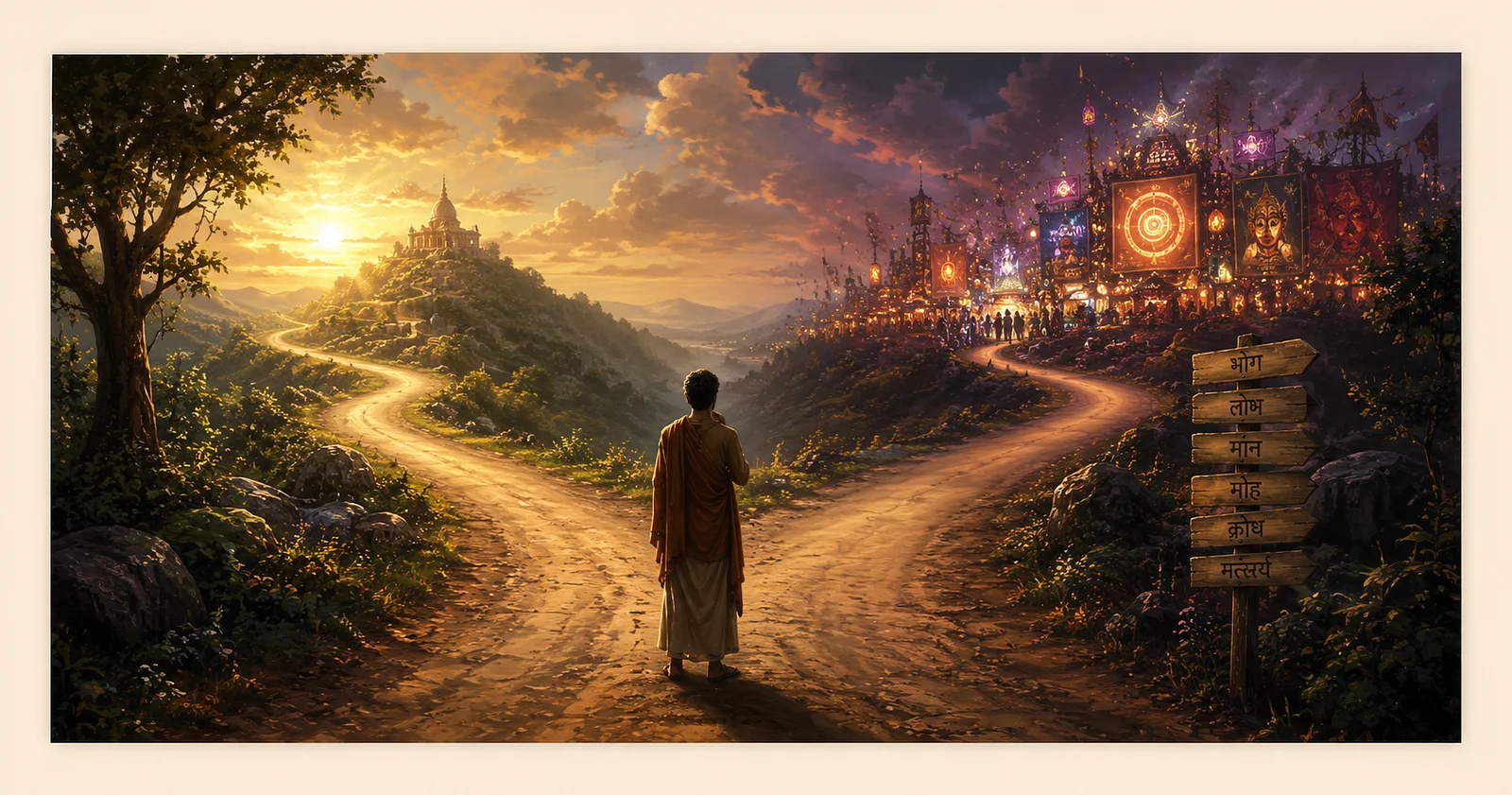
Good intentions die faster, whereas bad intentions catch fire.
Negative feelings and bad thoughts seem to lurk on the surface, whereas positive emotions seem to hide in The Deep caverns of the mind.
The number of good people needed to make good actions count always seems to be disproportionately higher than the number of bad people needed to cause infliction.
We strive hard to create societies that resist the manifestation of bad ideas. Each bad idea faces a significant challenge before it succeeds in becoming pervasive. But it appears in our daily experience that bad ideas spread like contagion.
What seems to be the difference in the success of manifestation between Good and bad ideas is how persuasively the power to fulfil them is being pursued. Any idea that enters the human sphere can manifest only if it finds congenial conditions that allow its expression. In either case, it is the individual and collective volition that is being competed for.
Good thoughts, feelings, and ideas are usually not in a competitive mood. Instead, they depend on the recipient’s ability to recognize the inherent value of these ideas. They usually depend on the conscious espousal and action. If not recognized, they lie dormant or retreat.
Bad ideas, negative feelings deploy persuasion to grasp the volition of individuals and masses. Persuasion remains archetypally foundational tool for forces of disintegration. This truth shows up in diverse mythic narratives across cultures.
Right here, we find the origin of this paradox. While good ideas are waiting to be espoused, bad ideas are being persuaded into action through a few cunning wolves that act as vectors.
It is here that one can recognize the role of cultural intelligence. A culture that is replete with narratives that fortify our chances to make the right choices is a blessing that helps us override the perils of seduction and inflation.
Persuasion is, in turn, adorned in various attire. Some of the most powerful costumes of persuasion are the ones that dismantle the capacity to discern and, at the same time, cause irresistible attraction to espouse bad ideas. A dual act of deception.
Doubt, confusion, conflict, etc., are tools to weaken viveka, the power of discernment. Seducing via power and ambition to sow the seeds of attraction. These are aimed at inherent weaknesses that inhabit the human psyche, which the dhārmika view has identified usually as Ariṣaḍvarga or Ṣaḍripu - kāma (desire), krodha (anger), lobha (greed), Mada (arrogance), moha (delusion), and mātsarya (jealousy).
For example, the idea of artificial intelligence is currently at this stage of persuasion. Most compelling arguments for higher productivity, creating abundance and bringing in more predictability are now being unleashed. It will be difficult to deny them. When its pitfalls or potential disasters are articulated, ironically, the power of human volition to make the discerning choices will be evoked.
This is how the power of lobbying overrides the power of discernment, through the path of corruption.
AI could be in use to enable superfast computation, simplify complex decisions during surgeries in operation theater, or any such superhero tasks that enable furthering of good work, before making it part of our gadget world.
But its titillations are far too strong to envisage such measured deployment. When titillations are high, correspondingly, our discernment will weaken.
We are standing right now on the edge of a precipice, as we step into a new era defined by technology, where the power of our discernment is most likely to concede its space of decision-making to the machine. This will happen at a pace beyond our comprehension and control.
Once this is done, then the forces of disintegration have no need for our conscious subscription any further. Soon, we will be very comfortable to espouse choice-making process as curated by machines. Outsourcing of choice will soon be all-pervasive. Auto-suggestions that pop up on screens that help us use efficient vocabulary, prompts that suggest alternatives to our consumer behaviour, will slowly modify our habits. Small, unassuming actions goaded by persuasions will become the norm. In the face of such an onslaught, even being able to choose our favourite dishes in a restaurant based on our preferences will seem like a heroic act.
Such a state of absence of volition is just akin to a state of slumber, with eyes wide open.
In a not-so-distant future, in retrospect, we might catch ourselves passionately agreeing, or made to agree, that an act based on personal volition after all was not a great idea, for the majority of humanity is not qualified to have such a privilege.
From a dhārmika perspective, this goes against every fibre of the culture that is tied by the girdle of svadharma and karma.
These ideas are not new in any way. They are perhaps echoes of the persuasions from the past that persistently succeeded in poisoning the world. One can plumb further metaphysical and occult depths to understand where such persuasion originates. It suffices for now to observe that human emergence into the realm of volition is an arduous journey over millennia. This miracle happened despite the absence of any conscious volition in the nether worlds from where we were awakened.
Our submission to deep, dark, inert existence was not meant to be forever. As we were exhorted out of this abyss, what urged our growth towards light seemed to hide even deeper than darkest negation. We intuit an illuminating, self-effulgent existence to ignite our aspiration to grow into our essence.
Conscious will that shapes shimmering volition in us has carved out life through its countless stumblings, without giving up hope to manifest beauty. Little illuminations of perfection stand as testimony that transcend the grasp of negation, tamas.
To put us back to sleep, from this semi-awakened state, we are called to submit our volition. This persuasion is draped in great temptation. Intellect usurped by temptation is the highway of descent into hell.
The only possibility we hold onto is to not give up good intentions, good thoughts, Good feelings and will for good action. To not give up our faith in this unseen but ever-felt exhortation from behind the veil of negation. As long as we can anchor in Dharma, to the best of our ability, in the face of adversity, our submission will not be complete.