.png)

Disclaimer: This article has no connection whatsoever to the film Karuppu or to any persons, productions, or commentary associated with it. It neither reviews, critiques, endorses, nor responds to the film or its content. The article is a standalone scholarly examination of the textual, epigraphic, and archaeological stratigraphy of Ayyaṉār and Karuppaṇṇasāmi worship, and any thematic resemblance to the film's subject matter is incidental. References to contemporary discourse are made only to situate the article's scholarly motivation and should not be read as engagement with the film itself.
I. Why this Article — Addressing a Persistent Misconception
In contemporary popular discourse, particularly in regional cultural-revivalist quarters, Ayyaṉār and Karuppaṇṇasāmi are often presented as uniquely Tamil deities — primordial Dravidian figures untouched by, and in some tellings actively suppressed by, the sāṃskṛtika-Vaidika tradition. The corollary claim is that hero-stone worship, the cultural matrix from which these deities emerged, is itself a uniquely Tamil-Dravidian institution.
The actual textual, epigraphic, and archaeological record does not support either claim. What it supports is more interesting and more honest: Ayyaṉār and Karuppaṇṇasāmi are Tamil instances of pan-Indian religious types, with structural cousins in virtually every linguistic region of the subcontinent, embedded in a ritual grammar — hero-deification, boundary-guardianship, sage-protector cult — documented in the oldest stratum of Indo-Aryan literature and in archaeological evidence stretching back millennia.
To say this is not to diminish these deities. It is to situate them truly. Karuppaṇṇasāmi is no less real, no less locally meaningful, no less ritually living, for being part of a larger family. Ayyaṉār is no less Tamil for being one regional expression of a broader Indian religious grammar. The "uniqueness" claim flattens the actual richness of these figures — composite formations standing at the intersection of multiple religious streams — into a fragile and historically unsupportable monoculture.
II. The Substrate: Hero-Stone Worship and the Vaidika Witness
The cultural matrix from which Ayyaṉār worship emerged is the deification of warriors who fell defending the boundaries of their community. In Tamil, this institution is called naṭukal (planted stone) or vīrakkal (hero stone); in Kannada, vīragallu; in Marathi, vīragaḷ; in Rajasthani, pāḷiyā; in Gujarat, khambhī; in the Himalayan regions, integrated into the devatā shrine complex. The oldest Tamil hero-stones — the Pulimaṅkompai stones in Theni district — date to the 3rd century BCE, bearing Tamil-Brāhmī inscriptions like "Kal pedu tiyan antavan kudal ur akol" (this stone is raised for Tiyan Antavan of Pedu village, who died in a cattle raid at Gudalur). Karnataka alone preserves over 2,650 hero-stones. The institution is subcontinental and ancient, not regional and recent.
The crucial point is that the Vedic corpus itself codifies a structurally identical ritual — the consecration of a planted stone over the dead, asking the ancestors to hold it firm and the deceased's spirit to be installed in it.
The locus classicus is Ṛgveda 10.18, one of the foundational Indo-Aryan funerary hymns, attributed to Saṅkusuka Yāmāyana. Three verses are decisive:
RV 10.18.4:
"I erect this barrier (paridhi) for the living, that none of them may approach this limit. May they live a hundred plentiful autumns, and may they keep death hidden by this mound."
Sāyaṇa, the 14th-century commentator, glosses paridhi as a circle of stones or an earthen mound erected as a ritual boundary between the living and the dead — structurally identical to the village-edge placement of the naṭukal in Tamil tradition.
RV 10.18.13:
"Here let the Fathers raise the pillar (sthūṇā) for thee; may Yama make an abode for thee there."
The Saṃskṛta word sthūṇā is precisely "a standing pillar, post, or planted stake." The verse calls upon the pitṛs — the ancestor-fathers — to raise this pillar over the deceased. This is the Vaidika naṭukal, by another name.
RV 10.18.12:
"Now let the heaving earth be free from motion: yea, let a thousand clods remain above him. Be they to him a home distilling fatness, here let them ever be his place of refuge."
The mound (citā) covers the dead. Together with the pillar (sthūṇā) and the boundary-circle (paridhi), this constitutes a unified ritual complex: earthen mound + planted pillar + protective enclosure + invocation of ancestors and Yama + ongoing worship. This is the vaidika pitṛmedha, and it is the structural ancestor of every Indian hero-stone tradition that follows.
The Atharvaveda's Book 18 — the pitṛmedha-sūkta — develops this Ṛgvedic kernel into an elaborate ritual programme, with detailed prescriptions for mound construction (AV 18.2.34), pillar installation (AV 18.2.37), and continuing worship at the funerary site (AV 18.3). The Vedic corpus does not merely know of hero-stone worship — it codifies a developed ritual technology of exactly this kind, in its oldest literary stratum, centuries before the earliest Tamil literary attestation.
The claim that hero-stone worship is uniquely Tamil collapses at this point. The institution is at least Vedic-coeval in textual attestation and archaeologically older than the textual record on both sides. Given parallels in Greek, Iranian, and broader Indo-European funerary practice, it is part of the deepest substrate of South Asian and Indo-European religious culture.
III. The Tolkāppiyam's Six Stages and Their Saṃskṛta Counterparts
The Tolkāppiyam (dated variously from the 3rd c. BCE to the 2nd c. CE) codifies naṭukal worship as a recognised puṟam poetic subject. In the Poruḷ-atikāram it aphoristically lists six stages of naṭukal erection, expanded by the commentators Iḷampūraṇar (11th c.) and Naccinārkkiniyar (14th c.):
#
Tamil term
Meaning
1
Kāṭci (காட்சி)
"Seeing/searching" — ritual selection of a suitable stone
2
Kāl-kōḷ (கால்கோள்)
"Taking the stone" — ritual transport on an auspicious date
3
Nīr-paṭai (நீர்ப்படை)
"Water-offering" — bathing/lustration with sacred water
4
Naṭu-kal (நடுகல்)
"Planting the stone" — erection with the hero's name inscribed
5
Peruṅ-paṭai (பெருங்படை)
"Great offering" — public ceremonial feast with garlands, peacock feathers, and toddy
6
Vāḻttu (வாழ்த்து)
"Praise/benediction" — formal divinisation through praise-songs and continuing worship
A complete ritual sequence — selection, transport, purification, installation, public dedication, ongoing worship — through which the dead hero is transformed into a worshipped deity.
The structural parallel with the Saṃskṛta ritual literature is one-to-one. Śatapatha Brāhmaṇa 13.8 — the great śmaśāna-cayana section — prescribes:
-
Sthāna-parīkṣaṇa — site examination. Cf. kāṭci.
-
Pāṣāṇa-grahaṇa — taking the stones. Cf. kāl-kōḷ.
-
Snāpana — bathing and purification. Cf. nīr-paṭai.
-
Sthūṇā-pratiṣṭhā — installation of the pillar with mantras. Cf. naṭu-kal.
-
Anna-dāna / piṇḍa-pradāna — public food offerings and community feast. Cf. peruṅ-paṭai.
-
Stotra — praise and continuing invocations. Cf. vāḻttu.
The Hiraṇyakeśin Pitṛmedhasūtra gives a virtually one-to-one match in Saṃskṛta. The Āśvalāyana Gṛhyasūtra 4.1–6, Pāraskara Gṛhyasūtra 3.10, and Kātyāyana Śrautasūtra 25.7–9 all preserve cognate prescriptions.
The Tolkāppiyam's six-stage naṭukal aphorism and the vaidika-sūtra pitṛmedha sequence are describing the same ritual. Whether this represents independent inheritance from a common Indo-European substratum, transmission from north to south, or descent from a pre-Aryan South Asian megalithic substrate is a genuinely open scholarly question. What is not open is the structural identity.
IV. The Nagaswamy Thesis — Vaidika Revanta and the Iconographic Body of Ayyaṉār
If the hero-stone substrate gives us the ritual matrix, the question remains: where does the specific iconography of Ayyaṉār — the horseman with sword and bow, accompanied by dogs and hunting attendants — come from? Not from the vaidika pitṛmedha (which prescribes the ritual but not the deity's image). Not from the Pulimaṅkompai-era hero-stones (simple inscribed stones, with no equestrian iconography). It enters the Tamil tradition from somewhere else.
R. Nagaswamy (1930–2022), the eminent Tamil epigraphist and former founder-Director of the Tamil Nadu State Department of Archaeology, gave the most distinctive answer. In Art and Culture of Tamil Nadu — particularly the chapter "Temples of Village Gods" — and in Tamil Nadu: The Land of the Vedas, Nagaswamy proposed that Ayyaṉār is the Tamil deified form of the vaidika-Paurāṇika Revanta.
Revanta is a minor but distinctive Saṃskṛta deity — the hunter-son of Sūrya and Saraṇyū, chief of the Guhyakas. His birth, narrated in the Markaṇḍeya Purāṇa chapter 108, occurs when Sūrya as a stallion and Saraṇyū as a mare unite in the forests of Uttara-Kuru:
"From the end of the ejaculation sprang Revanta, riding a horse, his body protected by armour, with a sword and a bow in his hands and provided with arrows and quiver. He was given the overlordship of the Guhyakas..." (Markaṇḍeya Purāṇa 108.11, 19–22)
Vārāhamihira's Bṛhat Saṃhitā (6th c. CE) gives the canonical iconographic prescription: "Revanta should be represented on horse-back accompanied by a hunting party" (58.56). The Kālikā Purāṇa adds that he carries "a sword in his right hand and a whip in his left, seated on a white horse" — earning the epithet Haya-Vāhana ("Horse-Vehicled"). Sculptural Revantas appear from the 6th c. CE onwards, from Bihar to Bengal to Afghanistan.
Nagaswamy's argument is that Ayyaṉār's iconographic profile — young male on horseback, armed with sword and bow, accompanied by dogs and hunting retinue, located at the forest-edge — is essentially the iconography of Revanta, transmitted southward through the Saura cult's expansion in the early medieval period. The Tamil Cāttaṉ — already named, already worshipped in the naṭukal substrate, already located at the village periphery — absorbed the Revanta complex from the 5th–7th c. CE onwards. The Saṃskṛta scholar writing under the pseudonym Manasatāramgini has independently argued in his 2006 essay "The deva Revanta" that Revanta is the proto-form of both the Maharashtrian Khaṇḍobā and the southern Śāstā/Ayyaṉār — independent corroboration of Nagaswamy's thesis from a Saṃskṛtaist's angle.
But this explains only one stream. The name and the teacher-semantic of Cāttaṉ / Śāstā come from elsewhere — the śramaṇa connection to Buddhism and Jainism.
The name Śāstā (शास्ता) is built from the Saṃskṛta root √śās ("to teach, instruct, rule, chastise") — the same root yielding śāstra, śāsana, śiṣya, anuśāsana. Śāstā is an agent noun: "the one who instructs." In pre-Buddhist Saṃskṛta it is a generic honorific. But in the Pali canon and Buddhist Saṃskṛta, Śāstā / Satthā becomes the central epithet of the Buddha — "the Teacher" par excellence.
The Tamil Cāttaṉ (சாத்தன்) corresponds phonetically to Saṃskṛta Śāstā by standard conversion rules. But Tamil also has the word sāttu (சாத்து), which the Tamil-language scholar Kantacāmi (1978) and others argue means "Buddhist monk" in early Tamil usage. The convergence is striking: the Tamil deity-name sits at the intersection of Saṃskṛta Śāstā (Buddha's epithet) and Tamil sāttu (Buddhist monk).
The Sangam record provides extraordinary onomastic confirmation. No fewer than two dozen named poets bear the personal name Cāttaṉār — including Cīttalai Cāttaṉār (Buddhist author of Maṇimēkalai), Ālamperi Cāttaṉār (Akanāṉūṟu 47, 81, 143, 175), Aḻicī Naccāttaṉār (Kuṟuntokai 271), Vaṇṇakkan Cāttaṉār (known for Saṃskṛta erudition), Perunthalai Cāttaṉār (Puṟanāṉūṟu 209), and many others. The deity-name was widespread enough to be a popular personal name during the Sangam period — as modern Tamils are named Murugan or Karthik. The most telling case is Cīttalai Cāttaṉār, whose Maṇimēkalai is suffused with Buddhist Abhidhamma and preserves Ajivika doctrine in greater detail than any surviving northern source.
The Cilappatikāram, traditionally authored by Iḷaṅkō Aṭikaḷ (a Jain prince-monk), is the earliest secure literary attestation of Aiyaṉ-Cāttaṉ as a compound deity-name. The first attestation of any kind is older: the 3rd-century CE hero-stone inscription from the Arcot district reading "Ayanappa; a shrine to Cattan" — the dedication of a hunting chieftain's memorial to the deity Cāttaṉ.
The 5th-century rock carving at Isurumuniya in Sri Lanka — a Buddhist temple complex — depicts a man-and-horse figure that Sinhala-Buddhist tradition identifies as Ayyanāyake, the Sinhala cognate of Ayyaṉār. This is the earliest surviving iconographic attestation of the deity, in a Buddhist context.
The convergent evidence supports a textured picture: the Cāttaṉ / Śāstā name and the teacher-protector semantic profile entered Tamil religion in an environment where Buddhism, Jainism, and the Ajivika tradition were strong, and the śramaṇa religions provided part of the conceptual scaffolding. Ayyaṉ in the Sangam stratum is best understood as a teacher-protector archetype — a deified sage-guardian — drawing on indigenous Tamil hero-deification, Saṃskṛta Śāstā honorific terminology, and Buddhist/Jain śramaṇa semantic resonance. The horseman iconography is grafted on later.
V. The Pallava Period — Institutional Crystallization and Paurāṇika Re-Parenting
It is the Pallava period — roughly 6th–9th centuries CE — that gives us the institutional temple cult of Ayyaṉār as we recognise it today, summarized in the (defensible) statement that "Ayyaṉār worship began in the Pallava period." Several developments converge:
The Saura-Revanta iconographic complex enters the south. Vārāhamihira's prescriptions transmit southward — almost certainly via the Pallava dynasty's northern dynastic-cultural ties. The already-existing Aiyaṉ-Cāttaṉ absorbs the iconography: horse, sword, dogs, hunting attendants. The clay-horse offerings characteristic of modern Ayyaṉār worship are a Tamil folk-religious instantiation — the deity needs a fresh horse each year for his nightly perambulation of the village boundary.
The Paurāṇika re-parenting takes hold. The Brahmāṇḍa Purāṇa, in its pre-7th-century core, introduces Śāstā as Harihara-suta — son of Śiva's union with Viṣṇu-as-Mohinī. The first Saṃskṛta attestation of Śāstā as a discrete named deity. The Harihara-suta narrative solves a sectarian problem: Tamil villages had both Śaiva and Vaiṣṇava households, and a single village deity belonging structurally to both lineages was a theological elegance. The Skanda Purāṇa's Asura Kāṇḍa — the only Purāṇa naming him Śāstā directly — narrates that Indra deputes Śāstā to protect Indrāṇī from the asura Sūrapadma. It is here that his consorts Pūrṇā ("the complete one") and Puṣkalā ("the abundant one") and son Satyaka are first named — transparently Saṃskṛta theonyms.
The Tamil Bhakti canon integrates the deity. Tirujñānasambandar (7th c.) sings of Ayyaṉār as "a celibate god, invincible and terrible in warfare, taking his abode alongside the bhūtagaṇas of Śiva" — the first explicit textual yoking of the older teacher-protector Cāttaṉ to a fierce-warrior identity. The bhūtagaṇa framing is the structural template for what becomes the kāval deivam retinue. Appar sings of Śāstā as progeny of Śiva and Tirumāl. The Tiruvāṉaikkāval sthala-purāṇa places Śāstā as Śiva's outer-sanctorum attendant. The Vaiṣṇava tradition also embraces him: Tirumaṅkai Āḻvār and Nammāḻvār mention Śāstā in temples like Tirumōgūr near Madurai.
Royal patronage and temple economy consolidate. Pallava and early Chola inscriptions refer to him as Mahāśāstā and Sevugaṉ. Land endowments are recorded; the worship is integrated into the temple-state economy.
The iconographic full form crystallizes. In Chola-Pandya temple iconography (10th–13th c. CE), Ayyaṉār acquires his standard form: seated in yoga-paṭṭa on a throne or white horse, between his consorts Pūrṇā and Puṣkalā, holding the chentu or sceptre, sword in hand, surrounded by vassals. This is the figure that emerges in Kerala by the 10th–12th c. as Ayyappaṉ of Sabarimala.
The key transformation is the shift in dominant register from "teacher" to "warrior-protector-king". The contemplative yoga-paṭṭa posture remains as a vestigial trace of the original teacher-figure — a yogic warrior who sits in meditation while holding a sword.
This is the Ayyaṉār the medieval Tamil world inherited: a deity whose name carries the resonance of the Buddhist Satthā, whose iconography carries the body of Saura Revanta, whose theology carries the genealogy of the Brahmāṇḍa Purāṇa's Harihara-suta, and whose ritual practice carries the immemorial Tamil substrate of naṭukal hero-deification.
VI. Karuppaṇṇasāmi's First Description — Mahākāla in the Kanda Purāṇam
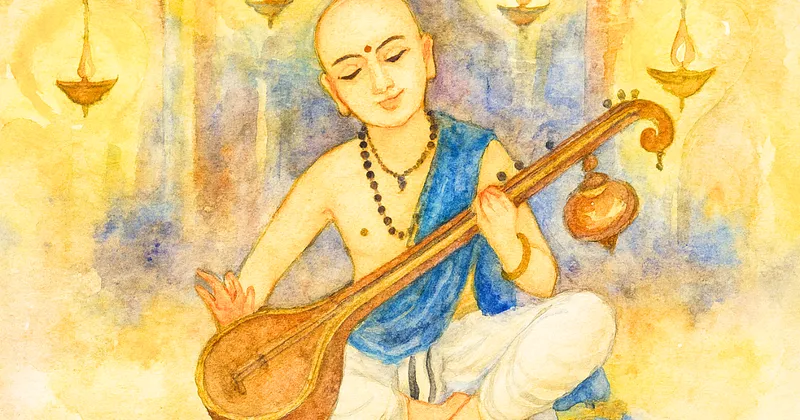
Karuppaṇṇasāmi as a named, iconographically discrete deity does not appear in any Tamil text before the Nayaka period (16th–18th c. CE). But the structural slot he occupies — Ayyaṉ's fierce commander, his sēṉāpati, the dark executive aspect complementing the contemplative-royal centre — appears in Tamil literature centuries earlier, in Kacciappa Civācāriyār's Kanda Purāṇam (14th c., the Tamil version of the Skanda Purāṇa).
In the Kanda Purāṇam's Mahā-cāttaṉ paṭalam ("the chapter of the Great Cāttaṉ"), Ayyaṉ is depicted as a sovereign deity with a military retinue. In the war between Indra and the asura Sūrapadma, Ayyaṉ dispatches his commander Mahākāla to protect Indrāṇī. This is the earliest Tamil textual instance of Ayyaṉār operating with a named fierce commander, and the commander's name is Mahākāla — the Saṃskṛta "Great Time / Great Black One."
The structural identity with what later becomes Karuppaṇṇasāmi is exact:
-
The name: Saṃskṛta Mahākāla = "the Great Black One" (mahā + kāla); Tamil Karuppaṉ = "the Black One" (karuppu). Semantic equivalence direct.
-
The function: both serve as fierce commander/executor under a contemplative-sovereign deity.
-
The iconographic register: dark-complected, weapon-bearing, martial.
-
The narrative role: both dispatched to protect a vulnerable feminine figure (Indrāṇī; the village goddess).
The 14th-century Kanda Purāṇam shows the structural slot already in place in the Tamil literary imagination two centuries before the Nayaka-period crystallization of the named Karuppaṇṇasāmi. The trajectory: Saṃskṛta Mahākāla → Tamil literary Mahākāla in the Kanda Purāṇam (14th c.) → Karuppar archetype in late medieval folk tradition → named Karuppaṇṇasāmi with poligar-derived iconography in the Nayaka period. The figure does not appear suddenly. He emerges over centuries from a Saṃskṛta literary parent refracted through Tamil Paurāṇika literature.
Even Karuppaṇṇasāmi — the most apparently folk-Tamil, most apparently non-Saṃskṛtaic of these figures — has his first textual ancestor in a Tamil Paurāṇika literature that is itself a vernacularization of the Saṃskṛta Skanda Purāṇa. The Tamil folk register and the Saṃskṛta Paurāṇika register have been interpenetrating, in this deity-stream, for well over a millennium.
VII. The Pan-Indian Archetypal Network
The comparative survey is what most definitively dismantles the "uniquely Tamil" claim. Functionally identical deities — central guardian + fierce dark commander pair, often equestrian, at community thresholds, serving as kuladevatā, mediated by oracle possession — exist across virtually every linguistic region of the subcontinent. The names differ; the type is constant.
Kerala — Ayyappaṉ / Dharma-Śāstā. The closest cousin, the same deity-stream as Ayyaṉār, diverged in the 10th–12th c. CE Kerala stratum. Hariharasuta genealogy shared, forest-edge location shared, brahmacāri-warrior duality shared. Ayyappaṉ acquired a major pilgrimage temple (Sabarimala), structured vrata tradition, and elaborate Saṃskṛtaic ritual. The fierce commander folds in as Kaduthāsāmi / Karuppasāmi.
Maharashtra and Karnataka — Khaṇḍobā / Mailāra / Mārtaṇḍa-Bhairava. Iconographically the closest parallel outside Tamil country. White horse, sword, hunting dogs, two consorts (Mhalsa and Banai, structurally parallel to Pūrṇā and Puṣkalā), kuladevatā of Dhangars, the great Jejuri temple structurally analogous to Aḻakar Kōvil. Manasatāramgini identifies Khaṇḍobā as the central Indian derivative of the Saura-Revanta complex. Fierce-commander figure: Maṇi-Malla.
Andhra and Telangana — Mallanna / Pothurāju / Beerappa. Mallanna of Komuravelli is the Telugu form of the Khaṇḍobā-Mailāra complex. Pothurāju, dark-complected and fierce, is the direct Telugu analogue of Karuppaṇṇasāmi.
Konkan — Vetāḷ / Vetoba. Dark, fierce, weapon-bearing village guardian — near-direct iconographic cousin of Karuppaṇṇasāmi, often paired with a higher village deity (Rāvalnāth) in the same division-of-labour pattern.
Tulu Nadu — Bhūta worship: Pañjurli, Kallurṭi, Guḷiga, Bobbarya, Kalkuda. The Bhūta cult, featured in Kantara, is the closest South Indian cognate. The kola ritual cycle is structurally identical to the Tamil sāmi-āṭi tradition. Bobbarya occupies a structural slot similar to Ayyaṉār; Guḷiga functions as the fierce executor parallel to Karuppar.
Rajasthan — Pābūjī, Tejājī, Goga-jī, Rāmdev-jī, Devnārāyaṇ, Bhomiyāji. The vīr-deval tradition — deified warrior-heroes, often horse-mounted, in oral-epic traditions. Pābūjī's paṛ functions exactly like Tamil villuppāṭṭu. Rāmdev-jī is a major equestrian protector-deity. Bhomiyāji — the boundary-stone deified-hero of nearly every Rajasthani village — is the direct Rajasthani Karuppar-equivalent.
Gujarat and Saurashtra — Vāghreśvar, Pāḷiyā-deified heroes. Pāḷiyā memorial-stones produce deified heroes as community guardians, often horse-mounted.
Madhya Pradesh, Chhattisgarh, tribal belts — Bhairam-deo, Bīr-bābā, Birsā. Tribal bīr (warrior-spirit) cults with deified heroes at village boundaries. Bhairam-deo is a Bhairava-folk-village fusion analogous to Karuppar.
Uttar Pradesh and Bihar — Brahm-bābā, Dīh-bābā, Bhairon-jī, Pīr-bābā. The brahm-thān — a raised platform with a stone at the village boundary — is the structural equivalent of the open Ayyaṉār shrine. Often Islamicized as pīr shrines.
Bengal — Dharma-ṭhākur, Dakṣiṇ Rāy, Pañcānan. Dharma-ṭhākur is significant because the name parallels Dharma-Śāstā. A non-iconic deity worshipped as a boundary-stone — possibly the closest Bengali cognate to the older Tamil Cāttaṉ substrate. Dakṣiṇ Rāy is the tiger-lord guardian of the Sundarbans.
Himachal Pradesh and Uttarakhand — Mahāsū Devtā. The Himalayan Ayyaṉār. Justice-dispenser, oath-binder, kuladevatā of entire valleys, oracle-possession tradition, four-brother retinue structure functionally similar to the kāval deivam complex.
Sri Lanka — Ayyanāyake. The Sinhala-Buddhist absorption of Ayyaṉār, attested from the 5th c. CE at Isurumuniya.
Indo-Caribbean diaspora — Sanganī Bābā. Karuppaṇṇasāmi worship transplanted with 19th-century indentured-labour migration, now operating in Trinidad, Guyana, Suriname, Guadeloupe, and Martinique Hindu ritual life with the same boundary-and-justice functions.
The pattern is unmistakable: a central deified guardian, often equestrian, located at community thresholds, paired with one or more fierce subsidiary deities receiving the meat-and-liquor offerings, serving as kuladevatā for specific martial-pastoral or agrarian communities, mediated by oracle-possession traditions, embedded in oral-epic narrative cycles, often theologically re-parented through Paurāṇika genealogies layered over an older substrate. Ayyaṉār and Karuppaṇṇasāmi are the Tamil instance. Khaṇḍobā and Maṇi-Malla are the Maharashtrian instance. Mallanna and Pothurāju the Telugu. Mahāsū Devtā and his brothers the Himalayan. The type is pan-Indian; the names and styles are regional.
VIII. Closing Synthesis
The honest stratigraphy of Ayyaṉār and Karuppaṇṇasāmi:
-
The deepest substrate is the pan-Indian hero-stone tradition, attested in the Vedic corpus (Rigveda 10.18, Atharvaveda 18, Śatapatha Brāhmaṇa 13.8) and codified for Tamil purposes in the Tolkāppiyam's six-stage naṭukal sequence — a one-to-one structural match with the Saṃskṛta pitṛmedha prescriptions.
-
The named figure of Aiyaṉ-Cāttaṉ emerges in the Sangam stratum (1st c. BCE – 3rd c. CE), drawing on a teacher-protector archetype with significant Buddhist and Jain śramaṇa resonance — visible in the Śāstā etymology (Buddha's epithet), Tamil sāttu (Buddhist monk), the twenty-odd Sangam poets bearing the name Cāttaṉār, and the Jain authorship of the Cilappatikāram. First inscription: 3rd c. CE Arcot hero-stone. First iconographic attestation: 5th c. CE Isurumuniya carving in a Buddhist context.
-
The iconographic body — horseman with sword, dogs, hunting retinue — is grafted on from the Saura-Revanta complex (codified in Vārāhamihira, 6th c., narrated in Markaṇḍeya Purāṇa 108) during the 6th–7th centuries CE, as Nagaswamy argued.
-
The institutional temple cult crystallizes in the Pallava-early Chola period (6th–9th c. CE), with royal patronage, codified iconography, Bhakti integration (Sambandar, Appar, the Āḻvārs), and Paurāṇika re-parenting through the Brahmāṇḍa Purāṇa's Harihara-suta narrative. The Sasta-imagery transforms from "teacher" to "warrior-king-protector," though the yoga-paṭṭa posture remains as a vestige of the original teacher-archetype.
-
The fierce commander archetype (which becomes Karuppaṇṇasāmi) first appears as Mahākāla in the Kanda Purāṇam (14th c.) — the Saṃskṛta "Great Black One" being the direct semantic parent of the Tamil "Karuppaṉ."
-
The named Karuppaṇṇasāmi with full iconographic crystallization emerges in the Nayaka period (16th–18th c. CE), absorbing the deified-poligar warrior-watchman into the Mahākāla-derived structural slot.
-
The modern village-religious form — clay horses, Velar priests, kāval deivam retinue, oracle possession, vegetarian-center and meat-receiving-periphery ritual structure — represents the Nayaka-period folk crystallization of all the above strata.
And throughout, the deity is one regional instance of a type with cousins from the Himalayas to the Konkan, from the Sundarbans to the Caribbean. Khaṇḍobā in Maharashtra, Mahāsū Devtā in the Himalayas, Mallanna in Telangana, Pābūjī in Rajasthan, Bobbarya in Tulu Nadu, Dharma-ṭhākur in Bengal, Ayyappaṉ in Kerala — all participants in the same pan-Indian religious grammar of guardianship, hero-deification, and protector-cult.
To say all this is not to take anything away from Ayyaṉār or Karuppaṇṇasāmi. They are real, locally rooted, ritually living deities, carrying genuine theological work in the communities that worship them. They are also — and this is the more interesting truth — beautifully specific Tamil expressions of a religious grammar that is the shared inheritance of the entire subcontinent. They belong to Tamil Nadu, and they belong to Bhārata. The deeper truth — that Karuppaṇṇasāmi descends in a clear textual lineage from the Saṃskṛta Mahākāla, that Ayyaṉār's body is Revanta and his name carries the Buddha's epithet, that the naṭukal worship that produced them is structurally identical to the vaidika sthūṇā-pitṛmedha ritual — is the truth that situates them properly within the Indian religious imagination: not as isolated regional curiosities, but as Tamil incarnations of some of the oldest and most pan-Indian religious patterns we have.
References:
Primary texts (with editions consulted)
Ṛgveda 10.18 (Funeral Hymn). Trans. R. T. H. Griffith, The Hymns of the Rigveda (1896). Rishi: Saṅkusuka Yāmāyana; devatā: Mṛtyu; metre: Triṣṭubh. Verses 4 (paridhi), 11 (“heave thyself, Earth”), 12 (clods/citā), 13 (sthūṇā / Yama). Wikisource (Griffith); Sanskrit + Wilson/Sāyaṇa at wisdomlib (RV 10.18.4).
Atharvaveda, Book 18 (Pitṛmedha hymns). Trans. R. T. H. Griffith, Hymns of the Atharva-Veda (1895). AV 18.2 · AV 18.3 · AV 18.4.
Śatapatha Brāhmaṇa 13.8 (śmaśāna / sepulchral-mound). Trans. J. Eggeling, Sacred Books of the East, vol. 44.
Markaṇḍeya Purāṇa, ch. 108 (birth and role of Revanta). Trans. F. E. Pargiter (1904). See summary at Wikipedia: Revanta.
Varāhamihira, Bṛhat Saṃhitā, ch. 58 (iconography; Revanta among the deities). Trans. V. Subrahmanya Sastri & M. Ramakrishna Bhat (1946). Internet Archive.
Kālikā Purāṇa (Revanta as Haya-Vāhana). Cf. iconographic summaries in the Revanta entry above.
Brahmāṇḍa Purāṇa (Śāstā as Hariharasuta — first Sanskrit attestation). See Wikipedia: Aiyanar.
Skanda Purāṇa / Kanda Purāṇam of Kacciappa Civācāriyār (14th c.), Mahā-cāttaṉ episode (Mahākāla protects Indrāṇī). See Murugan.org: Kanda Purāṇam and the Aiyanar entry above.
Tolkāppiyam, Poruḷ-atikāram (Puṟattiṇai-iyal) — six stages of naṭukal; with commentaries of Iḷampūraṇar and Naccinārkkiniyar.
Cilappatikāram (Iḷaṅkō Aṭikaḷ) and Maṇimēkalai (Cīttalai Cāttaṉār). See Wikipedia: Chithalai Chathanar.
Sangam corpus references: Puṟanāṉūṟu 209 (Perunthalai Cāttaṉār); Akanāṉūṟu; Kuṟuntokai. See Wikipedia: Saathanar.
Epigraphy & archaeology
Pulimaṅkompai hero-stones (Theni dist., Tamil-Brāhmī, c. 3rd c. BCE, found 2006). K. Rajan / R. Poongundran, reported in The Hindu and in R. Poongundran, Nadukal Kalvettukkal. Tamil Nadu Archaeology (hero-stones).
Hero-stone typology and counts (Karnataka ~2,650; earliest 5th c. CE). Upinder Singh, A History of Ancient and Early Medieval India. See Wikipedia: Hero stone.
Isurumuniya “Man and Horse” relief (Anuradhapura, 5th c. CE), identified with Ayyaṉār/Ayyanāyake (identification contested; cf. Parjanya). See Wikipedia: Ayyanayake and N. D. Kekulawala, “A Socio-historical Study of the Ayyanayake Belief,” JAHS (PDF).
“Ayyaṉappaṉ; a shrine to Cāttaṉ” inscription (Arcot; date to be confirmed). Cited in the Aiyanar entry above.
Secondary scholarship
Nagaswamy, R. Art and Culture of Tamil Nadu. New Delhi: Sundeep Prakashan / Aryan Books (ISBN 81-7574-015-9). Also Tamil Nadu: The Land of the Vedas. See R. Nagaswamy (bibliography).
Kantacāmi, S. N. (1978) — etymology of sāttu (“Buddhist monk”). Cited in the Chithalai Chathanar entry above.
“Manasatāramgini” (2006), “The deva Revanta.” Self-published essay (pseudonymous Sanskritist); cite as corroborative, not peer-reviewed.
Jarzombek, M. “Horse Shrines in Tamil India: Reflections on Modernity.” Future Anterior. Project MUSE.
.png)