The World of Nouns
In the previous part, we have already seen some nouns that emerge fairly directly from verbal roots and remain closely connected to the action expressed by the root.
Then things become more interesting as we enter the world of nouns.
A few broad categories are particularly useful for understanding the Saṃskṛta lexicon here. Traditionally, words can be discussed as rūḍha, yaugika, yogarūḍha, and yaugika-rūḍha.
A yaugika word is understood through its derivation. Its components contribute to its meaning, so the relationship between the form of the word and its meaning remains relatively transparent. Many of the transparent derivations we have considered fall into this category. Compounds can also produce yaugika words. Consider pāṭhaśālā, a "school" or "place of study," or pākśālā, a kitchen or place of cooking. The components contribute directly to the meaning of the compound.
A rūḍha word, by contrast, is primarily established by convention and usage. Its meaning cannot necessarily be recovered transparently from its constituent parts. Words such as vṛkṣa, "tree," whose meaning is primarily conventional rather than transparently recoverable from a derivation will fall under this category.
A yogarūḍha word occupies a distinct space: its derivation suggests a general sense, but convention has so strongly prioritized a specific referent that this conventional meaning acts as a default. For instance, paṅkaja literally means "born in the mud." While this derivation could technically apply to a weed or anything born in the mud, the word is so heavily weighted toward the "lotus" that it requires explicit contextual effort to override that default and evoke the wider etymological sense.
A yaugika-rūḍha word, on the other hand, has both an etymological meaning and a conventional meaning, but the two remain more evenly available. Context can lead the listener toward either the derived sense or the conventional referent. Aśvagandha, for example, etymologically means “the smell of a horse” or “having the smell of a horse,” while conventionally referring to a particular medicinal herb. The context can determine which meaning is intended.
Many traditional discussions stop with the basic threefold classification, without distinguishing between yogarūḍha and yaugika-rūḍha. This further distinction, however, points to something subtler: not all conventions operate with the same force. In yogarūḍha, convention is strong enough to make one meaning the default, while in yaugika-rūḍha, the conventional and derivational meanings remain more equally available, with context determining which comes to the fore.
Interestingly, even these four terms themselves illustrate the very principle they describe. These are all yogarūḍha terms. Rūḍha literally suggests something that has “climbed” and come to rest upon something else—a meaning that has, so to speak, climbed onto a word. Yaugika is what arises through yoga, or combination. Thus yogarūḍha is something that has become conventional through such a derivational combination, while yaugika-rūḍha is both yaugika and rūḍha.
We can use these categories to understand many different kinds of nouns.
Take the root ram, "to delight" or "to take delight in." A transparent derivation from ram: someone who takes delight might be described by a form derived from the root, such as rantā. We can then move to forms such as rama or ramana. Their connection to the original root remains visible, but their meanings and uses reflect a more developed relationship to that derivation. These forms can refer to someone in whom one takes delight.
This can then enter poetic naming. The consort of Umā, for example, can be called Umāramaṇa or Umārāma, in the relevant derivational sense: one who delights in Umā, or one in whom Umā takes delight.
This same basic mechanism can be applied to people, places, objects, and other things associated with delight.
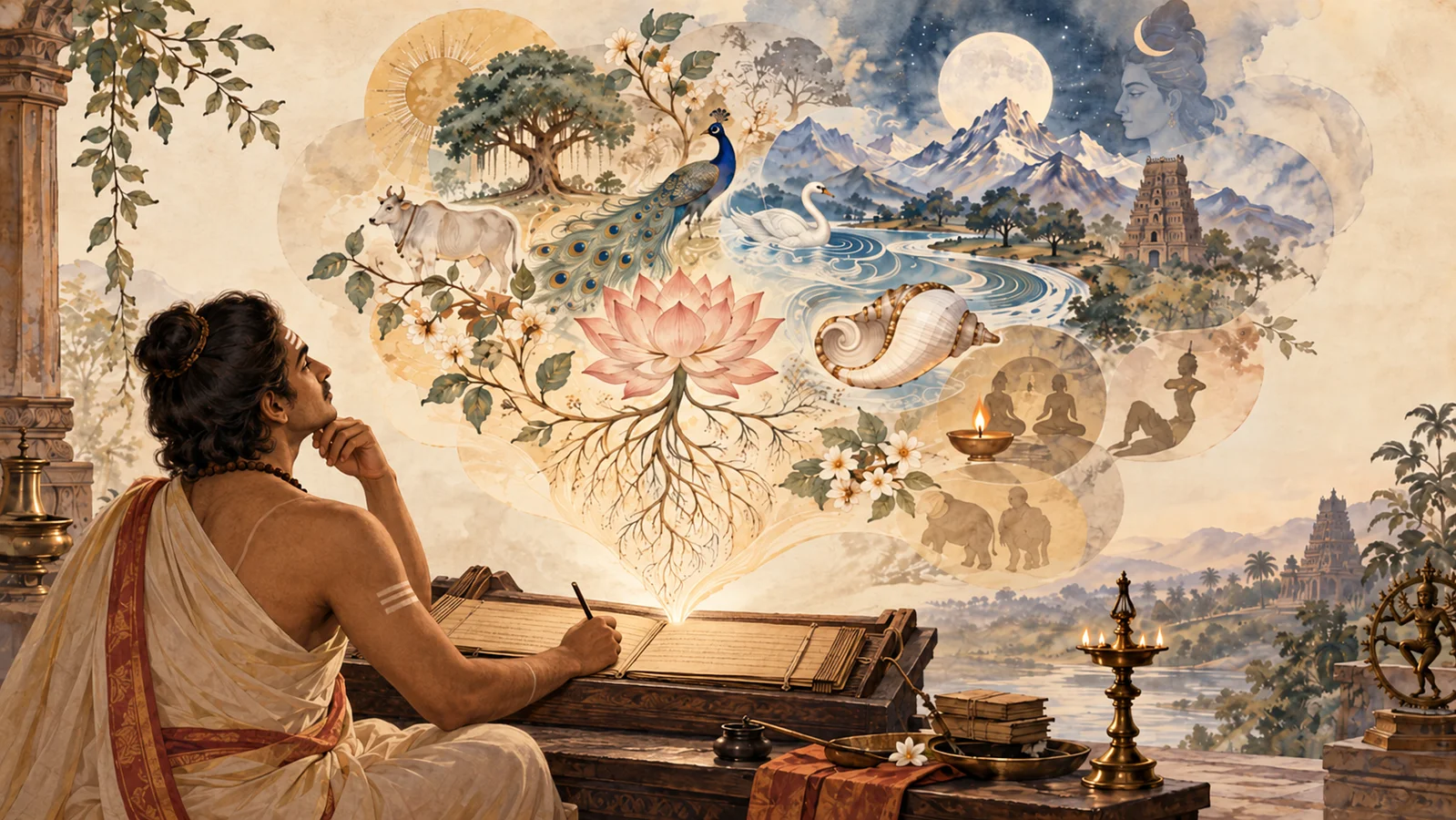
Then those words can themselves participate in further derivation and compounding. Nouns combine with other nouns. Prefixes and suffixes create new forms. Derived words become the raw material for further derived words.
Once you get there, you can keep breeding words on and on and on.
It becomes a system of interconnected possibilities.
The Lexicon Keeps Expanding
Here are a few examples of the interesting possibilities that arise when Saṃskṛta derives nouns and related forms from other nouns.
Suppose someone possesses danta, "teeth." A derivational process gives us dantī, "one who has teeth." An elephant, with its conspicuous tusks, can then be called dantī not merely because the derivation works, but because convention and usage have established the word as a name for the elephant. Again, something derivational becomes yogarūḍha through usage.
A similar process applied to a noun can generate a word meaning "descended from," "son of," "belonging to," or "connected with." Thus: Daśaratha yields Dāśarathi. Dāśarathi means a descendant or son of Daśaratha.
These are only a few examples, but they give us a sense of the range of possibilities. Saṃskṛta offers several processes of this kind, which can be applied to a noun to generate another noun related to it. Some are comparable to those found in other languages, while others are likely unique.
We looked at derivation from a broad level in Part One. If we zoom in a little, these are the kinds of details we begin to find.
When Associations Become Part of the Language
We saw a version of this in Part One with the relationship between the sun and the lotus.
The lotus opens in the presence of the sun. So if someone's face is compared to a lotus, the person who makes that face bloom with happiness can naturally be imagined as its sun.
The same relationship can move from the face to the heart.
If the heart is a lotus, another person's presence can be its sun. A devotee's heart can be imagined as a lotus, with the Lord as its sun. Or the Lord can be pictured as a bee resting on the lotus of the devotee's heart, while the devotee becomes the bee resting at the Lord's lotus feet. All of this can, of course, be expressed in a single compound, with multiple possibilities such as bhakta-hṛt-padma-bhṛṅga or bhakta-vaktrābja-sūrya, and many others.
The same basic image can keep generating new poetic possibilities.
The cultural association does some of the work for the poet. The reader already knows the relationship.
The same thing happens elsewhere.
A dark rain cloud delights peacocks.
The Lord can be the rain cloud, or the dark cloud, for the peacock that is the devotee's mind. The same metaphor can be applied in the context of two lovers. The underlying association remains available, and the poet can redirect it into different contexts.
The point isn't that there is one clever example. The possibilities keep repeating themselves. Again and again. The language gives the poet one route to describe something. Then another. Then another. Until the number of possible routes becomes enormous.
Even numbers can enter this game. Familiar objects or concepts associated with particular numbers can be used to represent those numbers.
Something traditionally associated with two can stand for 2. Something associated with five can stand for 5, and so on. Numerical information can therefore be encoded in meaningful words rather than written as bare numerals.
For example, Veda can represent four, because there are traditionally four Vedas.
A more far-fetched example is pañcatva. In a traditional conception in which death involves becoming one with the five elements, pañcatva, literally "becoming five," can serve as a term for death.
This has obvious poetic possibilities. It also has mnemonic value. And once again, the poet gains another way of saying essentially the same thing.
Now you have a good enough sense of the Saṃskṛta lexicon.
Let's look at all of this, together with the other features we saw in Part One, actually at play in some examples.
We Have Been Hearing These Since Childhood
Perhaps the nicest part is that you don't need to go hunting through some obscure mahākāvya to see any of this.
Many of us who grew up in Bhāratīya culture have been reciting Saṃskṛta ślokas since childhood. We may have memorised them before we could explain a single samāsa in them. But once you start looking at these verses as poetry, some very familiar ślokas suddenly become much more interesting.
Take this prayer to Śāradā:
शारदा शारदाम्भोजवदना वदनाम्बुजे ।
सर्वदा सर्वदास्माकं सन्निधिं सन्निधिं क्रियात् ॥(Śāradā śāradāmbhojavadanā vadanāmbuje | sarvadā sarvadāsmākaṃ sannidhiṃ sannidhiṃ kriyāt ||)
At one level, the prayer is simple enough: may Śāradā, whose face is like an autumn lotus, always remain in our mouth.
But listen to the verse a little more closely.
Śāradā is the name of the goddess. Then comes śāradāmbhoja: śārada means belonging to autumn, and ambhoja is something “born of water”—a lotus. So śāradāmbhoja is an autumn lotus. And when śāradā and śāradāmbhoja come one after another, the sound almost seems to repeat itself:
śāradā — śāradāmbhoja
The same beginning is heard again, but it now belongs to a completely different word. Then the lotus image is brought back once more in vadanāmbuje—the face, or mouth, imagined as a lotus.
So even before we get to the deeper wordplay, the verse keeps circling around the same sounds and images: Śāradā, śāradāmbhoja-vadanā, vadanāmbuja.
Then comes the repetition of sarvadā.
The first sarvadā is the familiar word: always.
But in its next occurrence, the word needs to be split differently—as sarva-dā, “the giver of everything”. So the same sound now carries two meanings at once: always and she who gives everything. This is not merely repetition for emphasis.
And then we get sannidhi.
Sannidhi ordinarily means presence or proximity. But the word can also be understood through a different division, sat-nidhi—a true or excellent treasure. So the prayer can be heard as asking Śāradā, the giver of everything, to establish her presence in our vadanāmbuja, our lotus-like mouth, as a precious treasure.
Two further associations work in the background. Śāradā is the goddess of speech, so asking her to remain in our mouth also suggests a prayer for eloquence and the ability to speak well. Moreover, the lotus is traditionally regarded as her seat. Asking her to sit in the lotus of our mouth therefore adds another layer of meaning: may our speech become a worthy seat for the goddess herself.
And there is another very familiar example.
अगजाननपद्मार्कं गजाननमहर्निशम् ।
अनेकदन्तं भक्तानामेकदन्तमुपास्महे ॥(agajānanapadmārkaṃ gajānanamaharniśam | anekadantaṃ bhaktānāmekadantamupāsmahe ||)
Again, you can simply read this as a prayer to Gaṇeśa. But look at what has been packed into these four short pādas.
Start with:
agajānana-padmārkam — gajānana...
If you hear gajānana, you naturally think of the familiar compound gaja-ānana: the elephant-faced one.
That makes agajānana sound as though it ought to mean “not elephant-faced”—the familiar a- prefix giving the opposite of a word.
But that is not what is happening.
The word can instead be split as agajā-ānana.
Aga is mountain, and agajā is “one born of a mountain”—Pārvatī, the daughter of the Himalaya. Ānana refers to face. So agajānana is not “not elephant-faced” at all. It is the face of Agajā, Pārvatī.
And then comes padmārka: the sun of the
lotus.
So Gaṇeśa is being described as the sun to the lotus-face of Pārvatī.

Why?
Because just as the sun makes a lotus bloom, the sight of her son makes Pārvatī's face bloom with happiness.
The poet could have simply said:
Gaṇeśa makes his mother happy.
Instead, we are given an image. The emotion is not stated directly; it is suggested through the relationship between the sun and the lotus. Pārvatī's face is the lotus, and Gaṇeśa is the sun that makes it bloom.
The same thing happens in the next part:
anekadantaṃ ... ekadantam
At first glance, ekadanta is familiar: the one-tusked Gaṇeśa.
And then we encounter anekadanta, which seems to suggest the opposite: one who has many tusks.
But again, the poet invites us to split the sound differently:
anekadaṃ tam
Here anekada is “the giver of many things”, and tam means “him.” So instead of anekadanta—the one with many tusks—we can hear anekadaṃ tam: "He who gives many things".
Thus the verse moves between:
agajā — gajānana
anekadaṃ tam — ekadantam
Pārvatī's face and the elephant face. The giver of many things and the one-tusked one.
The grammatical structure allows the poet to move between these possibilities without sacrificing the intelligibility of the verse. That is the sort of thing that is very easy to miss when you only read the śloka for its basic meaning.
Many other popular and semi-popular verses that many of us have heard contain striking examples of the same kind. Though we can keep going, let us stop with one more:
गोष्पदीकृतवाराशिम् मशकीकृतराक्षसम् (goṣpadīkṛtavārāśim maśakīkṛtarākṣasam)
रामायणमहामालारत्नम् वन्देऽनिलात्मजम् (rāmāyaṇamahāmālāraṭnam vande'nilātmajam)
The ratna, the precious jewel, in the great garland (mahāmālā) of the Rāmāyaṇa, the anilātmaja—the son of Anila, the wind—Hanumān. What did he do?
Goṣpadīkṛta-vārāśim begins with goṣpada, “a cow’s hoofprint,” and turns it into the action goṣpadīkaroti — “to make something like a goṣpada.” From this comes goṣpadīkṛta, “made into a goṣpada.” Applied to vārāśi, “ocean,” the compound therefore means “one who made the ocean like a cow’s hoofprint” — conveying the idea of someone for whom even an ocean was almost trivial to cross.
The same process appears in maśakīkṛta-rākṣasam. Maśaka means “mosquito”; maśakīkaroti means “to turn something into a mosquito,” and maśakīkṛta means “turned into a mosquito.” Combined with rākṣasa, we get the image of mighty demons being reduced to mere mosquitoes — something that could be crushed or dismissed with ease.
So within a single compound, we can move from noun → verb → participle → noun, and then use the resulting compound to describe the person who performed the action.
In the next part of this series, we enter the mind of a poet.

.png)