Read Part Two here
Saṃskṛtam has been part of my life since I was seven. Over the years, as I have studied it, written in it, and gradually found my way deeper into its literature, people have often asked me: what is it that I actually like about this language? My answer has very little to do with its age, or its status as a classical language. I like Saṃskṛtam because of what it allows its users to do.
Having learned and used several Indian languages, I have found beautiful features in all of them. Yet there are certain structural aspects of Saṃskṛtam that, at least in my experience, I have not encountered or heard of elsewhere in quite the same form or to quite the same extent. This article is simply an exploration of the features that make me enjoy Saṃskṛtam.
Words from Words
Perhaps the most fascinating feature of Saṃskṛtam is its extraordinary ability to build new words through compounding (samāsa) and derivation. Every language can do this to some degree, but Saṃskṛtam takes the idea to an entirely different level.
How many common words can you think of in English for water?
Perhaps water, aqua in scientific contexts, and a handful of poetic alternatives. Most speakers would struggle to name many more.
Saṃskṛtam begins very differently. Even among its most common vocabulary, water has numerous names: jala, ambu, nīra, salila, toya, vāri, ap, and many others. These are not obscure dictionary curiosities but words that occur naturally throughout the literature.
Now consider the lotus.
It can, of course, be called by its more direct names, such as padma or kamala. But since a lotus is "born in water," any word meaning "water" can simply take the suffix -ja ("born from") to produce another perfectly natural name for the flower.
-
Ambuja – born in water
-
Jalaja – born in water
-
Nīraja – born in water
-
Abja – born in water
-
Saroja – born in a lake
-
Sarasija – born in a lake
Each literally means "water-born," yet each naturally refers to a lotus.
Nor is -ja the only possibility. Other derivational suffixes can produce equally valid names. The language is not offering a single way to coin a word, but an entire system for generating them.
The network does not stop there.
Since the lotus blooms with the arrival of the sun, the sun can be described through its relationship with the lotus. It becomes the lotus's friend, beloved, or lord.
Thus we get expressions such as:
-
Padmabandhu
-
Ambujabandhu
-
Sarojabandhu
-
Padmapriya
-
Ambujapriya
-
Sarojanātha
All of these ultimately refer to the sun.
The lotus is also one of the most common metaphors for beauty, especially for the eyes. Therefore, any of these names for the lotus can become part of expressions describing a beautiful person or a deity.
-
Padmanayana
-
Kamalanayana
-
Sarojākṣi
All simply mean "the lotus-eyed one."
Notice what has happened.
Water gives rise to the lotus.
The lotus gives rise to the sun.
The lotus also gives rise to beautiful eyes.
This is not a simple linear chain. Each idea becomes a branching point from which many further expressions can emerge.
An ocean has more direct names, such as samudra and sāgara. But it may also be described through its relation to water, allowing many of the words for water to generate additional names for the ocean, such as jaladhi and vāridhi. Those, in turn, become available for further compounds.
Suppose a poet wishes to speak of an "ocean of compassion." There are numerous words for compassion—karuṇā, dayā, kṛpā, and others—and numerous ways of referring to an ocean. The possible expressions multiply rather than merely add.
Seen mathematically, the system is combinatorial. Every synonym, every productive suffix, and every semantic relationship becomes another branching point from which still more words can be generated. A comparatively small stock of roots gives rise to an astonishingly large expressive vocabulary.
This is one remarkable consequence of Saṃskṛtam compounding: it allows the language to breed words from words, creating an extraordinarily rich and interconnected semantic network.
How Far Can the Chain Go?
The ability to generate new vocabulary is only one side of the picture.
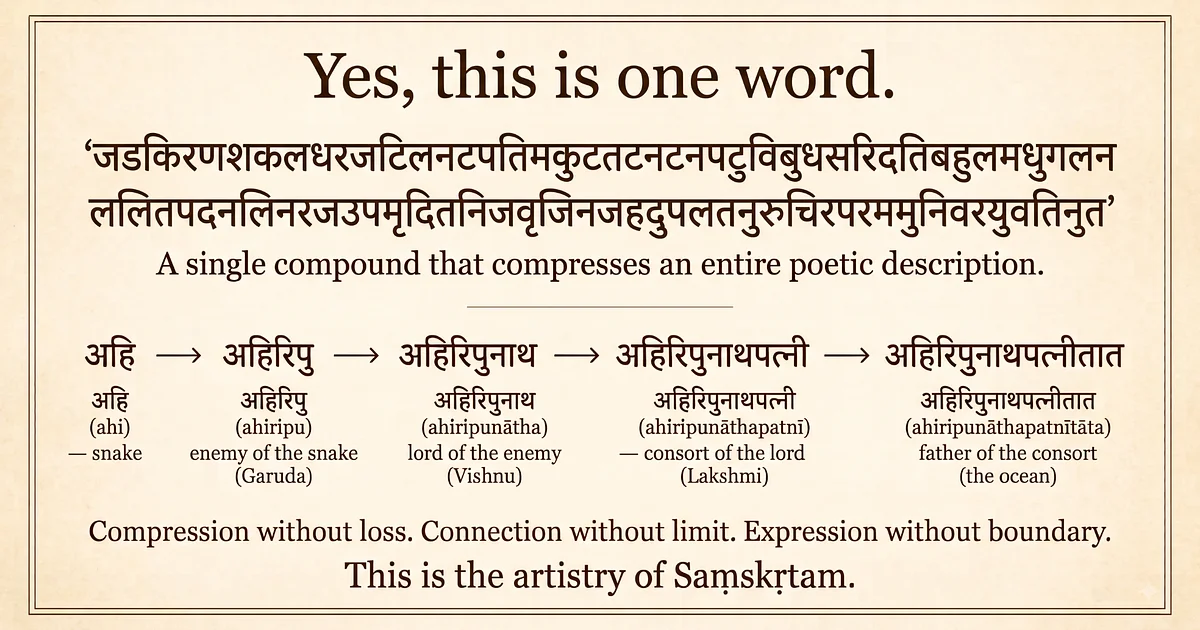
The very same machinery of compounding can also do something far more ambitious. It can keep extending relationships without any fixed stopping point, eventually compressing what would otherwise require entire phrases, sentences, or even narratives into a single grammatical word.
The simplest examples already illustrate the idea.
In English, we say "the son of Rāma," requiring three words and a connecting preposition. Saṃskṛtam simply combines the ideas into Rāmaputra.
If we wish to say "the enemy of the son of Rāma," we obtain Rāmaputraśatru.
"The friend of the enemy of the son of Rāma" becomes Rāmaputraśatrumitra.
The language simply keeps extending the compound without requiring additional connecting words.
Entire chains of relationships can be built into a single word.
Suppose we begin with the word ahi (snake).
The enemy of the snake is Garuḍa. Thus expressions such as:
-
Ahiripu
-
Sarpaśatru
-
Nāgāri
all refer to Garuḍa.
Now Garuḍa has a lord: Viṣṇu.
So one may continue with expressions such as:
-
Ahiripupati
-
Sarpaśatrunātha
which now refer to Viṣṇu.
Viṣṇu has a consort: Lakṣmī.
So the chain may continue further:
-
Ahiripupatikāntā
-
Sarpaśatrupatipriyā
which now refer to Lakṣmī.
Nothing forces the sequence to stop there. One relationship naturally leads to another, then another, and then another. Eventually, the final word may denote an entirely different entity while preserving every intermediate relationship within it.
When an Entire Story Becomes One Word
This process reaches its most spectacular expression in works such as the Raghuvīra Gadyam.
There, a single compound may contain a long succession of qualifying expressions.
Instead of merely saying "Rāma," the poet successively identifies him as:
-
the one who...
-
who accomplished...
-
who defeated...
-
who broke...
-
whose opponent was...
-
whose bow belonged to...
Each descriptor becomes another layer of the compound until, after narrating an entire sequence of events, the whole construction still functions grammatically as a single word whose referent is simply Rāma.
The word has not become shorter. In fact, it has become astonishingly long. Yet grammatically it remains a single lexical unit.
To appreciate just how unusual this is, imagine a compound that begins by describing Śiva, the owner of the bow Pināka. It then identifies Rāma as the one who broke that bow. Next it introduces Rāvaṇa, followed by Kārtavīryārjuna, who had defeated him, and finally Paraśurāma, who had defeated Kārtavīryārjuna along with countless Kṣatriyas. After carrying the reader through this chain of relationships, the compound finally arrives at its true referent: that Rāma before whom even Paraśurāma stood astonished.
What would require an entire sentence—or even several sentences—in English can, technically speaking, be expressed as a single compound word in Saṃskṛtam.
A beautiful literary example occurs in the Nārāyaṇīyam, where the entire backstory of the Bhikṣu Gītā is compressed into a single compound:
कश्चित् क्लेशार्जितार्थक्षयविमलमतिः
(kaścit kleśārjitārthakṣayavimalamatiḥ)
Literally, the compound means, "a certain man whose mind became purified through the loss of wealth that had been acquired with great hardship."
But the compound does far more than merely stack nouns together. It embeds an entire causal sequence. The wealth (artha) is qualified as having been painfully earned (kleśārjita). That wealth is then qualified by its loss (arthakṣaya). The loss, in turn, becomes the cause of a purified mind (kṣayavimalamatiḥ). Within a single lexical unit, the poet evokes the decisive turning point of the narrative: a miser who had accumulated wealth through relentless effort loses everything, and that very loss becomes the occasion for spiritual awakening.
Unlike compounds such as Rāmaputraśatrumitra, where each member simply extends a chain of relationships, क्लेशार्जितार्थक्षयविमलमतिः compresses an entire sequence of causes and consequences into a single lexical unit. Rather than merely linking nouns together, it embeds a miniature narrative within the structure of a single word.
Engineering Beauty
Poetry is not only about meaning.
It is also about sound.
Saṃskṛtam gives poets an extraordinary degree of control over how a verse feels when recited.
The language's rich system of derivation, compounding, inflection, and sandhi allows a poet to consciously engineer rhythm and auditory texture.
Suppose I want a verse in which almost every significant word ends with the same sound, perhaps because I want the recitation to resemble the rhythmic strokes of a mṛdaṅga.
Saṃskṛtam offers many independent grammatical routes to achieve exactly that.
Let us say I choose the sound -e (ए), as in the vowel of "they."
Most ātmanepada verb forms naturally end with that sound.
The locative (saptamī) forms of akārānta masculine nouns do the same.
The vocative forms of ākārānta feminine nouns also end identically.
Neuter dual forms provide yet another possibility.
Each belongs to a different grammatical category, yet all of them can converge on the same sonic pattern.
The result is that a poet can compose a verse like this:
वन्देऽहन्तेऽनन्ते सुपदरविन्दे विन्दे शन्तेऽतुलसुखकन्देऽमन्दे स्पन्दे शुभकरि बहुदयहृदययुते॥
vande'hante'nante supadaravinde vinde śante'tulasukhakande'mande spande śubhakari bahudayahṛdayayute.
This verse praises a goddess, bowing to her lotus-like feet while also speaking of her divine spanda (vibration or pulsation).
What makes the verse especially elegant is that nearly every descriptive word can be interpreted in multiple ways.
Each adjective may be understood as feminine, in which case it directly describes the goddess herself. The very same forms may also be interpreted as neuter dual, referring instead to her two feet. Alternatively, they may be read as masculine locative forms qualifying spande ( in the vibration"), expressing the idea of rejoicing in or contemplating that divine vibration.
Because Saṃskṛtam requires adjectives to agree with the nouns they qualify in gender, number, and case, each interpretation naturally produces exactly the same surface form.
For example:
-
अनन्ते (anante)
-
Feminine vocative: "O Infinite One!"
-
Neuter dual: "the two infinite lotus feet."
-
Masculine locative: "in the infinite vibration."
Exactly the same word supports all three readings.
Similarly,
-
अतुलसुखकन्दे (atulasukhakande)
-
"O unsurpassed source of bliss!"
-
"the two feet that are the unsurpassed source of bliss."
-
"in the vibration that is the unsurpassed source of bliss."
Likewise,
-
अमन्दे (amande)
-
"O unfainting, vigorous One!"
-
"the two feet that are ever vibrant and unceasing."
-
"in the powerful, undiminished vibration."
This gives the poet tremendous freedom to create rhymes.
The repeated -e endings create a striking rhythmic texture while simultaneously allowing multiple layers of meaning to coexist.
These are not forced puns. They arise naturally from the language's grammatical architecture.
The poet simply learns to use every possibility that the language provides.
Freedom of Word Order
Only after appreciating the richness of individual words does another remarkable feature become apparent: Saṃskṛtam's relatively free word order.
Unlike English, where changing the order of words often changes the meaning or produces an ungrammatical sentence, Saṃskṛtam relies primarily on case endings to indicate grammatical relationships.
Because those relationships are explicitly marked, words can often be rearranged with considerable freedom while preserving the same underlying meaning.
For poetry, this is invaluable.
If a word fits better at the beginning of a metrical line, it can be placed there.
If a different arrangement produces a more pleasing rhythm, that is equally possible.
If moving two words farther apart creates a more elegant alliteration, the poet is free to do so.
Meaning remains intact while aesthetics take the driver's seat.
The result is that meter, rhythm, alliteration, and emphasis can often be refined without sacrificing grammatical correctness. Rather than forcing the poet into a particular word order, the language offers a wide range of possibilities from which the most beautiful arrangement can be chosen.
The Art of Sandhi
Perhaps my second favourite playground in Saṃskṛtam, after samāsa, is sandhi.
Words merge together according to precise phonetic rules, creating continuous streams of sound. Yet those same streams can often be segmented in multiple legitimate ways.
A poet can deliberately exploit this.
The most obvious division may produce one meaning.
A different division may produce another.
Sometimes the first interpretation appears completely nonsensical until the reader discovers the intended segmentation.
At other times, both readings are perfectly meaningful.
This possibility opens the door to one of Saṃskṛtam literature's most fascinating literary devices: śleṣa, the art of simultaneous meaning.
A single verse may narrate two entirely different stories depending on how its compounds are interpreted and where the sandhi is split. The language itself provides the raw material; the poet merely learns to arrange it creatively.
Consider the following verse:
सर्वदो माधवः पातु यो गङ्गां समदीधरत्।
(sarvado mādhavaḥ pātu yo gaṅgāṃ samadīdharat.)
The most natural segmentation is:
सर्वदः माधवः पातु । यः गङ्गां समदीधरत्।
(sarvadaḥ mādhavaḥ pātu | yaḥ gaṅgāṃ samadīdharat.)
This gives the meaning:
"May Mādhava, the giver of everything, protect me, he who bore the Gaṅgā."
At first glance, this seems puzzling. Mādhava refers to Viṣṇu, whereas it was Śiva who bore the Gaṅgā in his matted locks.
The solution is to split the words differently:
सर्वदा उमाधवः पातु । यः गङ्गां समदीधरत्।
(sarvadā umādhavaḥ pātu | yaḥ gaṅgāṃ samadīdharat.)
Here, Umādhava means "the husband of Umā," that is, Śiva. The verse now makes perfect sense:
"May the husband of Umā always protect me, he who bore the Gaṅgā."
The elegance lies in the fact that both segmentations produce exactly the same continuous sound.
- सर्वदः + माधवः (sarvadaḥ + mādhavaḥ) becomes सर्वदो माधवः (sarvado mādhavaḥ), since the visarga before the voiced consonant म (ma) changes to ओ (o).
- सर्वदा + उमाधवः (sarvadā + umādhavaḥ) likewise becomes सर्वदोमाधवः (sarvadomādhavaḥ), because आ + उ (ā + u) coalesce into ओ (o) by vowel sandhi.
Thus, whether the underlying words are सर्वदः माधवः (sarvadaḥ mādhavaḥ) or सर्वदा उमाधवः (sarvadā umādhavaḥ), the listener hears the identical sequence सर्वदो माधवः (sarvado mādhavaḥ).
But the wordplay does not end there.
Even retaining the first reading, सर्वदः माधवः, we may reinterpret the second half. Instead of reading:
यः गङ्गाम्(yaḥ gaṅgām)
we may divide it as:
यः अगम् गाम्(yaḥ agam gām)
Here, aga means mountain, while gām means the Earth. Owing to sandhi, the initial a of agam disappears after yaḥ, so both readings yield the identical phonetic sequence यो गङ्गाम्(yo gaṅgām).
The verse can now be understood as referring to Viṣṇu: Kṛṣṇa, who lifted Govardhana, or Viṣṇu in his Varāha incarnation, who raised the Earth.
Thus, the very same sequence of sounds admits two perfectly valid interpretations:
-
yaḥ gaṅgām → "he who bore the Gaṅgā," referring to Śiva.
-
yaḥ agam gām → "he who bore the mountain and the Earth," referring to Viṣṇu.
Not a single letter changes. Only the segmentation does.
We encountered the same phenomenon earlier with the sequence vande'ham te. Read as vande aham te, it means, "I bow to your..." The object is completed later in the verse, yielding the meaning, "I bow to your lotus feet."
But if the sounds are grouped differently so that ahante is taken as a single word, it becomes an epithet of the Goddess as the embodiment of ahaṅkāra. The very same sequence of sounds thus carries an entirely different layer of meaning.
Literature That Should Be Impossible
Once all these freedoms come together, Saṃskṛtam begins to produce works that almost seem impossible.
One famous example is Rāghavayādavīyam, whose verses can be read in opposite directions to narrate two different epics, one associated with Rāma and the other with Kṛṣṇa.
There are verses in which the most obvious sandhi division yields an absurd interpretation, while a less obvious division suddenly reveals a perfectly coherent one.
There are verses that simultaneously praise two different deities.
There are verses that tell two different stories using exactly the same sequence of sounds.
These works are often described as literary feats or intellectual acrobatics, and rightly so. Yet what fascinates me even more is that none of them violate the language. They are not exceptions to Saṃskṛtam's grammar. They are made possible by it.
A Glimpse into a Remarkable Language
For someone who loves language itself, Saṃskṛtam often feels less like a tool for communication and more like a remarkably sophisticated system for constructing ideas, sounds, meanings, and patterns.
Its grammar gives you freedom.
Its compounds let you think in layers.
Its sandhi lets meanings intertwine.
Its flexible word order lets poetry breathe.
And when all of these come together, the language becomes capable of feats that still surprise me every time I encounter them.
This is only one reason I like Saṃskṛtam. I hope this is just the first of several reflections, and that I'll be able to articulate some of the other reasons soon as well.
Continued in Part Two

.png)