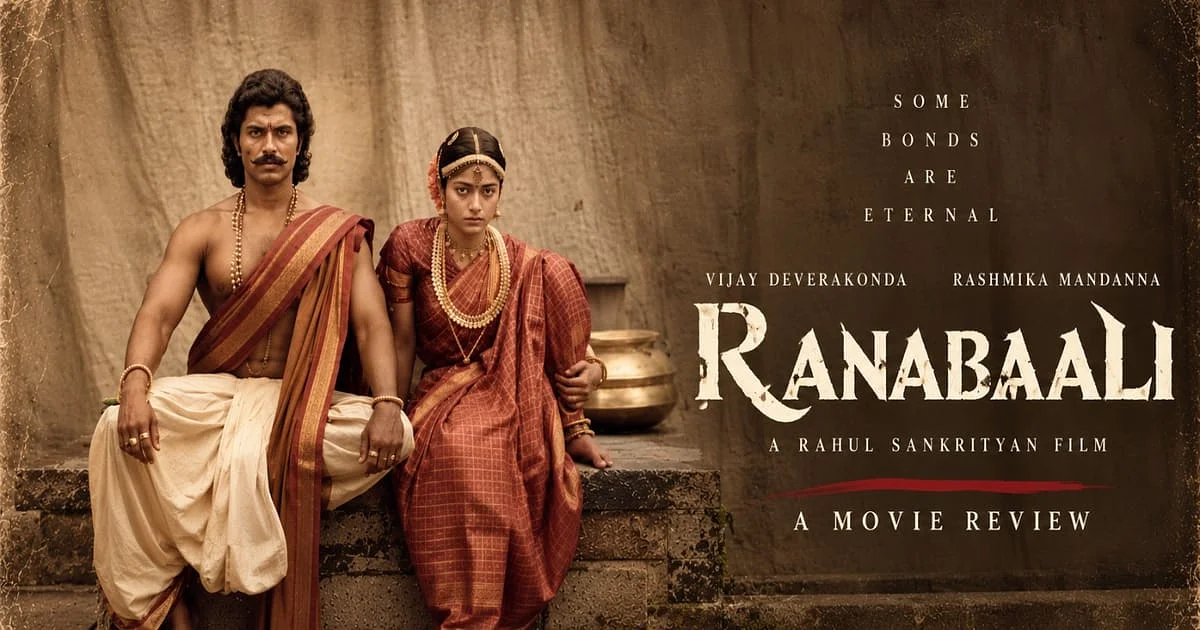
Note: Ranabaali, directed by Rahul Sankrityan, is a Telugu movie set in the 1870s. The movie, currently in theatres, stars Vijay Deverakonda and Rashmika Mandanna in the lead roles.
The Great Famine of 1876-78 India put 58.5 million people in distress across the Madras, Punjab, and Bombay presidencies, as well as in the princely states of Mysore and Hyderabad. Burdened with heavy taxation and hunger, innumerable carcasses of Indians lay ready to be feasted upon by vultures.These artificial famines caused between 5.6 and 9.6 million deaths. While it raged, Viceroy Lytton oversaw the export to England of a record 6.4 million hundred weight of wheat. In January 1877, Sir Richard Temple cut relief rations to one pound of grain (450 gms) and one anna a day for a working man, this came to be known as the “Temple wage” [1]. Mike Davis later set its 1,627 calories against the 1,750 of the Buchenwald diet [2]. The treatment of the Indians during famine is recorded as worse off in its nutritional diet aspect with respect to the 'Jews in Nazi Germany', yet we hear nothing about this horrifying state of affairs.
Temple, who was criticised for excessive expenditure on charitable relief during a previous famine, was appointed by the Viceroy of India as a plenipotentiary famine delegate to Madras during the famine of 1877. Seeing this appointment as an opportunity to retrieve his reputation, Temple implemented new relief policies which ultimately failed to relieve widespread starvation. Temple’s own principle was that ‘everything must be subordinated to the financial consideration of disbursing the smallest sum of money’ [2].
This is the history that is missing from our school textbooks; this is the history that the Raj buried. Anyone who wants to know what the 1870s did to the Deccan should watch Ranabaali on large screen, and give it the time and patience that a village gives to burra kathā (a storytelling form from Andhra), that runs past midnight. In the two plus years it took to research this film, it has drawn upon archival material and historical references, taking into account regional folklore too to celebrate the unsung heroes of the Rayalaseema area and its rich cultural identity, including the revered folk figure of Ranabali Murugan.
Viewers who prefer muted palettes and tasteful violence might find this jātara of a film tad loud, excessively red, and unequivocally unembarrassed by its devatās and its bali. The people of Singanamala (and Madras Presidency) though, both real and imagined, lived through the famine. Three hours in a cinema theatre does not even put a small dent in the huge debt we owe our ancestors for the inhuman sufferings they endured to give us life.
Ranabaali or Raṇabāli (Raṇabali Murugan is an attested deity name associated with a temple at Peruvayal, Ramanathapuram, Tamil Nadu, the film’s different spelling with ‘bāli’ instead of ‘bali’ could be the way some Telugus refer to Lord Kārtikeya). Here, the director seems to be referring to one who is strong in war and also a war sacrifice. Pronounced with the retroflex ṇ and the long ā, not ‘Ranabalee’ or ‘Ranaabali’ or ‘Raaṇabali’, Raṇabāli is a fictional character, a composite of three Rayalaseema (Seema) men. Rahul Sankrityan, the director, etches his hero based on the lived experiences of: Gadekal Bobbili Nagireddy, Budda Vengal Reddy of Uyyalawada, who gave away about 140,000 kg of his grain and fed more than 16,000 people a day during the Kshaya famine of 1866, and Uyyalawada Narasimha Reddy, the poligar who led the 1846 revolt against the East India Company’s revenue settlement and was hanged at Koilkuntla in February 1847.
दुर्भिक्षे राजा बीजभक्तोपग्रहं कृत्वानुग्रहं कुर्यात्दुर्गसेतुकर्म वा भक्तानुग्रहेण भक्तसंविभागं वा देशनिक्षेपं वा ॥
Arthaśāstra (4.3.17) tells us that a king facing famine must advance seed and food, must employ the hungry on forts and waterworks for food wages, must share the royal stores, or move people to better-supplied land. This is the rājadharma that the Raj abandoned. Accounts of several Hindu kings establishing royal granaries, providing tax remissions, free grain distribution during famines, droughts etc., are well recorded in our oral and written traditions. In sharp contrast, these famines were man-made disasters, engineered by the British in power and forced upon their Indian subjects. The film’s promotional conversation in which Sankrityan and Vijay Deverakonda sit down with J. Sai Deepak and K. Annamalai, lays out the political backdrop in detail for anyone who wants to learn more about this overlooked chapter of our history.
Sankrityan’s previous film, Shyam Singha Roy (2021), was handsomely made but was problematic for its colonial gaze. Thankfully, with Ranabaali he turns that gaze around, and to do this, the director skillfully adopts many classical tropes and wholesome bhāratīya aesthetics.
Nāṭyaśāstra presents two modes of representation (6.24): lokadharmī, realism, which follows the ways of the world, and nāṭyadharmī, stylized, which follows the conventions of the stage.
लोकधर्मी नाट्यधर्मी धर्मीति द्विविधः स्मृतः । भारती सात्वती चैव कैशिक्यारभटी तथा ॥
Ranabaali’s lokadharmī is strong. This is cinema as high art; it is not a freedom-struggle film but a portrait of a forgotten Rayalaseema, an ode to the land and its people, which uses burra kathā to showcase how oral memory keeps its heroes alive. The film also cuts its fiction against real Sepia photographs of the 1876–78 famine, which blur the line between fact and imagination, history and myth.
With a backdrop of the gorgeous Gandikota gorges and the scrub of the Seema shot spectacularly in earth tones by Nirav Shah, the landscape itself dons a special character. Ajay-Atul’s songs carry real poetry and do the work of a burra kathā’s sung narration, drawing the audience into a frightening ride. The film holds onto the Seema accent throughout, and every costume, down to the extras’ drapes, looks worn and authentic.
The film’s British cast seem one-toned and their dialogue delivery caricaturish but the lead pair and the supporting actors all perform with conviction and sincerity. Shivam Rao Nagasani’s production design recreating the late 1870s of the British-governed India, focusing heavily on the architecture and rustic atmosphere of Rayalaseema stands out. The nāṭyadharmī aspect makes its appearance in the slow-motion sequences and in the stylised cave fight for example, enticing those who appreciate a higher pitch in storytelling. Mythri Movie Makers must be commended for taking on such a risky project. In an era where the audience is hooked on two minute reels, it takes courage to back a three hour long film.
We have a film here that is shaped by itihāsa and purāṇa. The frame used in this film is burra kathā, which grew out of the jaṅgama kathā of wandering Śaiva singers. Its modern three-voice form took shape in Guntur around 1942 to carry political ideas to village audiences, and troupes still perform the Rāmāyaṇa and the Mahābhārata during Daśaharā and Saṅkrānti . Sankrityan has said he built the narrative to carry ‘the flavour of a burrakathā’. Released for Dasara (how the Telugus spell it), Ranabaali wishes to be heard the way a village hears its epics, as memory reworked for the present.
The film borrows a lot from our epics. A stillborn son returned to life at his mother’s demand reminds us of Parīkṣit, born dead from Aśvatthāmā’s weapon and revived by Kṛṣṇa at the pleading of the women of the household. A life that runs on borrowed time is similar to the story of Mārkaṇḍeya, who was granted a mere sixteen years, and of Satyavān, fated to die within a year.
Indian religious life has always held the mārga, the classical and textual, alongside the deśī, the regional and local. The grāmadevatā of Rayalaseema, the Gangammas and Polerammas, belong to the second stratum, and the jātara with its blood offering is how a village keeps its covenant against drought and epidemic. The film shows the annual bull ritual in full and without embarrassment. Viewers who flinch at it must ask themselves whether their discomfort is moral or merely metropolitan.
As for the film’s depiction of women, Indian epics’ strongest women seldom carry weapons. We have Kuntī, Gāndhārī, Draupadī and Sāvitrī, who act through speech, vow and endurance. Jayamma belongs to this category. She resists her husband’s bravado, argues with him, falls in love on her own terms, assists him, and carries the household’s future. While Ranabaali’s mother, who wrests his life from death, shields her daughter-in-law even from her own son! And to be noted especially is how the mother-in-law and daughter-in-law share a sweet bond that goes against the grain of the popular saas-bahu serials.
Nāṭyaśāstra states that rasa arises when causes (vibhāva), outward signs (anubhāva) and passing states (vyabhicāri bhāva) come together in the viewer. Ranabaali has the vīra (heroic) rasa where the hero’s strength serves the hungry, it has karuṇa (pathos) rasa depicting the famine itself, śṛṅgāra or love of course is strongly depicted by the newly weds Vijay Devarakonda and Rashmika Mandanna, interspersed with raudra and bībhatsa, fury and revulsion, directed against colonial control.
Ānandavardhana, the Saṃskṛta scholar, is of the view that a work should keep one rasa as its principal (aṅgī) and set the others beneath it (aṅga). For a famine film the principal rasa here is karuṇa, with vīra rasa being its redemption, while raudra and bībhatsa especially in the second half enhance the karuṇa rasa for us. Above all it is śṛṅgāra though, with its playfulness and longing, that stays with us.
Valour in itself can decline into bravado, but in service of another it becomes sacred sacrifice. Love and peace must, in the end, triumph over war and strife. After all, why do we wage wars? What higher purpose do they serve? What is that we want to establish after we win them? Peace, harmony, beauty, aesthetics, philosophy- these are all possible only when there is abundance of time and attention. Poetry overflows when there is prosperity. None of these are possible without a stable family unit, the basis of society, of culture, of all civilization. Ranabaali starkly depicts this conundrum; one must shed blood to safely continue one’s bloodline. In the interim if there is fleeting romance and unexpected love by the blessings of the gods, so be it.
And this is depicted beautifully via Saraswatiputra Ramajogayya Sastry’s lyrics, rendered melodiously by Shweta Mohan and Ajay Gogavale in “Endhayya Saami”:
ఏందయ్యా సామి ఇట్ట గాస్తాంది ఎన్నెల..
ఊపేస్తా ఉంది సిత్తరాల ఉయ్యాలా..
వీచేగాలికి అత్తరద్దిందెవ్వరో..
మారే జాముకి మందు పెట్టిందెవ్వరో
మాయదారి మనస్సాగాక జాగరమయ్యారా
తడిసిపోయారా… తడి మెరిసిపోయారా…
నీ చిలిపి కలల్లో… ఒళ్ళు మరిసిపోయారా
తడిసిపోయారా… తడి మెరిసిపోయారా…
నీ చిలిపి కలల్లో… ఒళ్ళు మరిసిపోయారా
Endayya Sami Itta Gastandi Ennela
(Oh Lord, why is the moonlight haunting me like this?)
Upesta Undi Sittarala Uyyala
(This magical swing is swaying me so intensely.)
Vichegaliki Attaraddindevvaro
(Who applied this sweet perfume to the blowing wind? )
Mare Jamuki Mandu Pettindevvaro
(Who slipped a love potion into the passing night?)
Mayadari Manassagaka Jagaramayyara
(Unable to control my restless mind, I’ve stayed awake all night)
Tadisipoyara Tadi Merisipoyara
(I’ve been drenched, and this wetness is shining brightly,)
Ni Chilipi Kalallo Ollu Marisipoyara
(losing myself completely in playful dreams of you.)
Despite constant allegations of sticking to formulaic depictions on the silver screen, Telugu Film Industry has time and again proven naysayers wrong by coming up with ‘out of syllabus’ movies. This year itself we have had Sing Geetham, Maa Inti Bangaaram, Rao Bahadur, Garividi Lakshmi and others.
This film deserves to be seen by non-Telugu audience too, and the filmmakers ought to consider releasing it in all Indian languages on a pan-India level. While the OTT partner is Netflix and many might plan to wait for digital streaming, Ranabaali’s visual depiction of an important yet disturbing phase of our history deserves a theatrical watch.
References and Notes:
-
Washbrook 1994, p. 145, Imperial Gazetteer of India vol. III 1907, p. 489
-
Note: Late Victorian Holocausts: El Niño Famines and the Making of the Third World is a 2000 book on history by Mike Davis about the connection between political economy and global climate patterns, particularly the impact of colonialism. He characterizes the Indian famines that took place under colonial rule as a genocide. In the statement made in the article, Davis compares the nutritional diet offered to Indian labourers under the British Raj with the nutritional value of food offered to the interned Jews in holocaust camps which was termed the “Buchenwald Diet”, and shockingly the Indian diet falls short by a significant margin.
Source: Mike Davis, Late Victorian Holocausts: El Niño Famines and the Making of the Third World Verso, 2001; calories for Buchenwald diet: 1750; Temple wage: 1627. Both involved hard labour (p.39); Temple's remark on financial considerations p.40