Introduction
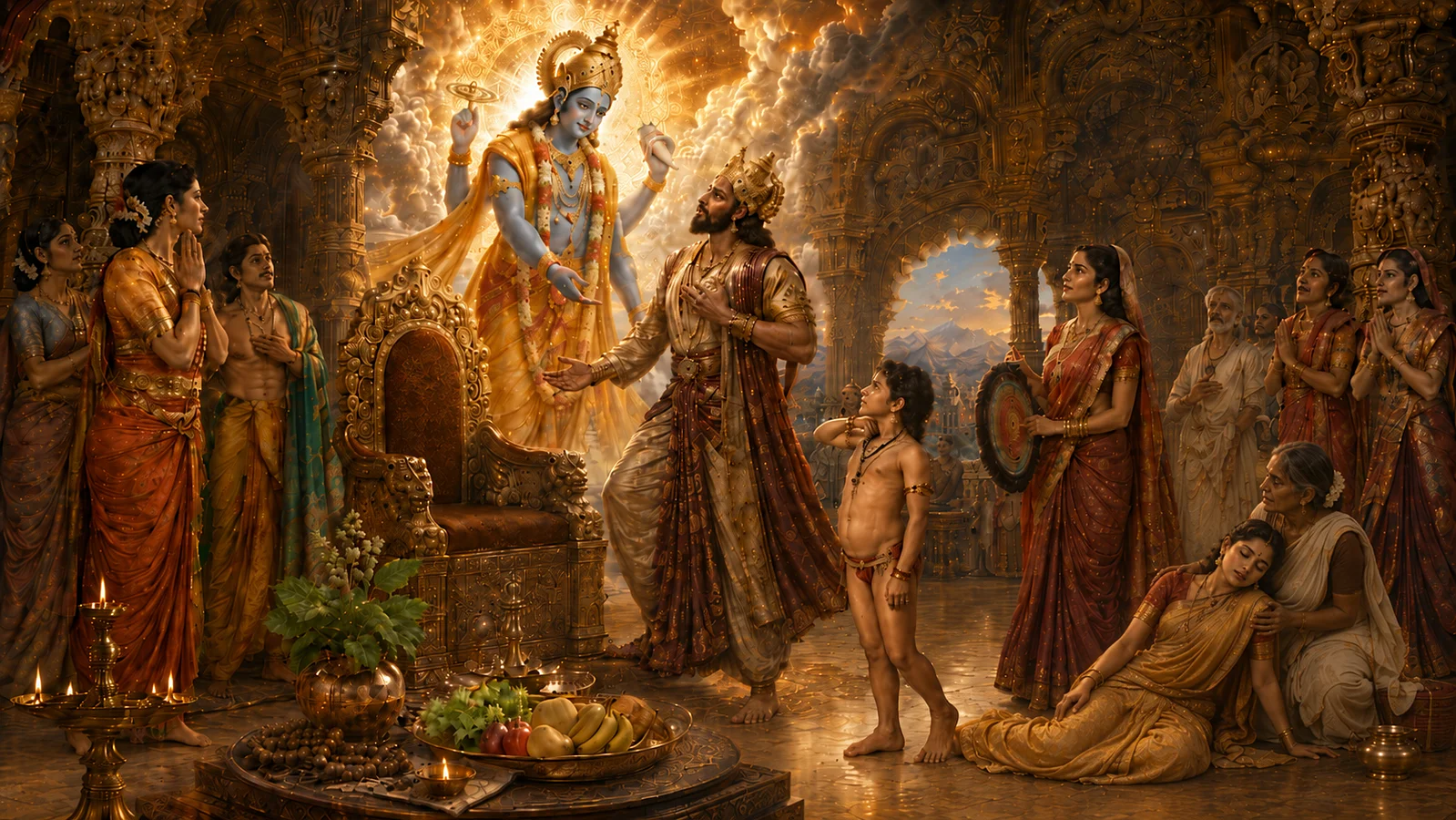
The historic chronicle of King Rukmāṅgada from the Nārada Purāṇa tells us of a king who is a staunch devotee of Bhagavān Viṣṇu and deeply committed to the observance of the Ekādaśī vrata dedicated to the deity, a sacred discipline associated with restraint, devotion, and the turning of the mind toward Bhagavān.
But like many stories from the Paurāṇika corpus, the tale does not remain confined to one plane. It is also about power. It is also about institutional balance.
The story of Rukmāṅgada provokes a profound dhārmika meditation on leadership.
The Devout King and His Kingdom
Rājā Rukmāṅgada’s strict observance of the Ekādaśī vrata dedicated to Bhagavān Viṣṇu, was also mandated to be performed by his entire kingdom through a royal decree. And, anyone who failed to observe it, was punished.
So far, the scene appears deeply sāttvika.
A king devoted to a Vaiṣṇava vrata.
A kingdom aligned with discipline.
A people habituated to restraint.
A social order where even animals are said to abstain from indulgence.
But the Purāṇic imagination rarely allows us to remain at the surface. It pushes us to ask deeper questions.
The Problem of Mandated Virtue
Rukmāṅgada’s personal discipline became state policy. This is where the difficulty begins.
A vrata, by its very nature, is meaningful when it is undertaken with śraddhā, discipline, and inner intention. When one fasts on Ekādaśī dedicated to Bhagavān Viṣṇu, the act is not merely biological abstinence from food or indulgence. It is meant to be a conscious redirection of desire. It is a training of the senses, mind, and will. It is an offering to the divine.
But when the same observance is imposed through fear, the inner meaning as well as the offering, both are weakened. This has far reaching implications. And, this is the central warning of the story.
Disruption of Ṛta
The consequences of Rukmāṅgada’s mandate is also cosmic.
The story tells us that the universal order - Ṛta, itself was disturbed. In Indic thought, ṛta refers to the underlying order of reality. It is the cosmic rhythm by which things hold together. Dharma, at the human level, must be aligned with ṛta. The natural rhythm of karma, consequence, death, judgment, and rebirth was disrupted by King Rukmāṅgada’s mandate.
All the jīvātmas from Rukmāṅgada’s kingdom were immediately transported to Vaikuṇṭha (Bhagavān Viṣṇu’s abode) after death, regardless of the actual quality of their lives or karmas.
This is a startling image.
People who had not necessarily cultivated virtue, wisdom, devotion, or self-mastery attained the highest destination merely because they had externally observed a vrata under compulsion.
The moral architecture of the universe was destabilized. The link between action, intention, consequence, and spiritual attainment was distorted.
A ruler is not free to redesign the moral universe according to personal preference, however noble that preference may appear.
Yama Without a Role
One of the most striking consequences of King Rukmāṅgada’s rule was that Yama - Dharma Rājā, was rendered functionless in his kingdom.
This is not a small detail.
Yama is not simply a god of death in the crude sense. He is Dharma Rājā - the lord associated with justice, consequence, moral accounting, and the orderly passage of beings according to their karma. His function is not arbitrary punishment. It is part of the cosmic administration of justice.
When every being, whether deserving or undeserving, from King Rukmāṅgada’s kingdom was sent to Vaikuṇṭha regardless of inner merit, Yama’s role was suspended and Vaikuṇṭha was getting crowded.
This is where the story becomes a powerful lesson in institutional thinking.
A system that depends entirely on the ruler’s will becomes fragile. It is structurally unstable. It bypasses roles, responsibilities, checks, and balances that exist for the welfare of the whole.
Yama’s displacement shows that even devoted enthusiasm, when absolutized and not applied in a dhārmika manner, can become disruptive.
A dhārmika order is sustained by the right functioning of multiple roles within a larger order.
The Dangers of Individual-Dependent Governance
Dharma is about the right proportion, right role, right timing, right qualification, and right process.
A system built around the personality of one ruler, becomes arbitrary and volatile. It depends excessively on one person’s conviction, preference, and authority. It may work while that person is present, but it lacks sustainability, as the next one who occupies the position might or might not be an ideal human being and would dictate as per his will because the precedent has been set.
Ethical statecraft requires good institutions apart from a good leader.
It requires clarity of roles.
It requires processes that do not collapse when one individual leaves.
It requires humility before the larger order of dharma.
Rukmāṅgada’s kingdom became individual-dependent. It was not the result of a mature social and spiritual ecosystem, but of a top-down mandate. This made it unstable, even if its immediate appearance seemed sāttvika.
Plurality Within Sanātana Dharma
The story also raises another critical issue: the plurality of Sanātana Dharma.
Dharma has always held within itself a multiplicity of saṃpradāyas, practices, disciplines, philosophies, ritual forms, deities, vows, and paths.
There are householders and there are also renunciates.
There are Śaiva, Vaiṣṇava, Śākta, Smārta, Gāṇapatya, Saurya, and many other streams.
There are paths of devotion, knowledge, action, mantra, yoga, ritual, service, and contemplation.
There are differences of adhikāra, stage of life, temperament, family tradition, region, and lineage.
A ruler who mandates one observance for all, risks flattening this plurality, which is detrimental. He may unintentionally interfere with other legitimate traditions and disciplines. What is prescribed for one person, lineage, or path may or may not be to the other.
This is why the dhārmika imagination is careful about adhikāra. Not every discipline is for everyone in the same manner. Not every vrata, practice, or mode of worship can be mechanically universalized.
Rukmāṅgada’s mandate infringed upon this diversity. His devotion to one form of practice became so dominant that it disturbed the wider civilizational ecology.
Sanātana Dharma is not protected by making everyone perform the same outer act. It is protected by preserving the conditions through which different saṃpradāyas, practices, disciplines, philosophies, ritual forms, deities, vows, and paths can pursue dharma according to their rightful paths.
The Proper Role of the State
The story of Rukmāṅgada becomes clearer when read alongside Dharmaśāstras and Arthaśāstra.
The primary role of the ruler is to uphold justice, protect the people, maintain order, secure prosperity, and create conditions for the pursuit of trivarga - dharma, artha, and kāma. This will open the path for Mokṣa.
The ruler must protect dharma, and not become the sole interpreter of mokṣa. The state has a role in sustaining social order, punishing injustice, protecting the vulnerable, supporting learning, ensuring prosperity, and maintaining public ethics. But the direct guidance of the path to mokṣa belongs to qualified teachers, ācāryas, gurus, śāstra-jñās, and living sampradāyic institutions. The State should not overstep this boundary. The political shouldn’t interfere or impinge into the spiritual.
This distinction is crucial.
The state may support dharma.
The state may protect sacred institutions.
The state may prevent adharma and injustice.
The state may create conditions in which people can pursue higher life.
But the state should not collapse the path to mokṣa into a legal mandate.
Mokṣa cannot be manufactured by decree.
Spiritual liberation is not an administrative outcome.
It requires inner transformation, knowledge, devotion, discipline, and the right guidance according to adhikāra.
Brahmā’s Intervention
The imbalance in Rukmāṅgada’s kingdom was so wide that it could only be rectified by divine intervention. Lord Brahmā intervened through Mohinī to restore balance, not merely for the king or his kingdom, but for the welfare of the entire creation.
This is significant.
Rukmāṅgada was eventually taken away to Vaikuṇṭha by Śrī Viṣṇu, while his family and kingdom remained behind. He was not given a moment to negotiate. This stands in contrast to the ‘ideal dhārmika king’ - Rāja Hariścandra, who, after his truthfulness and endurance (the key virtues for every leader) had been proven, was invited by Indra to ascend to svarga, but he insisted that his family and kingdom accompany him, and it was granted.
The difference in resolution is meaningful.
This is one of the most subtle aspects of the Purāṇic teaching. Dharma requires discernment beyond appearances.
Leadership in the Saptāṅga Model
The final lesson returns us to the saptāṅga model of the state.
Classical Indian political thought understands the state as composed of seven limbs: the ruler, ministers, territory and people, fortifications, treasury, army, and allies. Among these, the leader is the most influential entity. The character, priorities, and judgment of the ruler shape the entire organism of the state.
A leader’s personal commitments are not private in the ordinary sense. They radiate outward. They influence policy, institutions, incentives, public behaviour, and the moral mood of society.
But the story of Rukmāṅgada adds another subtlety: A ruler can distort even the cosmic system.
The leader is influential, but he must not become the entire system.
He must protect dharma, but not replace the organic ecosystem of dharma.
He must inspire virtue, but not reduce virtue to compulsion.
Sustainability as Dhārmika Balance
True sustainability is not merely environmental. It is also social, institutional, and cosmic.
A sustainable society is one in which roles are rightly distributed, traditions are allowed to breathe, institutions function according to their nature, and leaders act within the limits of dhārmika authority.
Dharma is not ‘centralization of virtue’. Dharma is ‘right alignment’.
This alignment includes the ruler, the people, the teachers, the administrators, the spiritual institutions, the economic order, the natural world, and the unseen moral order of karma.
When any one element overpowers the rest, even in the name of goodness, imbalance arises.
The Lesson for Today
The tale of Rājā Rukmāṅgada is deeply relevant for contemporary leadership.
Today, leaders often seek to create change through sweeping mandates. Sometimes these mandates arise from moral urgency. Sometimes from personal conviction. Sometimes from impatience with the slow work of institutional cultivation.
But dhārmika statecraft teaches that not everything should be imposed by the state.
Some things must be taught.
Some must be cultivated.
Some must be modeled.
Some must be protected.
And these must be left to families, communities, teachers, temples, maṭhas, saṃpradāyas, and civil society.
The state has immense power, and therefore it must practice restraint. It must know the difference between enabling dharma and enforcing uniformity. It must know the difference between protecting spiritual life and administratively controlling it. It must know the difference between public order and inner liberation.
Rukmāṅgada’s story reminds us that leadership is about understanding the architecture of order.
Conclusion: From Personal Virtue to Dhārmika Statecraft
Systems cannot rely solely on individuals for the continuous upliftment of creation. Even the best ruler must operate within dhārmika limits and strive to enable people to tread the path of dharma.
The story of Rukmāṅgada therefore leaves us with a vital lesson:
A ruler does not impose his understanding of dharma, but creates the conditions in which dharma can flourish, traditional institutional plurality can breathe and their institutions can function, and beings can pursue their rightful paths.

.png)