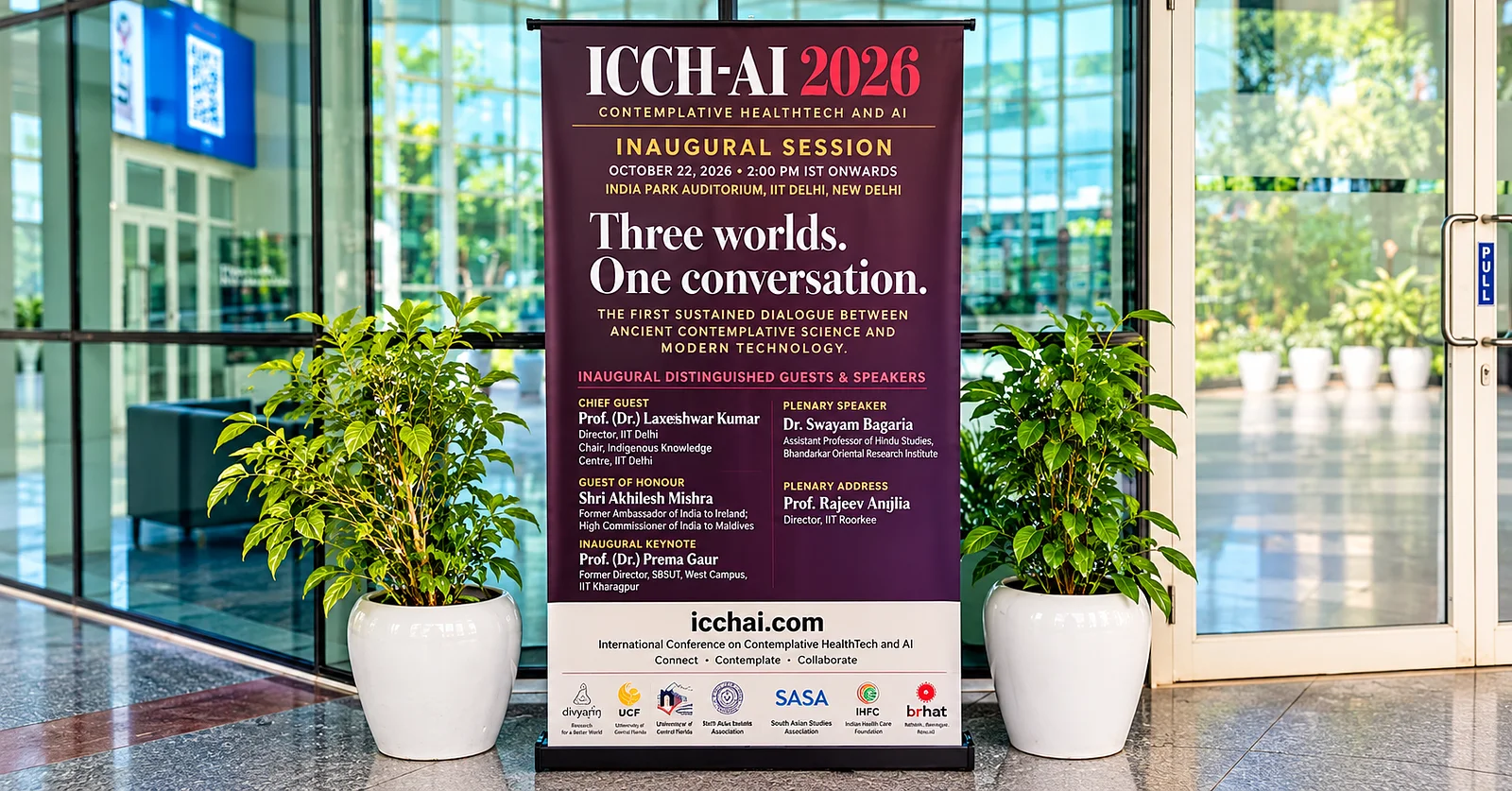
The International Conference on Contemplative HealthTech and AI (ICCH-AI 2026), the first of its kind in India, was held in a hybrid format from 21st to 23rd October 2026, with its in-person sessions at the Indian Institute of Technology (IIT), Delhi. It brought together researchers, scholars, clinicians and technology experts working at the intersection of contemplative practice, neuroscience, artificial intelligence (AI) and digital health. A pre-conference roundtable on 21st October was followed by an in-person inaugural session before a fully occupied auditorium on 22nd October, with the online main conference streaming worldwide from that evening and concluding on 23rd October. The response reflected growing interest in how contemplative traditions and emerging technologies might inform one another, and participants from India, the United States, Europe and elsewhere offered perspectives from science, clinical care, philosophy and ethics.

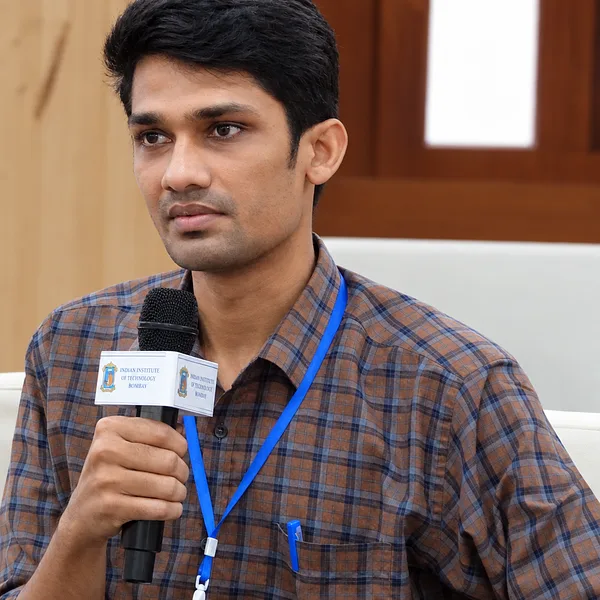
The conference was driven by Shri. Satyam Tiwari, a contemplative neuroscientist and yoga researcher, and Senior Research fellow at IIT Mandi and Founder of Dhyanly (Yogaxbiofeedback PVT LTD). His work combines contemplative neuroscience, yoga research, Indian Knowledge Systems, and emerging technologies. As the visionary behind the conference, he created a platform that fosters collaboration between ancient knowledge traditions and contemporary science. Moderator Dr. Steve Habberlain, of the University of Central Florida, called him “the driving force behind this conference and a real life bridge” bringing together East and West.
A single question ran through all three days: how can AI and digital technologies be woven into mindfulness and mental healthcare without compromising the human values that underpin these practices? AI-enabled tools are increasingly relevant to health monitoring, personalised interventions and mental health support, yet they raise pressing questions of privacy, accountability, human agency and the limits of automation. Speakers repeatedly insisted that AI systems remain evidence-based, culturally sensitive and responsive to individual needs.
The pre-conference programme on 21st October took the form of “Manana: The Contemplative Futures Roundtable,” in which Shri Raghava Krishna, Founder and CEO of Bṛhat, presented the organisation’s vision and work. He highlighted the growing demand for culturally rooted knowledge, practices and experiences, and drew attention to a critical gap: the lack of enabling infrastructure that connects Indian Knowledge Systems with contemporary institutions, creators and communities. Building capabilities, credible applications and trust, he emphasised, is what allows civilisational knowledge to translate into meaningful impact. Shri Anand Krishnaswamy, Director of IKS Education and Leadership at Bṛhat, took part in the discussions alongside scholars and practitioners, exploring opportunities for collaboration, research and the wider application of contemplative knowledge.

The in-person inaugural session on 22nd October, held at the RNA Park Auditorium, IIT Delhi, opened with a lamp-lighting ceremony and welcome from the organising team. The chief guest, Prof. Tankeshwar Kumar, Vice-Chancellor of the Central University of Haryana, and the guest of honour, His Excellency Shri Akhilesh Mishra, former Ambassador of India to Ireland and former High Commissioner to the Maldives, addressed the gathering, and Prof. Prerna Gaur, former Director of NSUT West Campus and an IEEE leader, delivered the inaugural keynote. Dr. Rajeev Ahuja, Director of IIT Ropar, joined online for a plenary talk. Spotlight talks followed, among them Dr. Swayam Bagaria of Harvard Divinity School on the question “Are We Spiritual Automatons?”, IIT Delhi faculty on research questions in yoga, AI in yoga-based rehabilitation and AI and Indian Knowledge Systems, a retrospection on Indian classical psychology from the Morarji Desai National Institute of Yoga, and evidence on meditation and mental resilience during the COVID-19 pandemic. Shri. Satyam Tiwari spoke as convenor, and Shri Ramesh Tiwari, Director of Dhyanly, offered the vote of thanks, after which participants gathered for refreshments and networking before the online programme began.


The online sessions on 23rd October began with a contemplative practice led by Dr. Amy Wheeler, Chair of the Yoga Therapy and Ayurveda Department at Notre Dame of Maryland University. Participants were invited to find a comfortable position, place a hand on the body and tell themselves, “I am here right now,” before imagining one another as points of light across the world. “We are all part of this together,” she said. “It is no one person, no one university.” The shared intention, she explained, was “to guide ethics in the field to honor the ancient teachings of India and stay true to them and to meet modern science and health tech so that we can also guide the future.” Dr. Habberlain then outlined the format and encouraged questions and collaboration across disciplines.

The first presentation came from Dr. Bala Subramaniam, Professor of Anesthesiology at Harvard Medical School and Beth Israel Deaconess Medical Center. Drawing on research into meditation and consciousness, he argued that spiritual, experiential knowledge and scientific inquiry must be connected, because “they’re not mutually exclusive.” He examined the links between breathing, brain activity and the autonomic nervous system. Findings on inflammation, immune responses and sleep were discussed, including home-based recordings showing increased deep (N3) sleep among meditators. He described relaxed alertness, in which “you are alert at the same time you are relaxed,” and suggested that AI could analyse breathing patterns, speech and other physiological signals to give individuals personalised feedback on their inner journey, provided the people using the technology exercise awareness and judgement.
Dr. Sara Lazar, Associate Professor of Psychiatry at Harvard Medical School and a researcher affiliated with Massachusetts General Hospital, presented neuroimaging evidence on how meditation changes the brain. An eight-week mindfulness-based stress reduction programme was associated with changes in grey matter in regions linked to self-awareness, perspective-taking, memory and learning. The amygdala findings drew particular interest: “The more stress reduction people reported, the smaller their amygdala became,” a result she described as important because it countered the claim that the effects were merely placebo. Meditation, she noted, is “often referred to as attention training”: the mind wanders, and the practitioner learns to bring it back. She extended its benefits to memory, sustained attention and mental flexibility, with evidence that mindfulness may support cognition in older adults.
Dr. Wheeler’s own presentation turned these scientific themes towards clinical training. She acknowledged that many yoga practitioners are wary of AI owing to the environment, privacy and cultural authenticity, but argued that avoidance is not a strategy. “The technology will get built without us if we don’t participate,” she said, urging the community to consider how to “participate responsibly and have a voice in this discussion.” Training clinicians, she explained, means preparing them for a healthcare system that “wants people who can begin to self-manage,” and she believes yoga therapists will increasingly need to work alongside health technology. Her central point was that “we humans are necessary in the equation,” because current health technology measures breath rate, sleep and steps while leaving out mood, thoughts, relationships and meaning. “All of the health tech and the AI is really focusing on the hard biodata, but we know in yoga therapy that is only a small piece of the puzzle.” She described a mobile app she is developing that pairs wearable data with assessments based on the guṇas and the doṣas , so that users receive practices matched to their state rather than generic breathing or meditation advice.
Dr. Habberlain presented research on where AI ends and mindfulness teaching begins. AI now powers mindfulness apps and chatbots, he observed, but participants in his study warned of an AI that merely affirms, one called it “flabby mindfulness,” in which learners feel progress without undergoing the struggle that real progress demands. His position was unequivocal: “AI cannot meditate for you. There’s no algorithm that can do this for you.” He described AI-generated empathy as “simulated” rather than genuine attunement, and proposed a framework that keeps direct teaching within a human zone while letting teachers use AI for lower-risk tasks such as drafting scripts they then review.

Discussion also turned to practical integration. Affordability, scalability and individualised care were identified as priorities, and yoga-based support for patients undergoing chemotherapy showed how access can widen without losing human connection. Digital tools can assist practitioners, but professional judgement remains essential. A presentation on moving from ancient wisdom to AI-powered healthcare in India struck a similar note, calling AI “a capability multiplier, not an independent authority.” It proposed using AI to record oral histories and organise manuscripts while keeping a clear line between preserving a tradition and endorsing a medical claim: neither the age of a practice nor its origins is sufficient evidence of efficacy.

Further spotlight presentations broadened the field. Dr. Michael R. Sheehy, Research Associate Professor at the University of Virginia and Director of Research at its Contemplative Sciences Center, described a system, part of the university’s AI and Human Flourishing initiative, that helps researchers design practices for specific populations, such as improving focused attention among fourth-grade students. Rather than relying on unrestricted AI output, it draws on a curated collection of peer-reviewed research, separates evidence from inference and research gaps, and checks claims against original sources, with human interpretation retained because contemplative practices may not suit every population or context. Dr. Maria K., a computational neuroscientist, examined Tibetan monastic debate as a practice combining logic, concentration and emotional regulation, reporting EEG studies in which experienced debaters showed greater concentration, and cautioning that Western-derived questionnaires travel poorly across cultures.
Dr. V. Natesh Chamberlu introduced the work of the Indian Knowledge System for Mental Health Applications (IKS-MHA) centre at IIT Mandi, which brings together Indian philosophy, neuroscience, yoga, Āyurveda and the performing arts. Dr. Sat Bir Singh Khalsa presented yoga as a comprehensive practice of postures, breathing, relaxation and meditation rather than mere exercise, citing meta-analyses on stress, sleep and mental health and arguing for yoga therapy in healthcare, schools and workplaces.
Parallel tracks extended the conversation into philosophy and health technology. Professor Theodore of Bar-Ilan University in Israel explored the Bhagavad Gītā in dialogue with AI, raising questions about ethics, knowledge and the responsibilities of machine intelligence. Dr. Ishwar of the Centre for Yoga, Wellness and Integrative Medicine at Mahatma Gandhi University of Medical Sciences and Technology discussed how heart-rate variability, sleep, respiration and patient-reported outcomes might document the effects of yogic practice, while warning about privacy, informed consent, patient dignity, cultural context and the limits of predictive systems. Data alone, he stressed, cannot guarantee wisdom or sound clinical judgement.
The closing discussion proposed an international society for contemplative AI and digital health to support research exchange, networking and future conferences, with shared research frameworks, ethical standards and interdisciplinary participation. Speakers urged inclusive participation guided by research interests and contributions rather than seniority alone.
Across all three days, the conference showed the promise of bringing contemplative traditions into dialogue with neuroscience, healthcare and AI, while consistently reinforcing the need for rigorous evidence, cultural sensitivity, ethical safeguards and human judgement. As a pioneering initiative, it gave researchers and practitioners from many disciplines and countries a platform to exchange ideas and explore collaboration. Spearheaded by Shri Satyam Tiwari, it positioned India at the forefront of efforts to connect contemplative traditions with developments in AI and digital healthcare, and demonstrated the potential for India to lead in encouraging a more humane, ethical and culturally grounded approach to technological innovation.
The conference was made possible by its partner organisations: Dhyanly; the University of Central Florida; the Indian Institute of Technology Mandi; the Indian Institute of Technology Ropar; Loyola Marymount University; Notre Dame of Maryland University; the Technology Innovation Hub of IIT Delhi (IHFC); and Bṛhat, with IIT Delhi hosting the in-person sessions.