On May 29, 1953, Tenzing Norgay and Edmund Hillary became the first climbers in recorded history to reach the summit of Mount Everest. Yet, while Hillary went on to receive a knighthood and considerable recognition from the British establishment, Tenzing's contribution was often relegated to the margins of the story. A Sherpa by birth, Tenzing possessed an intimate knowledge of the mountains, an extraordinary understanding of the terrain, and a relationship with Everest that went far beyond the technical demands of mountaineering. Without his expertise, and that of the Sherpas who supported the expedition, the historic ascent would almost certainly not have been possible.
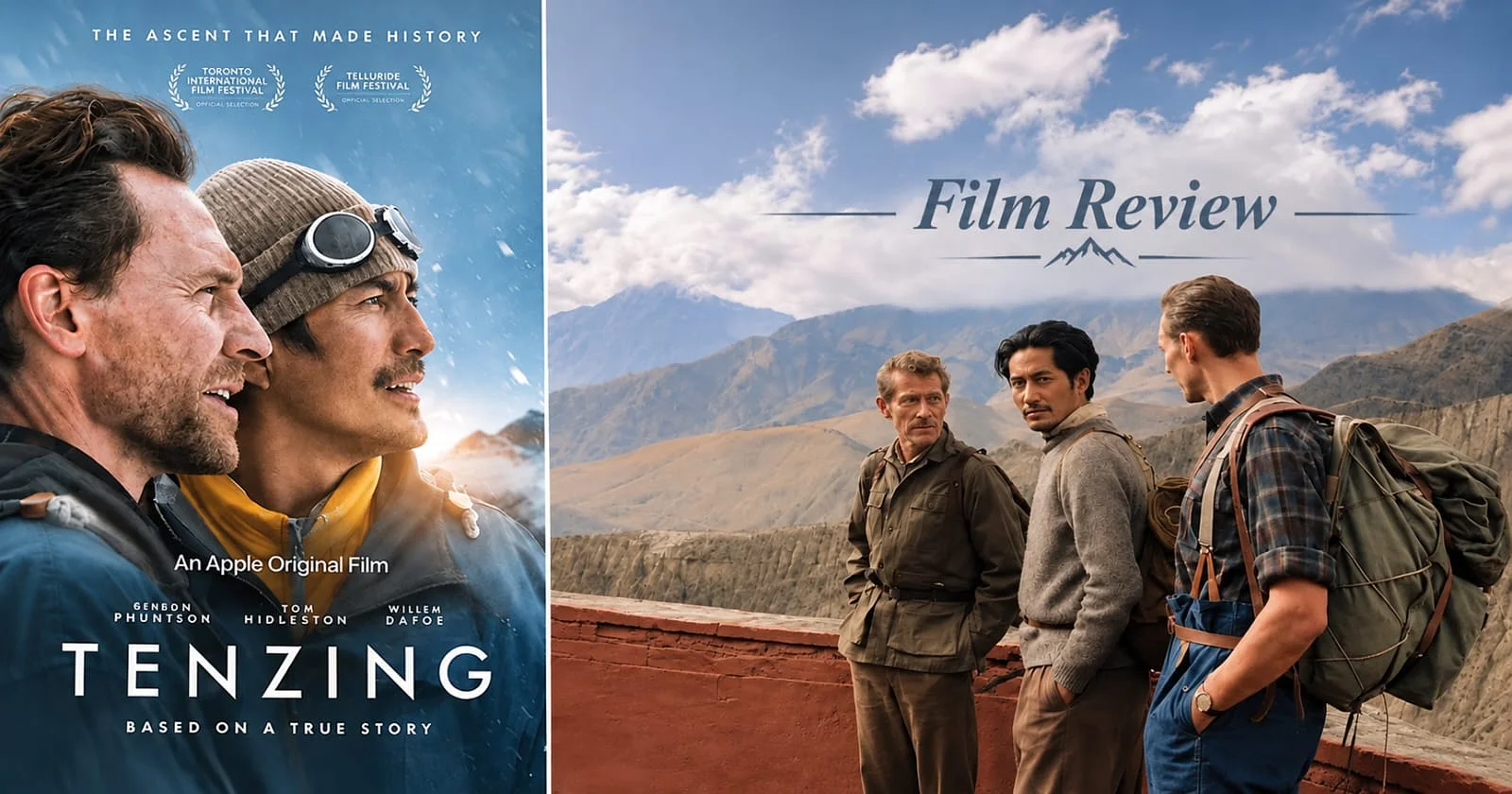
Tenzing (2026) attempts to correct this historical imbalance by retelling the story of the first successful Everest expedition from Tenzing's perspective and, more importantly, that of the Sherpas who made the climb possible. Led by the military-style leadership of Colonel John Hunt, the expedition is presented not simply as a triumph of British mountaineering, but as a story of the people whose labour, knowledge and courage were indispensable to its success. What makes the film particularly compelling, however, is that it is as much a meditation on humans’ relationship with nature as much as it is a mountaineering drama. Beautiful, spiritual and stirring in equal measure, it offers a striking contrast between the Western impulse to conquer the natural world and the reverence with which indigenous Himalayan communities have traditionally approached it.
The film establishes this distinction early on. As a young boy, Tenzing encounters the mountaineer George Mallory and develops a desire to climb Chomolungma (the Tibetan name for Everest). But a man who overhears him does not think that this is a propitious ambition to have: "The Mother Goddess does not want to be climbed. They will offend her." This seemingly simple remark establishes the spiritual worldview that is an undercurrent throughout the film. The mountain is not merely a geographical obstacle or a prize waiting to be claimed. She is a living deity, a protective Mother Goddess who commands reverence.
It also raises an interesting question: what exactly drove Europeans to spend nearly three decades attempting to reach the summit? The competition between European nations to be the first to conquer Everest was notable. Britain, France, Switzerland and other countries invested enormous resources in expeditions, driven by national prestige and the desire to accomplish what had previously seemed impossible. The film captures this attitude particularly well through Colonel Hunt's language during the course of the climb. He repeatedly describes the expedition in military terms, referring to it as the "siege of Everest". At one point, Tenzing asks Hillary if he sees Chomolungma as an enemy. Hillary responds, "I think the British in general see nature as something to be conquered." Tenzing reflects on this attitude: "Maybe that's where we have been going wrong."
This exchange is perhaps the most important philosophical moment in the film. It reminds us of Lynn White Jr.'s influential essay, The Historical Roots of Our Ecologic Crisis (1967), in which he examines how certain interpretations of the Western Christian tradition, particularly the injunction in Genesis for man to exercise dominion over the earth, helped establish an anthropocentric worldview in which nature was increasingly understood as something to be subdued and exploited. The desacralization of nature has profound consequences for how human beings interact with it.
The film’s telling of the story from the perspective of the Sherpas beautifully illustrates their reverence for their Mother. For them, climbing Everest is not a test of human endurance or a national achievement. It is an undertaking that demands humility, prayer and an understanding of the mountain as something greater than themselves. In one of the film's most moving sequences, as the expedition approaches the higher camps, the group of accompanying Sherpas refuse to continue carrying oxygen and supplies further up the mountain. When Tenzing asks them why they have stopped, one of them explains: "Tenzing, None of us have ever been this close before. Stabbing our spikes into her body. Now her shoulders. We did not know it would feel like this."
The Sherpas are troubled by the thought that their climbing spikes are piercing the body of the Goddess, causing Her pain. Tenzing reassures them: "If we pray to her, she will protect us, as she has done so far. Once you're up on her shoulders, you'll be so close, you can whisper that prayer into her ear." They subsequently offer rice to the mountain and pray before continuing their ascent. It is an extraordinarily beautiful sequence that shows the mountain is not an inert mass of rock and ice, but a living presence, a mother who watches over and protects those who approach Her with humility. This is a worldview in which the natural world is not merely a source of resources available for human consumption: it is sacred, and possesses a spiritual significance that places obligations on human beings. Such an understanding is deeply embedded in Hindū and Buddhist traditions, and it is precisely this reverence for nature that modern societies could learn from, particularly at a time when economic development increasingly comes at the expense of ecological sustainability.
The film also does not shy away from the racial prejudices that shaped the expedition (and continues to influence mountain climbing in the Himalayan region even today). The Sherpas are repeatedly referred to as "porters", reducing their considerable mountaineering abilities to a supporting function. They are expected to carry enormous loads up the mountain, often climbing with greater ease than the Europeans they accompany, yet are denied the recognition and status afforded to the expedition's British members. The British climbers are made to feel like the principal protagonists of the expedition while the Sherpas are relegated to the background, almost as if they were mules. The indignity is also made clear when, as they prepare to begin the trek from Kathmandu, the Sherpas are made to sleep in stables outside the house, whose rooms are reserved “only for climbing members”.
The film captures the colonial mindset through another revealing line: "Gentlemen, this is a British mountain and Britain is depending on us." It is an extraordinary statement, considering that the mountain belongs to neither Britain nor any other European nation. Yet the language of national possession and conquest is precisely what defined much of the expedition's ambition and indeed, reflects England’s colonial greed at the time. Against this backdrop, Tenzing emerges as a figure who must constantly negotiate between two worlds. He is indispensable to the expedition, but he must also fight for the dignity and recognition of his people. His knowledge is valued when it serves the expedition's objectives, but the social and racial hierarchies of the time make it difficult for him and the other Sherpas to be treated as worthy equals.
One particularly tender moment captures the spiritual dimension of Tenzing's character. Before the expedition begins its climb, he insists that the team visit a Buddhist monastery and offer prayers. There, he asks a monk, "Rinpoche, how do I know the correct way?" The monk responds, "You just need to climb... like a child climbs into his mother's lap." It is a beautiful line, and perhaps the simplest expression of what the film is trying to communicate. The climb is not an act of conquest but one of trust, humility and surrender.
Aside from the film's script, brilliant acting by all the leads and the values it communicates, its visual treatment deserves equal appreciation. The cinematography is magnificent, capturing the grandeur of the Himalayas. The shots of the squares of Kathmandu, the monastery where the expedition offers its prayers, the journey towards base camp and the vast expanse of the sunlit peaks of Chomolungma are particularly striking. One of the film's most poignant visual moments is Tenzing's wife's cremation on a mountainside. The mountains are woven into the emotional and spiritual lives of its characters.


The historical imbalance in the recognition afforded to Tenzing and Hillary is also worth remembering. While Hillary was knighted by Queen Elizabeth II and received numerous honours, Tenzing's achievements did not receive comparable recognition from Britain. In a 2013 Guardian report marking the sixtieth anniversary of the ascent, Tenzing's grandson called for a gesture of recognition from Britain, drawing attention to the continuing disparity in how the two climbers were remembered. A Nepali folk song offers a rather telling reversal of the conventional narrative: "Our Tenzing Sherpa climbed the highest mountain, pulling Hillary along."
There is, of course, a larger irony to the entire story as well. Neither Tenzing nor Hillary could have anticipated what their achievement would eventually set in motion. As Hillary later reflected, "Both Tenzing and I thought that once we'd climbed the mountain, it was unlikely anyone would ever make another attempt. We couldn't have been more wrong."
Everest has since become one of the world's most sought-after adventure destinations. What was once an extraordinary feat demanding years of preparation, specialised knowledge and exceptional physical endurance has increasingly become accessible to wealthy adventure seekers willing to pay for guided expeditions. The tally as of December 2025 is: 7,563 people have successfully reached the summit, accounting for 13,737 recorded summit ascents. The growth of commercial mountaineering has created an entire economy around Everest, but it has also brought considerable environmental costs.
Reflecting further on the film, it is difficult to ignore the consequences of this growing appetite for climbing the world's highest mountain. Every climber generates an estimated eight kilograms of waste during an expedition, much of which is abandoned on the mountain. Discarded oxygen cylinders, broken tents, food packaging and human excrement litter its slopes, earning Everest the unenviable reputation of being the world's highest garbage dump. The problem is compounded by melting glaciers, which are exposing decades-old waste previously buried beneath snow and ice.
The crisis is not merely one of aesthetics. Improperly discarded garbage and human waste contaminate the local watershed, threatening the drinking water of thousands of people in surrounding communities. During the monsoon, waste dumped in open pits can enter streams and rivers, increasing the risk of waterborne diseases. It is particularly troubling that the scale of commercial mountaineering has outpaced the regulatory and logistical capacity to manage its environmental consequences.
Nepal has introduced measures to attempt to address the problem, including a refundable deposit of $4,000 requiring climbers to bring down at least eight kilograms of waste. However, enforcement remains inadequate, particularly at higher camps, where monitoring is difficult and climbers can easily abandon bulky equipment, oxygen cylinders and other refuse with little accountability. The problem is further compounded by the concentration of climbers along Everest's principal climbing routes, resulting in overcrowding and bottlenecks that place additional pressure on an already fragile ecosystem.
Comparisons with mountain regions in Europe and North America also reveal the importance of regulation, infrastructure and enforcement. The Alps and Rockies, for instance, benefit from established park management systems, greater resources for waste removal and, in many areas, more effective mechanisms for regulating access. Nepal, meanwhile, faces the difficult task of balancing the economic benefits of mountaineering tourism with the protection of an extraordinarily sensitive ecological region. As a relatively poor country that depends partly on climbing permits and tourism revenue, it cannot be expected to shoulder this responsibility alone. Expedition operators, climbers and the wealthier countries whose citizens generate much of the demand must also be held accountable. The mountain that the Sherpas once regarded with such reverence as a living Goddess has become commercialised to cater to wealthy adventure seekers.
The story of Tenzing Norgay, therefore, carries a significance that extends well beyond the history of mountaineering — a sentiment that this film has captured extraordinary well. His achievement deserves recognition in its own right, as does the contribution of the Sherpas who made it possible. Tenzing reminds us that there is a fundamentally right (dhārmic) way of approaching nature.
Humanity might learn how to climb the world's highest mountain, but it must learn when to exercise restraint. The reverence for nature embedded in Hindū, Buddhist and other indigenous traditions offers an important corrective to a model of development that treats the natural world as something to be possessed, exploited and exhausted. There is something deeply tragic about turning one of the most magnificent and ecologically delicate landscapes on Earth into a monument to human excess. For those who have lived in her shadow, Chomolungma has always been something much greater than a conquest; Tenzing encapsulates this with utmost beauty and grace.
Watch the film on Apple TV: https://tv.apple.com/in/movie/tenzing/umc.cmc.6lic0hhuxkrbem0n29vzjopii
References:
Everest anniversary: Tenzing Norgay's grandson calls for 'gesture' from Britain
https://www.theguardian.com/world/2013/may/29/everest-anniversary-tenzing-norgay
Everest 1953: First Footsteps - Sir Edmund Hillary and Tenzing Norgay
https://www.nationalgeographic.com/adventure/article/sir-edmund-hillary-tenzing-norgay-1953
Trash and Overcrowding at the Top of the World
https://education.nationalgeographic.org/resource/trash-and-overcrowding-top-world/
Amidst Growing Mountain Tourism in Nepal, Mount Everest Confronts the Perils of Pollution