“Modern” seems to want a definite stopping point, an “end of history” when it is complete, but not yet to have found one. From Machiavelli to Nietzsche, each philosopher offers a new formula yet admits the need or the possibility of further progress beyond his own- Harvey Mansfield
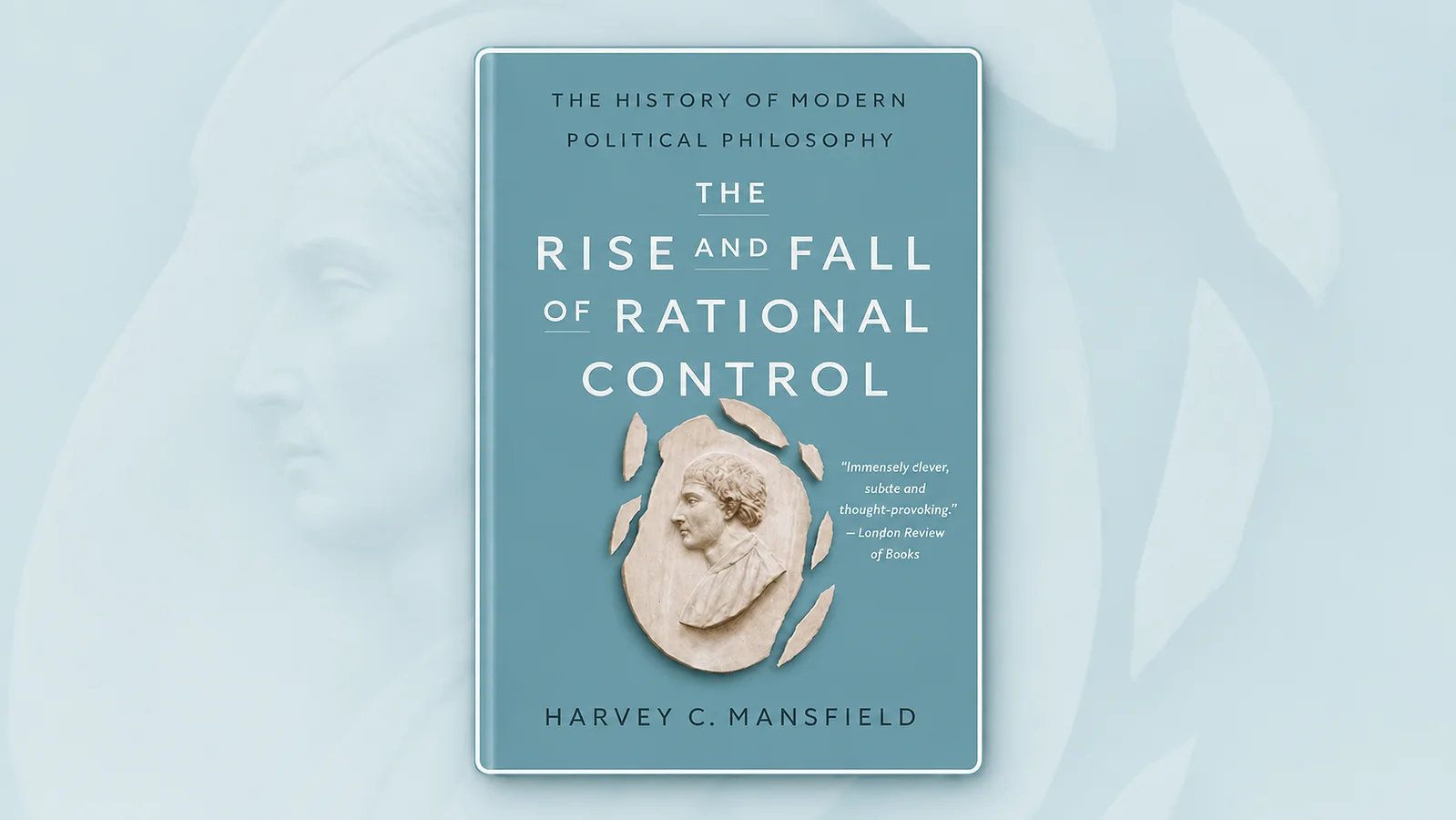
The Rise and Fall of Rational Control is an abbreviated philosophical history of the political principles that govern the modern secular state by Harvey C. Mansfield, an American political philosopher, prolific writer and thinker and Professor of Government at Harvard University. It is an intellectual retelling of the emergence of ideas and philosophers building on each other’s work, which has influenced modern life to a considerable degree. Mansfield’s use of the term ‘rational control’ refers to the phenomenon of using human reason or pushing the limits of science to not merely contemplate or understand the world, but to actively master and engineer it to meet human needs — thereby linking knowledge with power and wealth. In Mansfield’s words, “Rational control from its rise is an idea of the application of reason to revolutionize the life of human beings as individuals and in politics in order to liberate them from the unreason of prejudice, tradition and superstition. This idea was begun and maintained by philosophers and has an internal history of rise and fall from Machiavelli to Nietzsche.” While tracing the political/ philosophical history of the West, Mansfield discusses each successive thinker’s views on science, natural law, and the delimitations and origins of power — in light of their ideas and influence on rational control.
In the beginning, there was the realism of Machiavelli, seen as the founder of modern political philosophy, being the first to mark a decisive straying from the ancient tradition. Mansfield writes, “the owl of Minerva took flight at the dawn of modernity, when Machiavelli fashioned his plan or plot to change the world through modern political philosophy.” Machiavelli replaced the pursuit of ideal political virtue with “effectual truth”—an emphasis on how politics actually works, particularly the acquisition and maintenance of power. The ruling class does not necessarily conform to conventional morality, but acts according to political necessity. For Mansfield, this initiates modernity’s project of rational control: using human reason to transform political life and achieve “practical” results. Yet Machiavelli’s revolution also shifts attention away from the cultivation of the soul and noble virtue towards power, security, and the management of human behaviour, setting in motion the tensions that later thinkers, especially Marx and Nietzsche, would expose.
Hobbes comes next, presented as a key figure in developing modern liberalism by grounding political order in self-preservation and the fear of violent death. Hobbes’ argument is that individuals escape the insecurity of the state of nature by establishing a sovereign authority that guarantees peace and security. For Mansfield, this exemplifies modernity’s attempt to achieve rational outcomes by directing basic human motives towards political stability. However, this approach reduces political motivation largely to survival and self-interest, neglecting the higher human aspirations of honour, virtue, and sacrifice.
Coming to Locke, a central architect of modern liberalism, Mansfield challenges the view that his primary aim is to limit government. “What Locke does not recommend is to limit the sovereignty of government.” Instead, Locke distinguishes between “absolute power and arbitrary power; the first is necessary, the second not.” Mansfield argues that Locke favours indirect government, which exercises control without appearing oppressive. His concept of property enables individuals to pursue wealth rather than rely on “virtue or public spiritedness or sense of duty” to achieve a good life. Similarly, religious toleration allows “a more or less free market of ideas” instead of imposing particular beliefs. Mansfield sees this as Machiavellianism entering liberalism: political order is secured by managing self-interest rather than cultivating virtue. His larger concern is that liberalism, while protecting individual rights, risks neglecting the honour, civic responsibility, and public spiritedness necessary for the meaningful exercise of freedom.
Locke’s discussion of the ownership of private property and the impact it had on Western society is particularly notable. Arguably, it is the predecessor to today’s unchecked capitalism, responsible for removing the taboo against greedy acquisition for the sole purpose of the accrual of personal wealth, a sin that was frowned upon in the Bible and by thinkers before him. As Mansfield puts it, “Locke’s theory made it possible to seek gain without limits and yet, since it made a change in morality, to do so without the shame of avarice. A new category of virtue became apparent—honest avarice. With this theory in charge it was no longer immoral or illegal to seek to become rich.” This then leads into a discussion of rights being the cornerstone of modern government, especially property rights, and how the state came to be, primarily, an instrument through which private property is protected.
Mansfield’s discussion of Rousseau touches on the clash between modernity and religion: it appears that modern societies can either settle on one religion that is undemanding, or have no religion at all. Rousseau believed that “progress in science and civilization does not bring progress in morals.. but a retrogression.” Christianity was not rejected but desensitized, made reasonable or “latitudinarian”, and modern regimes, grounded in modern principles of religious tolerance, encouragement of commerce, constitutional government, and the sacrosanctity of individual rights were established. Rousseau posited that moral progress is not the same as intellectual progress in the sciences and arts, and that generally, the movements run dialectically: the more intellectual, the less moral. The rise of modern arts and sciences have brought about a decline in morality. Then there is the emergence of the necessity of modernity’s rejection of “ancient virtue”, which hinders “progress”. Rousseau challenges the view that science and morality necessarily advance together, arguing that nature may protect morality by resisting scientific progress. This creates a dilemma between restricting knowledge in the name of moral well-being and pursuing scientific progress at the risk of moral decline and catastrophe, that “Intellectual progress in the arts and sciences, that is, the advance of reason, has not been accompanied by moral progress.”
This tension between intellectual progress and moral decline leads to a broader question: how does history transform human nature? By tracing society and morality back to their origins in the state of nature, Rousseau seeks to understand how history transforms human beings and to reconcile the apparent conflict between science and morality. “Philosophy considers what is permanent and eternal and asks how important humans are in that light. History assumes that humans are important and that what happens to them is of central and ultimate concern, never mind eternity.” Therefore, Rousseau’s contribution lies in treating history not merely as a record of past events, but as a means of understanding the transformation of human nature itself. Hegel, on the other hand, views the history of the World as a history of “working out in stages of a rational Christianity”, that is, “the morality that overcomes nature overcomes God”. For him, modern political philosophy is the culmination of all of political philosophy: that is, until his idealism is dismantled by Marx and Nietzsche later on. Unlike Hegel who interprets historical development through the evolution of spirit and freedom, Marx, on the other hand, explains historical stages through economic conditions and modes of production. History advances through class struggle and revolutionary transformation, culminating in the overthrow of capitalism. For Nietzsche, the deeper truth of history is that human life advances through creative acts that introduce new ideas and values. Historical knowledge is therefore only valuable when it serves life and inspires creation, and counterproductive when relativism and nihilism subvert human action.
The contrast between these views reflects Mansfield’s larger argument about modernity: while successive thinkers attempt to explain history and establish the conditions for human freedom, they disagree fundamentally about the nature of freedom and the purpose of historical progress. Mansfield writes “We have defined modernity as based on the belief that man is alone, free of any obligations to God or to nature. Men have been given very little and they owe very little or no gratitude.” This, he says, is the major distinction between modern and premodern or ancient political philosophy: it is that broadly, the moderns stand for freedom and the ancients stand for virtue. “Why do the moderns say that men are free? It is because they are free from God and from nature; they have no natural obligations.” Life is a burden because man must expend his life and freedom meeting his own necessities that nature does not readily supply. “Men are not only not born with natural gifts for which they must be grateful, but instead they are born with great needs that must be met.”
This distillation, as ancient virtue and modern freedom, also raises the question of whether scientific knowledge and rational institutions can adequately address the moral dimensions of human existence. “Science takes men out of themselves and gives them to the universe, but the grandest feat of science is to come back to the knowledge of man; it seems that taking man out of his obscurity did not help him.” The difficulty of grounding morality within modernity becomes particularly evident in Kant’s attempt to establish universal moral principles through reason. Kant argues that true morality must be independent of happiness, self-interest, and empirical circumstances, resting instead on pure reason and unconditional moral duties. By treating morality as a categorical ideal that transcends practical limitations, he contends that striving towards the unattainable can produce greater moral achievement. Pure morality is vindicated in history through the gradual emergence of a “just” political order through competition, rivalry, and human antagonisms, even when these arise from immoral motives. His central challenge was to reconcile this natural, often amoral process of historical progress with the ideal of universal morality, human dignity, and freedom, while recognising the difference between morality and legality, or that between genuine sincerity and more outward conformity. “To keep morality pure, Kant separates it from law, and to show morality in success, Hegel identifies it with law. What Kant and Hegel share is the belief that freedom can be made actual—that is, a rational society constructed in which men are not and will not be irrational.”
Taken together, Kant and Hegel illustrate Mansfield’s account of modern political philosophy as an effort to formulate rational principles that can establish virtue, morality, and freedom within political life. Mansfield details the manner in which successive Western philosophers have sought to reconstruct virtue through new theoretical principles, often reduced to a single governing principle such as justice. For example, to Hobbes, justice means keeping promises made to the sovereign; to Kant, it means adhering to universal rational duties without making exceptions for oneself, regardless of human weakness. The relationship between morality and political institutions becomes especially important when considering how religion shapes historical development. First and foremost, for Machiavelli, politics actively shapes history through the acquisition and maintenance of power, whereas for Hegel, politics is subordinate to culture and religion, which drive historical development. Hegel thus reversed the primacy of politics in modern thought, viewing the evolution of religious and cultural consciousness (of the people, not of the rulers) as central to the development of human freedom. Hegel viewed Christianity as the historical vehicle through which the idea of universal human freedom becomes realised in the world. He sought to rationalise and secularise Christian revelation, arguing that the incarnation of God finds its fulfilment in a society where freedom is universal and the divide between Church and State disappears. At its core, Hegel’s position is that Christianity’s truth is realised not merely through religious belief or ecclesiastical authority, but through the historical development of human freedom and rational society. Marx takes this discussion in a more radical direction, seeking not merely to understand the intertwining of religious and political institutions, but to overcome the conditions that make them appear necessary. Marx advances the argument that religion and politics are human creations that become alienating forces when they appear as necessities governing human life. By overcoming this alienation, humanity can transcend religious authority and political conflict, achieving a state of freedom and peace in which these institutions are no longer necessary. Mansfield writes that “Marx does not adopt the liberal view that the state should be neutral to religion; he insists that the effectual meaning of the state’s “neutrality” is atheism. Liberalism is a contradiction between an atheist state and a religious majority that in practice overwhelms its atheism.”
Nietzsche is the philosopher who brings the modern project of rational control to a crisis. To Nietzsche, modernity is an attempt “to unbend the bow”. Man is a bow, which when taut, can send an arrow farther than he knows, but the idea and program of modernity is “to reduce tensions.” Modern thinkers had sought to use reason, science, and political institutions to liberate human beings from prejudice, necessity, and suffering. Nietzsche argues that this project risks producing the “last man”: a comfortable, security-seeking individual who avoids risk, ambition, and greatness, and whose life is reduced to routine pleasures and the pursuit of well-being. For Mansfield, Nietzsche’s central contribution is his rejection of the democratic tendency to treat equality, safety, and ordinary human needs as the highest standards of morality. Nietzsche instead restores the distinction between the just and the noble—between what society expects from everyone and what it admires in exceptional individuals. Through the idea of the will to power, he emphasises self-mastery, discipline, struggle, and the capacity of a few individuals to overcome themselves and create new values. Yet Mansfield is critical of Nietzsche’s solution: by subordinating reason and the search for truth to power, Nietzsche risks making philosophy an instrument of domination rather than rational inquiry. He rejects the distinction between nature and human convention because it privileges an impersonal, scientific view of reality over human experience. He replaces it with a distinction between surface and depth, arguing that the apparent world is not something to be dismissed as superficial, but something open to deeper interpretation. The cow as seen by man is not only white (the surface attribute) but also sacred (the interpretation), so that the thing seen through art and religion means more, and is more profound, than either what every ordinary person can see or the universal dehumanized thing that the scientist can see. His emphasis on exceptional individuals also raises questions about the morality of greatness and the treatment of ordinary people. Mansfield sees Nietzsche’s lasting insight in his recovery of nature, genuine creativity, and human excellence against the artificiality and conformity of modern democratic society, even as his philosophy and nihilistic views remain dangerous when power is allowed to replace reason as the ultimate pursuit.
Ultimately, Mansfield argues that the “fall” of rational control occurred likely with Marx and Nietzsche, when modernity’s promise to secure human freedom through reason, science, and political institutions encountered its limits. Marx challenged liberalism for failing to overcome alienation and create genuine community, while Nietzsche’s criticism extends to its emphasis on equality, security, and comfort at the expense of human excellence and creativity. Postmodernism inherits Nietzsche’s perspectivism but, in Mansfield’s view, fails to transcend modernity, reducing the critique of universal truth to another perspective without offering a compelling alternative. Mansfield therefore proposes a reworked liberalism that preserves individual rights and liberty while restoring the importance of human nature, virtue, honour, courage, and sacrifice. His thesis at its core is that rational control can secure the conditions of human life, but it cannot by itself determine how life ought to be lived; political philosophy must therefore examine not only how society can be organised, but also what makes human life meaningful and worthy.
A particular concern arising from the discussions relayed in the book is that virtue becomes identified with the “ancient” tradition, as though it were an inherited, archaic obstacle to progress rather than a continuing necessity of human life and dignity. In the Western philosophical trajectory Mansfield describes, virtue increasingly becomes something to be rediscovered, reformulated, and rationally justified by successive thinkers. This contrasts with the epistemology of Indian knowledge traditions, in which morality is understood as a body of wisdom embedded in a living civilisational tradition. Within the IKS framework, ethical life is articulated through concepts such as dharma, guṇa, puruṣārtha, and ṛta, transmitted through śāstra and ācāra, and cultivated within families, communities, and political institutions. Morality, therefore, need not await the emergence of a new philosophical system to acquire legitimacy; it already exists as a lived inheritance that can be practised, interpreted, debated, and refined. This does not mean that Indian traditions are free from disagreement or historical change, but that philosophical inquiry takes place within an existing moral and metaphysical framework rather than requiring every generation to reconstruct the foundations of ethical life from its first principles.
Mansfield’s account of Western political philosophy raises a fundamental question about the foundations of the current framework of societal organisation and political order. From Machiavelli to Nietzsche, political philosophy appears as a succession of competing ideas, each attempting to uncover the source of human nature, morality, and freedom in order to exert control. This Western intellectual tradition can be likened to a “free market” of ideas, in which successive thinkers challenge inherited principles and experimented with new models of social and political organisation. Yet if morality is repeatedly subjected to philosophical reconstruction by individuals that lived in turbulent times, what provides society with a stable foundation for distinguishing the virtuous from the expedient and the just from the unjust? The danger is that society becomes an experimental ground for abstract theories whose consequences are unknown, yet eventually borne by actual human beings in distant societies, while the moral foundations necessary to evaluate those consequences remain unsettled. For instance, the export of communist revolution, which is supposedly a universal theory of history and class struggle, to countries whose social, political, and economic conditions differed considerably, led to mass death, political repression, civil conflict, and institutional breakdown. The point is that the imposition of an abstract theory of society onto complex human communities can carry devastating consequences, especially when inherited institutions, local traditions, and moral codes are overlooked. This concern extends to the concept of a modern liberal government, which often seeks to maintain social order through individual rights, self-interest, and institutional management rather than through a shared conception of virtue. As Mansfield’s critique suggests, rationally organised institutions cannot, by themselves, answer the deeper question of what constitutes a good human life.
The deeper layer alluded to by the book is the distinction between a society that continually experiments with the foundations of morality and one that draws upon an inherited tradition of ethical and metaphysical knowledge. The former offers the possibility of innovation and criticism, but risks losing the continuity and shared standards through which social life acquires meaning. The latter offers moral resources that transcend individual preference and political expediency, while still requiring interpretation and responsible application. The question is not whether a society should permit debate or intellectual experimentation, but whether these activities can remain meaningful without a deeper understanding of human nature, moral obligation, and the ends of collective life. Mansfield’s call to recover virtue, honour, and the cultivation of the soul points towards this unresolved problem. From an IKS perspective, the response would be to restore the relationship between political organisation and a substantive shared idea of morality, recognising that institutions should not merely manage human interests; they must also cultivate the moral, social, and spiritual conditions in which individuals and communities can flourish.
Buy the book here: https://www.amazon.in/Rise-Fall-Rational-Control-Philosophy-ebook/dp/B0FHHQST6W