यद्यदाचरति श्रेष्ठस्तत्तदेवेतरो जनः ।
स यत्प्रमाणं कुरुते लोकस्तदनुवर्तते ॥ BG 3.21 ॥
yad yad ācarati śreṣṭhas
tat tad evetaro janaḥ
sa yat pramāṇaṁ kurute
lokas tad anuvartate
Whatever a great person does, others emulate; whatever standard they set, the world follows.
Leadership is a lifelong sādhanā, a spiritual practice and a journey of continuous evolution. It is not a destination to be reached, but a path to be walked, one step at a time, one action at a time. ~ Dr. R Balasubramaniam
Introduction
We live in times that are volatile, uncertain. They demand a systems-scale paradigm shift in how we think about and resolve challenges across AI and its impact on cognition and livelihoods, ecology and regenerative development, the climate crises, international geopolitics, national growth, education and more. The universal call is to move from a fragmented worldview towards one that is integrated and oriented towards harmonious global futures.
For leaders and seekers of all sizes and sectors, in corporate boardrooms, educational institutions, research labs, public service and development sectors and more, these rapidly shifting times raise a singular question: How do we act with purpose and clarity? How do we know what is ‘right’?
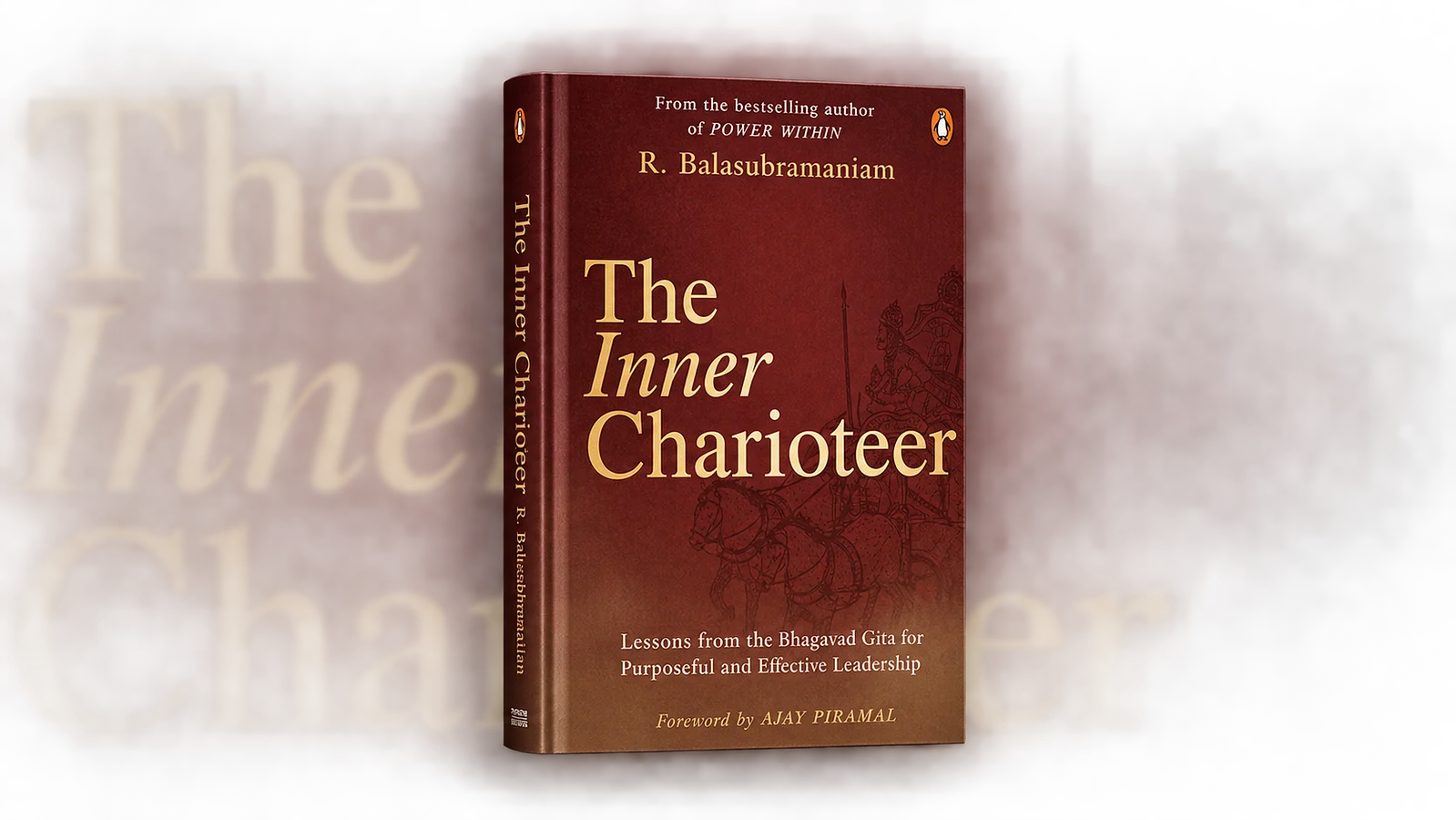
Through his latest book, “The Inner Charioteer”, Dr. R Balasubramaniam tells us that leadership that is spiritually grounded in a deep commitment to values, purpose and self-awareness has the power to create integrative organizations and build a more thoughtful and compassionate world. In doing so, he births a critical work that looks at the Bhagavad Gītā entirely from a leadership lens, anchoring it in his own lived experiences across decades of pioneering grassroots development work as Founder of Swami Vivekananda Youth Movement (SVYM) and Grassroots Research and Advocacy Movement (GRAAM), institution building for the Capacity Building Commission through Mission Karmayogi, and service in the higher echelons of the Government of India.
The narrative arc of the book takes us on a reflective and interpretative journey of the 18 chapters of the Gītā. The depth of the book is emergent from the author’s honesty in narrating his own experiences, failures and personal yet universal questions that he has encountered on his leadership journey. It reminds us we do not arrive as perfect leaders. It is an evolutionary process, akin to a moment-by-moment trial by fire, a tapasyā in itself.
As we engage with the book, we witness and learn from the reflections of a leader who lays out the core messages of the Bhagavad Gītā with reverence and humility.
Reflective & Civilizational: Flow of Contents and Design
The chapters of “The Inner Charioteer” are designed in a manner that appeals to anyone who seeks to lead, work and act with awareness and presence: in boardrooms, on field, in families and in everyday life alike. In that it successfully contextualises and makes accessible the wisdom of the Gītā to the layperson and the dilemmas they hold within.
Each chapter offers reflective cues at various junctures and a set of takeaways and simple exercises at the end. This is an invitation that stays true to the Indic tradition of anubhava - to make each idea one's own lived experience through consistent practice.
Akin to Dr. Balu’s earlier work, “The Power Within”, this book also features elegant and classic illustrations that become a critical visual aid to comprehending the subtler principles of the Gītā and function as frameworks that can be absorbed, taught and applied.
One of the significant aspects of the book is that it gives us a glimpse of Dr. Balu’s journey in and through the villages of Bhārata as well as the auspices of the offices of the Government of India. In one way, it thus offers an immersion into the cultural-civilizational landscape of Bhārata that is pregnant with unbroken traditions, practitioners, leaders through whom the lessons of the Gītā live on.
For example, in Chapter 14 he writes of his experience with Kempaiah, an elderly tribal chieftain who maintained poise even in the face of his people being forcibly relocated from the forests they had called home. Kempaiah’s goal was simple yet profound: emotions had their role in leading but they shouldn't cloud judgement.
The narrative also integrates episodes from the Itihāsa-Purāṇa to illustrate central ideas. For instance, the kathā of Rājā Nahuṣa from the Mahābhārata is utilised to showcase how one’s lack of mastery over one’s senses and desires can lead to terrible outcomes for the individual. In another chapter, the contrast in the attitude and actions of Rājā Yudhiṣṭhira and Karṇa is deployed to indicate the qualitative distinctions between sāttvika and rājasika dāna.
A Glimpse of Central Leadership Themes
Through elaborate reflections on select verses from this eternal dialogue between Arjuna, the great warrior, and Yogeśvara Śrī Kṛṣṇa, Dr. Balu offers perspective on several critical leadership themes and key principles. It begins with Arjuna’s crisis of identity and his willingness to seek wise counsel in a poignant moment where he questions the scale of devastation that his actions are about to yield.
It moves through how a leader can anchor themselves in clarity and self-awareness, the idea of the Self and spiritual leadership, relationships and team building, the humility to learn and serve, working with śraddhā and devotion but devoid of attachments, what can guide decisions amid uncertainty, the practice of equanimity, navigating as also leveraging the triguṇas, drawing strength from the larger unseen and finally the beginning of leadership in inner freedom and stillness.
In the book, Dr. Balu explains that “The Gītā is a co-creation, a dynamic interplay between confusion and clarity, vulnerability and wisdom, question and answer. It is a testament to the transformative power of a true mentor-mentee relationship, a model for effective leadership development.”
Each chapter reminds us of instances in our own lives, of our follies and personal moments of transformation, of areas where we could do with deeper clarity, of questions held around who we are and purpose. It awakens conviction, inspires and guides. Some verses and sentences are strikingly clear while some others will unravel with time and context. The personal anecdotes are alive and speak to us through the pages. It is this ability of the book to shine light on dilemmas, questions and challenges held close in our hearts and resonate to each individual’s unique context that makes it an engaging, intellectually honest and at many instances, a heartwarming and thought-provoking read.
One striking emphasis is on how leadership is deeply relational and about the ability to see potential where everyone else sees limits; about recognising the right of every individual to rise and always believing in their inherent dignity and capacity. Such leadership creates a space of safety and maitrī bhāva. It designs interventions for those who have drifted to return to their center. It holds compassion for mistakes. And it builds trust through care, courage and connection.
In the book this is illustrated through moving instances of community building,showing up and developing trust with villagers even in the face of resistance, and deep-hitting and transformative realisations.
Another related theme that stands out is serving with śraddhā and bhakti, I.e. conviction and devotion, and how it is essentially about the quality of attention and intention that we bring to what we do. The chapter on “Faith and Leadership”, highlights the principle of sāttvika śraddhā , or the conviction that values integrity in intent and action. The quality of a team’s conviction determines its behavior under pressure. The leader therefore does not only serve, but also cultivates the quality of śraddhā that runs through their team and work.
Such leadership that serves with love and is ever tuned to a higher purpose, fundamentally requires the capacity to engage fully and remain free from the bindings of the ego and the need for recognition. Here a leader’s actions become an offering unto the One Consciousness manifesting itself as the community around us.
This leads us to another inter-connected and foundational principle of purposeful action. Clarity of conviction itself emerges from clarity of purpose. This is not a passionate desire for success at all costs. It calls for focused engagement with the task at hand coupled with freedom from obsessing over outcomes. It is to see oneself as a humble instrument. It is also the ability to sustain commitment to one’s deeper purpose amid distractions that will inevitably plague life and mind.
Such perseverance stems from buddhi (intellect), dhṛtih (resolve) and tapas of the śarira (professional presence and conduct), vāk (speech that is steady, agreeable and beneficial) and manas (a mind governed by silence and self-restraint). The book narrates an elevating kathā of Śrī Hanumān as the embodiment of vāṅmayam or vāk tapas. We invite you, dear reader, to partake of that tale through the book!
Dr. Balu shares a beautiful personal story with us in lieu of these ideas. During construction of a hospital at Kenchanahalli, funds were scarce and he found himself facing a wage bill that he did not have the capacity to settle. Yet the words of his guru stating with conviction that no good work started in the name of Swami Vivekananda will suffer for want of funds, echoed firmly in his heart. As providence would have it, he treated the young son of a family that had lost its way and the father handed a grateful contribution that turned out to be more than enough for the wages to be paid.
“It was faith taking form and was an affirmation that when one’s intent is pure and aligned with service, the higher power finds its way to support,” Dr. Balu writes.
Chapter 18 further elaborates on the element of the unseen, or the force of the daivam. One may wonder if this is superstition, especially on the challenge-ridden path of leadership. But as the book gently yet firmly shows us, it is not. It tells us that for any leadership action, five components are essential: the adhiṣṭhānam (context), the kartā (doer), the karaṇam (instruments), the ceṣṭā (effort) and finally the daivam (that which is beyond our control).
The unseen is nothing but the convergence of time, circumstances, forces beyond our finite planning and as seen in the anecdote above, it is also grace. It gives the leader the intensity to act with responsibility while remembering that they are the trustees of a larger process and instruments through which collective forces find coherence. This is the leadership of instrumentality.
The book outlines many such vital principles and frameworks, all of which cannot be delineated here. We will conclude this section with two more key ideas and leave you to purchase the book and immerse yourself in it.
Each of us is familiar with the rise of (unbridled) desire and its consequent emotions such as anger, greed, jealousy and so on. These along with attachment and aham-bhāva destroy a leader from within. The Indic tradition stands tall in its placement of indriya-jaya or self-mastery as the crest jewel of liberated leadership.
This leader is one who engages, works, and serves with complete involvement but without possession; the one who neither holds on to the work nor is held by it; the one who serves the role but is not consumed by it. They are in a state of yukta, i.e. their mind is disciplined, integrated and inwardly balanced.
They are anchored in and act from an unshakeable and steady center. There is a certain depth of inner quietude and clarity that underlies that actions and decisions. Such a leader has the ability to engage fully with complexity and remain composed in turbulent times. It is such a leader who builds sturdy institutions that transcend time. The book talks to us about individuals such as Jamshedji Tata, Dr. APJ Abdul Kalam and others who embodied the qualities of conscious, resonant leaders.
There are multiple chapters in the book where Dr. Balu highlights the qualities of a leader. One such section explains how qualities or virtues are the pillar on top of which skills such as strategic thinking and team building stand. Some of them are:
-
The wisdom and humility to listen and discern
-
Mastery over the pushes and pulls of emotions such as anger, envy and reactivity
-
The ability to simultaneously think across scales of time and focus on the immediate
-
The ability to radiate clarity and confidence in teams through inner alignment
-
Cultivating leadership in others through trust, mentorship and creating conducive environments to learn and act
-
Contentment and inner quiet, equality in joy and sorrow that allows steadiness even under pressure
In the book, Mudalimadaiah, the chieftain of the Kadukuruba tribe states with quiet emphasis, “A yajamāna is not a position, it is a responsibility.”
“To lead is to walk endlessly. It is to grow without pride, serve without seeking reward, celebrate without attachment and stay attuned always to the larger whole.
When leaders themselves are lit by the awareness that ‘everything flows from the Source’, they become mirrors in which others glimpse their noblest selves.” (Excerpt from Chapter 10)
The Way Forward
We started off by highlighting the need for a radically different paradigm of leadership than the one that exists and informs our decisions and processes today.
Drawing from the age-old tradition of the Bhagavad Gītā, “The Inner Charioteer” comes as a comprehensive offering packed with deep insights, principles and frameworks. It brings the paradigm of spiritual, service-oriented and wisdom-anchored leadership.
The chapters are already structured and designed to inform and aid renewed curricula building for public and corporate leadership training programs and thereby nurture transformative systems. The book can also be synthesized to build real-time tools and diagnostics that can further contribute to dharma-anchored leadership studies and practice.
Similarly, our young people who will only encounter increasingly complex and uncertain times as they step out into the world, are in dire need of the anchorage and vision for life that the Gītā offers. The book offers an opportunity to bring the conversation between Śrī Kṛṣṇa and Arjuna to creatively engaging mediums that are suitable for capturing the attention of young learners and crafting a meaningful experience for them. These could include immersive and staggered learning modules, digital games and simulations that unlock leadership skills and pathways and more.
May “The Inner Charioteer” find its way to the desks and homes of millions of leaders and seekers. May the touch of Śrī Kṛṣṇa inform, illumine and sanctify the learning and leadership journeys of many, thereby transforming the manner in which public service, creativity and economy is imagined in our nation and beyond.
“Krishna stands for wisdom, the inner compass. Arjuna stands for effort, the outer action. When both are present together, the result is right action and right outcome. It is this alignment between wisdom and action that lies at the heart of the Inner Charioteer.” (Excerpt from Chapter 18)
Link to purchase the book here:
Sarvam Śrī Kṛṣṇārpaṇam astu!





.png)