“The very ink with which all history is written is merely fluid prejudice”- Mark Twain
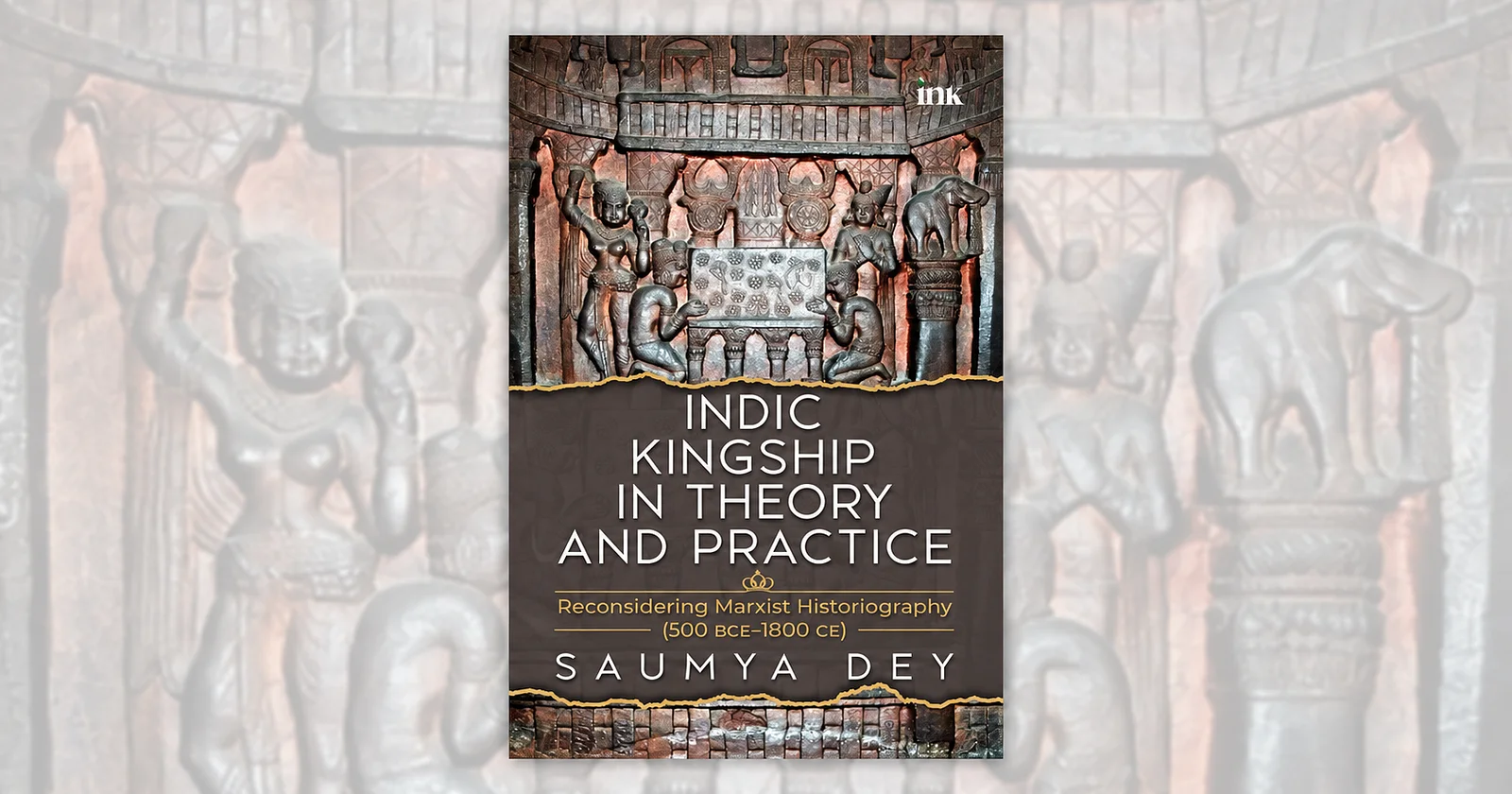
History is what historians say it is, rather than what actually took place. Saumya Dey, in his latest work Indic Kingship in Theory and Practice: Reconsidering Marxist Historiography, discusses the subjectivities into which Marxist historians have leaned while attempting to see Indian history, particularly kingship, through red-tinted glasses, and has taken the first steps towards bringing a more indigenous perspective to light. It starts out by discussing the methodology of writing history, ie, historiography, and its “liminal” nature, entailing the filling in gaps in records and data with preconceived notions, and producing imaginations that intend to influence the reader.
Particularly influential is the construct of historical materialism — first developed by Karl Marx and Friedrich Engels — a theory of history that explains social change primarily through material conditions—especially the organisation of production, economic relations, class structures, and the conflicts arising from them. Rather than treating ideas, institutions, religion, or political authority as autonomous forces, it tends to understand them as shaped by, or responsive to, underlying material and economic structures. As Will Durant writes, “Our knowledge of any past event is always incomplete, probably inaccurate, beclouded by ambivalent evidence and biased historians, and perhaps distorted by our own patriotic or religious partisanship”.1 This is precisely why history needs to be continually questioned and rewritten, and perhaps what Dey intends with this book.
While all this is true, the deconstruction of historiography itself raises a further epistemological question: if historical “facts” are not really facts, and are, in actuality, mediated by the historian, then, is the emergent historical interpretation inevitably shaped by subjectivity? As Dey himself states: “the historical fact is by no means a given or an axiom”. Then, on what grounds are the claims presented in the present book to be regarded as anything more than another subjective reconstruction of the past?
The answer cannot simply be that this account is less ideological and more objective than a Marxist one, for every interpretive framework carries assumptions about what constitutes valid knowledge and explanation. The stronger claim is that an account of Indian kingship becomes more historically valid when it is grounded in India’s own sources, categories, intellectual traditions, and interpretive philosophies, rather than being compelled into an external conceptual framework such as Marxist historical materiality. This idea is not explicitly stated by the author; however, it may reasonably be understood as an underlying presupposition of his argument.
In addition, Dey’s restatement of Indic kingship from a purely endemic imagination is not an impossible demand for perfectly objective history, but is more of an overarching call for an epistemological decolonization: a recognition that colonial historiography did not merely record Indian social reality but reproduced it through categories shaped by the coloniser’s own intellectual inheritance, social experience, historical trajectory, and, crucially, imperial interests. The task of decolonisation, therefore, is not simply to replace one ideological interpretation with another, but to interrogate and deconstruct the very process through which colonial categories came to constitute our understanding of the past, and to recover the indigenous sources and conceptual vocabularies through which that past can be understood on its own terms. It is, in this sense, an act of reclaiming not merely the historical narrative, but the authority to determine the terms by which that narrative is known and interpreted.
To this end, the book critically examines the Marxian historicist position, questioning both its claim to originality and its affinity for economic determinism—the interpretation of historical societies primarily through material and economic relations—and its reduction of human institutions to conflicts between social “classes.” The first chapter traces the transposition of these assumptions into Marxist historiography of India, focusing particularly on Romila Thapar and R. S. Sharma’s interpretation of Indic kingship, which the book argues portrays the king as an instrument of elite interests and an agent of class domination. Chapters 2–4 develop a counter-argument by turning to Saṃskṛta textual traditions and the historical practice of kingship. Chapter 2 examines the ideal ruler as conceived through dharma, presenting the king not as the partisan of a privileged class but as a benefactor and protector of the entire social body. Chapters 3 and 4 then examine major manifestations of Indic kingship between 500 BCE–500 CE and 501–1800 CE, respectively, while rejecting the conventional (European) ancient–early medieval–medieval periodization because of its dependence on the Marxist concept of “feudalism”. Dey therefore wishes to counter the economically deterministic account of Indian kingship, and puts forth that the institution in actuality "accommodated and addressed the social body at large”, and did not “engender an Indian feudalism”.
S. A. Dange’s India from Primitive Communism to Slavery (1949) is one of the earliest explicit applications of historical materialism to India. A founding member of the CPI, Dange openly intended history to serve the project of developing workers’ class consciousness by demonstrating the existence of class struggle and evolving modes of production in India. Later on, in the same vein, D. D. Kosambi undertook pure activism disguised as historical scholarship. The danger arises when such an ideological framework becomes the dominant interpretive lens and turns complex historical institutions into morally reductive narratives of oppressor versus the oppressed. This churns out a sensationalist view of the past, in which Brahmaṇas and Kṣatriyas are the principal villains and other social groups are their passive victims, flattening the diversity of historical actors, institutions, motivations, and regional contexts into a predetermined story of class domination. For example, R. S. Sharma interprets the royal epithet viśāmatta as indicating the king’s propensity for the “forcible collection of taxes from [his] clansmen,” thereby portraying the later Vedic ruler as a self-serving and coercive suppressor.
Dey’s book next turns to the theoretical conception of kingship within Saṃskṛta textual traditions, beginning with the Ṛg Veda and proceeding through the purāṇas, itihasa, Dharmasūtras, Dharmaśastras and the Arthaśāstra. A broadly consistent conception of the king as the upholder of ṛta and dharma is drawn: the king is not only the executive authority but also serves as a paternal figure and an impartial benefactor for the entire social body. Even where the king is granted coercive power through daṇḍa, this power is conceived as serving social order and collective welfare rather than the interests of any particular class. It can also be concluded from the texts that significant ethical and moral constraints are placed upon the exercise of royal power, including restrictions on exploitative taxation and corruption. The book argues that any differential treatment meted out to the various varṇas should be understood within their historical context rather than retroactively interpreted as evidence of a class-suppressive kingship. Next, the book addresses the question of how these ideals translated into actual political praxis. The subsequent two chapters examine significant imperial polities and their ruling dynasties from the 6th century BCE to the 18th century CE, asking whether the principles articulated in the textual tradition—dharma, impartiality, protection, welfare, and restraint—were reflected in the conduct and institutions of historical Indian kingship.
The book concludes that its argument is not apologia for the ancient Hindū kingship, but rather, its reassessment as a historically sophisticated institution that sought a broad social basis rather than functioning primarily through elite domination and coercion. It argues that Indic kingship combined bureaucratic administration, popular institutions, subordinate ruling lineages, and moral-sacral authority, enabling it to incorporate and regulate diverse sections of society without a suppressive or authoritarian flair. Its political praxis being intertwined with dharma, made kingship an expression of the wider social and religious world of Hindū civilisation. Marxist historiography, in contrast, by treating history as governed by universal laws derived from a specifically European intellectual framework, imposes a preconceived trajectory upon societies whose historical particularities may not conform to it.
Dey therefore contends that such a framework is incapable of adequately capturing the institutional diversity and complexity of Indic history. More fundamentally, it argues that Marxian historicism is not primarily concerned with neutrally representing the past, but with diagnosing perceived failures in existing political and economic systems in order to facilitate a revolutionary or utopian future.
Ultimately, the book’s premise is an important one, particularly for Indians seeking to re-examine the biases that continue to shape the academic study of Indian history. Its challenge to the enduring dominance of Marxist historiography is timely, especially when postcolonial approaches have yet to substantially displace the Marxist frameworks that have long clouded interpretations of India’s past and dominant current political narratives.
The book is not without its shortcomings, however. It can be repetitive, and considerable portions contain information that feels tangential to its central argument. The writing is often convoluted and lacks economy and clarity. The second half of the book, in particular, might have been stronger had it resisted a largely chronological account of the changing centres of political power across India and instead remained more tightly focused on kingship, using historical examples selectively to bolster its arguments.
Also, the book would have benefitted from a broader examination of the category of the “ruler” beyond the monarch—to include regional elite or wealthy classes, landlords, and other intermediate holders of power—and a more sustained engagement with the wider social structures that Marxist historiography invokes in its sweeping indictments of Indian society. Such an expansion could have extended the critique beyond kingship and interrogated the Marxist account of Indian social organisation more generally.
Despite these limitations, the book succeeds in raising a question that deserves far greater attention: whether we can truly decolonise Indian history without first questioning the intellectual frameworks through which it has been understood thus far.
Purchase the book here: https://www.amazon.in/INDIC-KINGSHIP-THEORY-PRACTICE-Historiography/dp/9365476135
or at https://www.bluone.ink/books/indic-kingship-9789365476132
References:
-
The Lessons of History by Ariel Durant and Will Durant (1968)


.png)