धर्म्यमर्थ्यं यशस्यं च सोपदेश्यं ससङ्ग्रहम् ।
भविष्यतश्च लोकस्य सर्वकर्मानुदर्शकम् ॥
सर्वशास्त्रार्थसम्पन्नं सर्वशिल्पप्रवर्तकम् ।
नाट्याख्यं पञ्चमं वेदं सेतिहासं करोम्यहम् ॥
dharmyam arthyaṃ yaśasyaṃ ca sopadeśyaṃ sasaṅgraham |
bhaviṣyataś ca lokasya sarvakarmānudarśakam ||
sarvaśāstrārthasampannaṃ sarvaśilpapravartakam |
nāṭyākhyaṃ pañcamaṃ vedaṃ setihāsaṃ karomyaham ||
Meaning:
“I shall create that which communicates dharma and artha, brings renown, contains instruction and gathers knowledge together, and represents all the activities of the world, including those yet to come. Endowed with the meaning of every śāstra, setting all arts and crafts into motion, and containing the narratives of history, I create the fifth Veda called Nāṭya.”
Source: Śrī Bharata Munī, Nāṭyaśāstra 1.14–15.
Each one of us will have a familiar memory: of our parents packing us off to dance and/or music classes, which during our times were traditionally Carnatic or Hindustani classical music, Bhāratanāṭyam or classical dance forms, or the mṛdaṅgam, flute, tabla, and so on. For Indian families of those days, enrolling their child to learn the arts, sports, etc. was a matter of pride.
For kids, these classes serve as wondrous young beginnings into the world of rhythm, footwork, and lyrical expression that they engage with alongside regular schooling activities. However, as life catches up, the arts either take back or side-stage, their potential left unfulfilled. Yet, when the arts become the centre stage in an artist’s life, what flowers is an unfailingly inspiring journey.
This brings me to a set of imperative questions:
-
Are the arts only to be considered as ‘hobbies?’
-
Are they to be confined as extracurriculars alone in schools?
-
Are they meant only for college cultural fests?
-
What is the role of art in our lives, and what do they mean to society?
-
What have the arts meant to us as a living civilization?
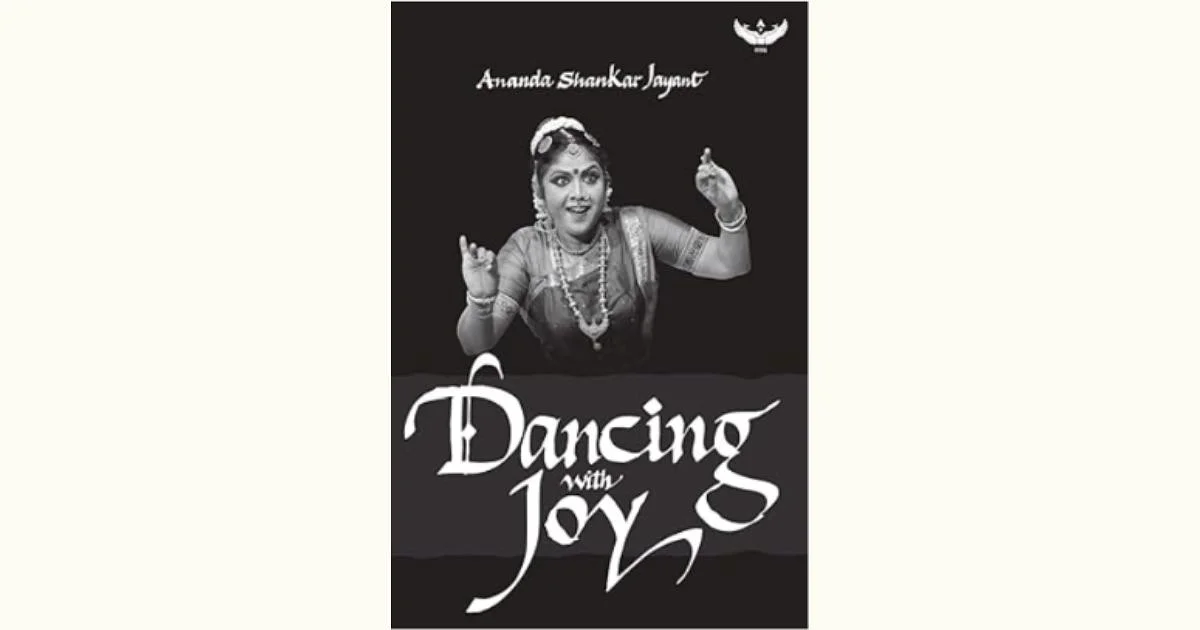
‘Dancing With Joy’, by Padmashri Dr. Ananda Shankar Jayant, answers these questions and more. It accords art and culture their rightful place as an ageless, priceless civilizational inheritance, as that which nourishes the individual and collective in its entirety. The book asks: What is that collective Bhāratīya citta that has created a colossal centuries-old legacy of refined, elevating arts and aesthetics across its magnificent kṣetras, cave temples, written and oral traditions, itihāsa and kāvya, to name a few? What are its qualities? How can we serve to preserve and perpetuate?
The book also shows us what a life lived in dedication to and in service of the arts and the civilizational treasure it holds truly looks like.
The first two chapters of the book are a sojourn into how Bhārata teaches and moulds the child at home and through the gurukula, seeding samskāras that are powerful, positive, and uplifting. As Ananda ji introduces us to her world, we encounter the first of the two women who shaped her devotion to dance, travelled with her to dance classes and (later) performances, enrolled her into the prestigious Kalakshetra, wrote music and sourced rare kīrtanas for her, stitched costumes and made hairstyles, aided the growth of her creative vision and most critically, set the traditional Hindu home environs with care, discipline and solid values. This was Ananda ji's mother, a woman of deep courage and substance as seen through the eyes of a proud daughter.
“We celebrated the many Hindu festivals with devotion, helping Amma in little tasks even as we learnt the customs and rituals for each puja. Introduction into our civilizational knowledge started right there with Amma as our first guru.”
We also meet her silent, stoic, and supportive father who plays a huge role at critical junctures - whether that was in nurturing a love for Carnatic music in his daughter, allowing her to join Kalakshetra as a full-time Diploma student at the age of 11, or instilling in her the discipline to pursue and complete her academic studies.
As this section traces the joyful blossoming of a young performer, we land in the presence of the dynamic Director of the Kalakshetra Foundation, Chennai: Smt Rukmini Devi Arundale. Lovingly called ‘Athai’ by her students, she is the second woman, the Guru who shapes Ananda ji's journey as a danseuse and is also known as a figure who has contributed in great strides to institution-building, preservation of the arts and cultivation of young artists in contemporary Bhārata.
“Your dance must help you reach a state of oneness with a higher consciousness. We must internalize our dance in such a way that you become one with it. We must forget our petty mundane selves, only then we become channels for the arts of the Masters to manifest through us, only then will something uplifting happen.” - Rukmini Devi Arundale
She is prompt in recruiting the budding Ananda ji into Kalakshetra, and with that, we receive a glimpse of what life looks like in the precincts of an art-centric gurukula, as also the multi-faceted nature of the Indian classical arts. In this review, I share a small snippet.
Ananda ji describes the intensive routine and curriculum at Kalakshetra as a deep dive into the civilizational wealth of Bhārata. Across six exciting and life-defining years, she was introduced to the gāyatri japa and dhyāna, Carnatic music lessons, Bhagavad-Gītā and Upaniṣads, Bharatanāṭyam theory, the art of staging a concert, aesthetics, choreography, multiple folk dance styles and more, in a truly immersive guru-śiṣya paramparā format.
What also stands out is the space provided for learning by observation and doing - be it the osmosis that happened as she watched Rukmini Ji and other senior teachers compose and choreograph or perform roles in concert productions such as Mīnākṣī Vijayam, Damayantī Svayamvaram and many others. This is a characteristic of the gurukula ways of teaching-learning.
“I learnt important tenets of choreography and stagecraft, just watching Athai choreograph and have a production go up on stage. The greatest learning a student of dance could ever dream of.”
Throughout the book, as the reader, we come in touch with essential śiṣya gunas and ātma guṇas that flower in one's being through the climate of inquiry and immersion that any Bhāratīya vidyā or kalā provides. One such critical guṇa that shines through in Ananda ji’s formative years is her curiosity to learn and absorb, to observe and practice and to be truly receptive to all opportunities of learning provided.
The Art and Tenor of a Full Life
As the book progresses, the many facets of the author's life arc as a professional Bharatanāṭyam artiste, teacher, entrepreneur and choreographer unfold. There are many lessons and insights to draw. However, for the sake of this review, I present a few central ones that spoke to my heart, with the hope and wish that you pick up the book soon (and an art form along the way!).
In the manner that Ananda ji chooses to navigate gaining her matriculation certificate and higher degrees on one hand and nurturing her growing dance career on the other; through her decision to train for and take up a senior position at the Indian Railways; to serve as a bureaucrat for 30+ years alongside building a unique institution as an artiste - what speaks to us through the pages of the book is an indomitable iron-clad will to stay the course and thrive, while at it.
"Our unique skill and craft is the ignition key to a great life, and endorses us with purpose. Our commitment to our dreams is the true pathway for comebacks from setbacks."
This is also representative of why bhāratīya education lays all-round emphasis on nurturing a child's latent characteristics and talents through the vidyās and kalās, sans over-indexing on one of the two. Another central aspect is her intent and ability to engage fully with the various facets of her own self, breaking long-held societal notions around work and passion, adopting the arts as a career and what constitutes success and a good life.
"A deep engagement with every facet of who we are, is a life well lived. Anything else is a compromise," she writes.
Not only as a performer, but as a teacher who shares her art with hundreds, as a choreographer staging impactful and path-breaking productions, as a dance scholar, an international speaker, a householder, a high-ranking bureaucrat and much more. Laid out across the book are these simple nuggets that stir one's own yearnings, calling out to buried parts of ourselves and nudging us to nurture our core strengths and passions, showing us that they provide us with impetus to sail through life's responsibilities and challenges with grace.
Creating With Joy
If the initial chapters set the foundation, the next few sections verily form the heart of the book. It is as if we are sitting on the edge of the window seat in a fast-moving and aesthetically immersive train, watching extraordinary scenes of creativity and determination unfold.
As a performer par excellence and founder of Shankarananda Kalakshetra, this period from the late 1980s onwards witnesses multiple magnum opus dance productions being birthed from Ananda ji's expansive creative vision that further go on to tour various cities in Bhārata and prestigious festivals across the Americas, Greece, Russia, Canada, South Korea, China and more.
We are introduced to the rigor and depth of research and the months (sometimes years) of painstaking detail, of sheer hard work that goes behind staging a production that reaches us as a powerfully soul-elevating experience. For instance, Śrī Kṛṣṇam Vande Jagadgurum', her first full-length popular, two-hour dance production (Aug 1987), depicting the various facets of Śrī Kṛṣṇa’s life, draws from texts such as Kṛṣṇa karnāmrutam, Śrī Kṛṣṇa Caritāmrtam, Śrimad-Bhāgavatam, among others. Dance and the arts, largely, are nothing but tapasya for a lifetime, that refines the being akin to how a diamond is shaped.
"Selecting themes, scripts, setting them to music, choreography, rehearsals, costumes, and the final presentation of sharing not just my creativity, but also offering stunning visual memories that the audience could take back, inspired my creative arc."
While inspiration arrived naturally from Bhārata's corpus of kathās from the itihāsa-purāṇa, the humongous musical treasures of the vāggeyakāras and greats such as Annamācārya and bhakta Rāmadasa, the mārgam and ekāharya formats of Bharatanāṭyam, and impetus provided by Ananda ji's own mother ~ societal events and cross-continental stories also shaped some of her out-of-the-box creative endeavors and built a risk-taking mindset that would continue to support her in charting her path as an artiste serving a civilizational renaissance in her own way.
Two such examples:
-
One that blended the graceful stances of Bharatanāṭyam with the lightness and flow of contemporary dance styles, set to jazz music to showcase the story of Jonathan Livingston Seagull's tireless and deeply inspiring search for excellence.
-
And another, a visually potent dance theatre work that utilized searing English, Saṃskṛta and Tamizh poetry to both question and address social challenges faced by women back then and culminated in a resilient woman rising to her inner strength and taking her rightful place in society.
This voyage takes further curves, with the vibrance of Kuchipuḍī and an invitation to edit a colorful, well-researched coffee table book dedicated to ‘Andhra Dance Traditions’ added to the repertoire, with a detailed introduction to the kalās of the great Telugu lands for us, the reader.
To sum up, these chapters brim to the rim with the rasa of ānanda, encapsulating within them the glories of Bharatanāṭyam and Kuchipuḍī as classical dance forms and their preservation of civilizational idiom and memory and the fulfillment an art form brings to anyone who chooses to engage with them, heart and soul.
Dancing Through Cancer
This is one of the defining chapters in the memoir and in Ananda ji's life - not so much for the condition itself but in how she chooses to overcome and where she draws her strength from.
The chapter is stirring in its portrayal of the excruciating battle with cancer and the ravages that chemotherapy causes to the body on one hand and Ananda ji's grit in breaking the silence and morbidity associated with the condition. She decides to speak about it to her loved ones with cheer, goes through and rises above the emotional rollercoasters and all through anchors on dance as her core strength, mounting monumental achievements during this period.
"(After lumpectomy on July 7), from 21st July, for five nights, carrying through my commitment, I went up on stage daily to complete and present Nritya Shakti, the 5-day dance festival successfully, even as my mornings got busy with pre-tests before I started the next cycle of treatment - chemotherapy."
In previous chapters, we witness the Śrī Rāma bhakti that courses through her veins and pushes her to present timeless productions such as ‘Thyāgarāja Rāmāyaṇam’ and ‘Śrī Rāma Nāmam, Entha Ruchi Ra.’
As a Nritya Choodamani awardee, Ananda ji is called upon to convene two editions of the landmark Natya Kala Conference or NKC (hosted by Krishna Gana Sabha, Chennai) in 2008. Even as she continued to deal with cancer treatment, it was Śrī Rāma who appeared as an inspiration again.
The 1st of the two NKCs hosted by Ananda ji is a dedication to Śrī Rāma and the Rāmāyaṇam in Performing Arts. It brought alive the tattva of Śrī Rāma to adults and children, scholars and rasikas alike through its exploration of textual traditions, folklore and oral traditions inspired by the Rāmāyaṇa, performance traditions from South East Asia, dance traditions from across Bhārata, Śrī Rāma bhakti and its impact on celebrated music maestros, visual arts and storytelling sessions for the young ones. This was a benchmark for NKC itself, as many doyens of dance, art critics, and reviewers wrote.
The 2nd edition, focused on all that matters in and for the world of dance. From the evolution of dance to received legacies, to innovation and new talent, sustenance of the arts, challenges around artists' livelihood, impact of performing arts on media, and so on, emerging as another iconic blend of scholarship and practice.
It was not Śrī Rāma alone. The sacred core of Bhāratīya civilization is its quest for cosmic truth, the rsi and guru paramparas that make the highest wisdom accessible and the sustaining force of life, and its great devatās who hold us safe and strong in a myriad forms. It is the magnificent rūpa, the unique guṇas of a devatā, and the depth of a bhakta's bhāva towards them that becomes the lodestar during challenging times.
In this context, Ananda ji draws strength from the fierce yet compassionate form of Durgā Devī, the Mother Goddess - Her 18 battle-ready arms offering courage and protection, the source of inspiration and resilience.
"Durga - resplendent, beautiful, bedecked. Her eighteen arms ready for warfare, as she rode into the battlefield astride Her Lion.
Durga - The embodiment of Shakti, of creative feminine energy. The fearless one."
Simhanandinī, set to the Simhanandana tāla, is a rare art form from the ritualistic repertoire of Kuchipuḍī dedicated to Durgā Devī. After Ananda ji learns this art from a traditional maestro after a long quest, she presents an excerpt from Simhanandinī when she is invited to represent Bhārata at the renowned TED India Conference. Her session outlines the power of stories and captures metaphorically, her poignant journey of dancing through breast cancer, with the power and anugraha of Durgā Devī.
As this chapter closes, one feels that peculiar emotion that arises after a storm has passed and calm reigns, with the śakti of the Divine Mother starkly visible through the pages.
An extraordinary life is often crafted with one's indomitable will, with divine grace and the unrelenting support of loved ones. A special mention here for the life partner who makes the performing artiste in Ananda ji thrive and brings humor to her darkest periods, and her entire team that participates vigorously in her creative endeavors.
Of Innovation And The Way Forward
Among many other adventures, a few central ones speak of the foresight and innovative spirit essential to bridge gaps in training methodologies, in the spread of arts and storytelling in modern Hindu society and among the young, and to create festivals and platforms that bring civilizational thought to the fore.
At a time when the idea of a technological future was beginning to emerge, ‘Natyarambha’ was launched as a one-of-a-kind web application and digital aid for practicing Bharatanāṭyam basics, accompanied by detailed guidance, mnemonics, music and interactive visuals.
As the world battled lockdown, ‘Kutty Kahani: Eternal Stories - Young Storytellers’ offered 55 episodes of ancient stories creatively retold by enthusiastic young children, augmented by cutting-edge animation and design. This series drew praise from Prime Minister Śrī Narendra Modi on one of his Mann ki Baat episodes.
And finally, with a 4-edition run thus far, Rāmāyaṇa Kalpavṛkṣam, inspired by Kavi Samrat Vishwanatha Satyanarayana, has grown to become Bhāgyanagaram's (Hyderabad) very own multi-art festival packed with music, dance and visual art performances, exhibits and workshops and scholarly talks by young and senior scholars celebrating the essence of our civilization - Śrī Rāma and the Rāmāyaṇa. Bṛhat has been honored to collaborate and serve Ananda ji's vision for this landmark civilizational initiative across its 4 editions. Towards the end of the memoir, she asks critical questions and outlines a vision for the preservation and flourishing of the Indian classical arts.
She points out that we as a society have cast the arts aside, trivializing them as mere entertainment, thereby unseeing a critical aspect of our collective consciousness and ignoring the role of the arts as legacy carriers. We have forgotten that our ancient and medieval empires engaged with the sciences, trade, and arts alike, leaving behind legacies of art and aesthetics that continue to command wonder and respect.
Our times, fraught with the crisis of loneliness and growing strife at individual and collective levels, echo the need for the healing and empowering nature of the arts more than ever. For our young people, the arts offer potential to build deep personal reserves of fortitude and discipline, of joy, beauty, and harmony, and essential skills such as multi-disciplinary thinking, creativity, collaboration, enhanced focus, and so on.
Therefore, the book asks:
-
Can we establish Vidyākalākṣetras that will serve as state-of-the-art performing and visual arts institutions?
-
Can the arts be treated as MSMEs (Micro, Small, and Medium Enterprises)?
-
Can we look at Indian classical art theories and how they can impact design-tech interfaces?
-
Can we rebuild our education systems to become arts-integrated?
-
Can we aspire for an arts quota and a consistent cess-like funding from the State?
-
Can development and corporate projects commit to building arts infrastructure?
-
Can we commit to reviving the principle of building worthwhile legacies for our future generations through arts revival?
For educators, storytellers, and art and culture policymakers, the memoir offers a glimpse of the deeply transformative potential that the performing arts hold. For working professionals, it is a call to step into the world of any art form that speaks to us, if we haven’t already.
For young dancers picking up this book, be ready to be introduced to the doyens of the world of dance and what it takes to build a life of larger value for oneself and the world.
I found myself enriched by simply reading the names of maestros like Śrī Pakkiriswamy Pillai, Smt Rukmini Devi Arundale, Śrī KN Dandayuthapani Pillai, and countless others. In that sense, Dancing With Joy offers an impetus to dive deeper into both the practice of dance and music and the parampara that has sustained it through time.
We hope Ananda ji’s memoir serves as an inspiration to many more and that her journey continues to nurture the next generation of culture-rooted Bhāratīyas.
"Dance to me is a language. Dance to me is a journey, my life-breath, a process of life, of ascension in multiple layers of the intellectual, emotional, physical and spiritual."


.png)