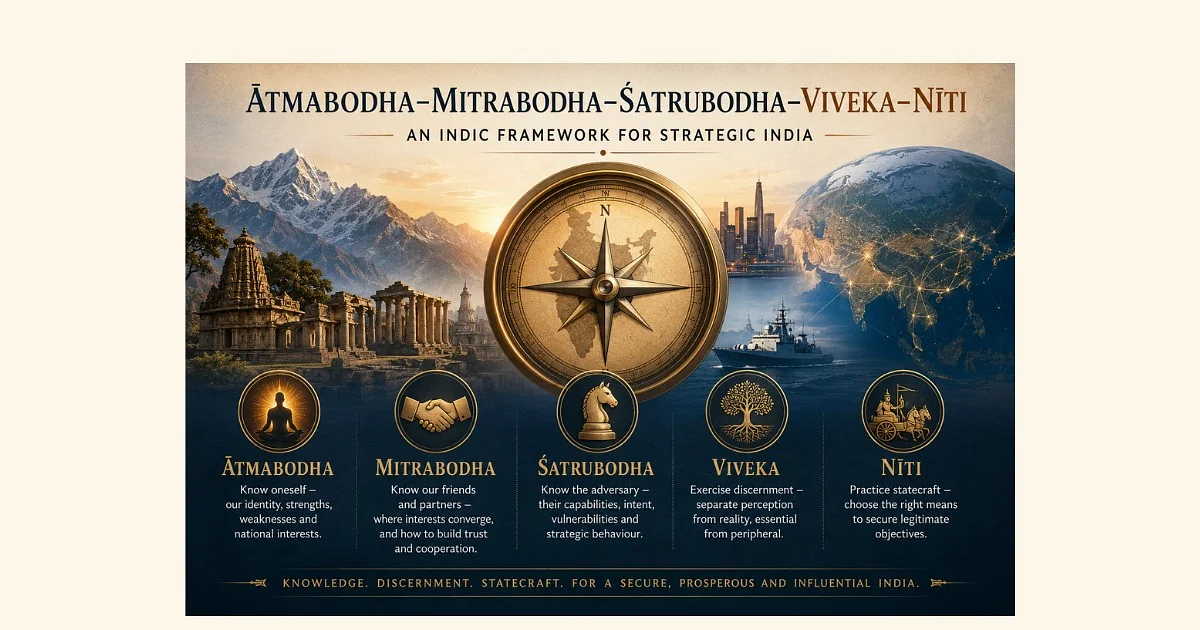
In the current geopolitical climate, states are facing a crucial challenge: How does a country see itself, its allies, and its enemies, and what options does it have? The question has been approached in traditional strategic thinking terms: know yourself and know your enemy. But today's international politics is much more complex. Some friends don't necessarily have the same interests. Rivals can work together on a case-by-case basis. Threats can come from “unusual” sources. Often, the highest strategic risk lies not with an outside enemy but in not understanding oneself.
This requires a more comprehensive conceptual approach for India that can be achieved by using the five ideas of Ātmabodha, Mitrabodha, Śatrubodha, Viveka, and Nīti. These can be interpreted as self-awareness, awareness of companions/ partners, awareness of opponents, discernment, and statecraft. These together provide a helpful perspective on India's strategic posture in a multipolar world.
The First Principle is Ātmabodha: Knowing Oneself
Ātmabodha is more than cultural pride. If a state has to develop a coherent foreign policy, it must have a reasonably clear understanding of its identity, interests, capabilities, and limitations. It is intelligent self-consciousness. For India, it means acknowledging its civilizational legacy, constitutional democracy, economic hopes, geographical location, demographic power, technological strength, military capability, and developmental quandaries. It also involves identifying vulnerabilities: disparities in economic development, reliance on technology, institutional constraints, energy vulnerabilities, border issues, and internal social divisions.
The difference between self-confidence and self-congratulation is very significant. A nation that abounds in its own strengths has no real knowledge of itself. True Ātmabodha is the bravery to identify weaknesses as explicitly as strengths. This has clear ramifications for foreign policy. It is not a slogan to pursue "strategic autonomy" for India. To achieve strategic autonomy, the nation must be economically strong, militarily capable, technologically advanced, diplomatically flexible, and domestically resilient. If these foundations are missing, autonomy is a dream and not an action plan.
The Second Principle is Mitrabodha: Knowing One's Friends and Partners
International politics is not a place where one finds purity in friendships. States have eternal self-interests, and partnerships are fluid depending on the situation. This is evident in India's ties with the U.S., Russia, France, Japan, Australia, the Gulf countries, ASEAN nations, and African nations. Mitrabodha for India, then, is to know not just who is friendly but why a particular state is willing to cooperate, where there are common and where there are conflicting interests. The Quad is an example. India, the United States, Japan and Australia work together in the Indo-Pacific region because they are concerned about a free, open and stable Indo-Pacific region.
But they have different agendas on issues. India has a distinct history with Russia, a distinct economic engagement with China and strategic agendas with the Global South. So, there's a distinction between alignment and partnership. There is no such thing as a mature foreign policy that would ask, “Who is our permanent friend?” It questions “Where are our interests aligned, how, and why?” Therefore, Mitrabodha guards India against two extremes: overreliance on one partner and over-suspicion of all partners.
The Third Principle is Śatrubodha: Knowing the Adversary
This is perhaps the most misinterpreted concept. Śatrubodha is not to make enemies. Nor it is seeing every competitor as an enemy. It is important to differentiate between competitor, rival/ adversary and existential threats when using strategic thinking. The most obvious example is China. India needs to be aware of the power of China's military, its economic reach, technological dreams, maritime strategy, border stance, BRI, and its growing footprint in the Indian Ocean. But it is not enough to just pick up on the negative side of the relationship with China. India also has a high degree of economic engagement with China, and both have a shared membership in a number of multilateral institutions. The strategy is not hostile but correctness of evaluation, but there are questions that need answers.
What are the enemy's goals? What can it do? What are its weaknesses? What is its attitude toward us? What are the red lines for it? Where is it better than it is in other places? Where can we discourage it? Where is the opportunity for partnership despite the competition? It's here that intelligence and strategic analysis are essential. A country that ignores threats, preferring a more palatable worldview, is strategically illiterate. But a country that has an enemy in every disagreement is just as bad for itself.
The Fourth Principle is Viveka: Discernment
This could turn out to be the most crucial part of the structure, as information doesn't create wisdom. One state can have a lot of brain power over another state and still be wrong. The challenge is not having enough information; it's not having enough judgment. Viveka is the process of separating the essential from the peripheral, the perceived from the real, the short-term challenge from the long-term threat, the desired from the doable. Take the Ukraine situation, for example. India has been dealing with a very challenging strategic scenario with Russia, the United States, Europe, Ukraine, and other countries from the Global South. An elementary solution would be to select one side.
A more sophisticated understanding does take into account India's concern about energy security, defense supply, territorial sovereignty, ties with the West, and its historical ties with Russia. Likewise, the Indian stance on Indo-Pacific is not that of “anti-China” politics. India has justifiable concerns related to the security of the sea, freedom of navigation, resilience of supply chains, and stability in the region. Viveka empowers India to indulge its interests without turning all relationships into confrontations. Viveka is thus the intellectual link between knowledge and action.
The Fifth Principle is Nīti: Statecraft
It is not enough to know oneself, one's partners, and one's enemies. A state has to ultimately make a decision on what to do. It is Nīti's realm. The ideas of statecraft, diplomacy, power, alliances, intelligence, and strategic calculation have been a part of Indian political thinking for a long time. For instance, the Arthaśāstra of Kauṭilya addresses statecraft as a practical art of dealing with security, prosperity and maintaining the state. Nīti does not indicate anything narrow in terms of morality, nor does it indicate anything narrow in terms of Machiavellian manipulation. It can be better seen as an art of selecting suitable means for attaining legitimate political goals. It is an important consideration in the foreign policy of today's India. The multi-partnership approach of India is an expression of Nīti. It is capable of cooperation with the Quad, of defense cooperation with Russia, of closer strategic engagement with France, of participation in the Gulf, of closer relations with ASEAN, and of relations with Iran, and yet it is looking for more strategic space. Some pundits deem this to be a contradiction. It can be seen instead as strategic flexibility. There needs to be room for flexibility.
Without a hierarchy of interests, every relationship now becomes opportunism. Nīti requires prioritization. The five concepts are thus in sequence. “Who are we?” is the question asked by Ātmabodha. Mitrabodha asks: “Who can be our partner?” Śatrubodha asks: “Who can oppose us?” Viveka questions: “What is essential, and what seems to be essential?”. Finally, Nīti asks, “What is to be done?”
This structure is also an antidote to the current political discourse. In democracies, the enemy (and political opponents) are often the same. Another aspect of this would be the international political appeal for simplistic friend/friend and foe/foe classifications. This is a type of thinking that can be harmful if applied strategically. India's strategic culture, on the other hand, needs to build the ability to identify difference, competition, rivalry, hostility, and war. Not all conflicts are conflicts. Not all partnerships need to be aligned. Not all enemies have to be fought. Not all compromises are about weakness. When this framework is applied, it establishes identity and realism without any complacency, power and judgment, and values and interests without any paranoia.
If Mitrabodha is not accompanied by Viveka, it can create dependency. Without Viveka and Nīti, there can be an infinite amount of analysis without action. But when Nīti is without purpose and ethics, it can simply become opportunism in the short run. Hence, India requires all five.
A new international order is emerging, one that is increasingly fractured, competitive, and uncertain. The world of inherited certainties that followed the Cold War is fading. The competition among the great powers is growing. Technology is turning into a space of strategic competition. Economic interdependence is increasingly being weaponized. The tools of power are maritime spaces, critical minerals, supply chains, data, and semiconductors. In this context, the best thing that India can do is not pick one single camp. It might be that India can make sense of itself and its own circumstances, comprehend its policy and program interests, and interact with a couple of centers of power without becoming subservient to any one. To do this, we must have a strategic culture that is able to consider things in other than binary terms.
Conclusion
A fivefold vocabulary of Ātmabodha–Mitrabodha–Śatrubodha–Viveka–Nīti is possible and valuable. The ultimate lesson is easy: A country must first know itself, then understand those who can help it, those who can hurt it, and the difference between them. However, knowledge is not enough. It must be transformed by intelligence into good policy. It is not only a thought exercise in India. It must be done strategically. With a growing multipolar world, the only thing that will not be in question is whether India has power. What is more important is whether India has the self-awareness, strategic vision and political acumen to harness that power. That is where the foundation assumes critical importance- Mitrabodha and Śatrubodha are strategic awareness, Viveka is the instrument of judgment, and Nīti is the art of action.