Ugādi: The Science and Ritual of New Year
Overview
This is a 2-day live workshop that explores Saṃvatsarādi – the first day of the Hindu New Year, from every relevant dimension. Beginning with the verse from the Brahma Purāṇa that locates creation itself on Caitra Śukla Pratipadā, participants explore the rich landscape of Yugādi as it is celebrated across Bhārata and the global diaspora. This workshop will cover the astronomical and mathematical foundations of the Pañcāṅga and the practice of Pañcāṅgaśravaṇa. It also focuses on the ritual prescriptions of the Dharmaśāstras and practical methods for transmitting this living knowledge to the next generation so that the practice of dharma is renewed in every generation.
Intent
We live in an age where our festival days are observed as holidays, occasions for food and family, but the deep meaning behind the rituals has been lost. The cosmological vision encoded in Yugādi, the sophisticated time-science of the Pañcāṅga, and the dhārmika worldview they embody are urgently in need of revival. This course exists to bridge that gap: to help practitioners move from mechanical performance of rituals to conscious, meaningful engagement with them. When we understand why we light a lamp, why we listen to the Pañcāṅga, why the day’s Navagraha configuration matters, we are no longer merely following custom. We are participating in a living civilisational consciousness.
This course is an invitation to that participation.
Structure
This is a compact 2-day live workshop, designed as a self-contained introduction to the cosmos and culture of Yugādi. Day 1 is dedicated to understanding the Pañcāṅga while Day 2 moves from knowledge into practice. The two days are designed to work as a unified whole and may serve as an entry point into Bṛhat’s broader offerings in Dharma Śikṣā and Jyotiṣa. This workshop is part of a year-long festival series covering many more festivals ahead.
Contents
Module 1
16 March - Kālagaṇanā and the Pañcāṅga – Bhārata's Science of Time
An exploration of Bhārata’s sophisticated system of time-reckoning rooted in the movements of the Sun, Moon, Jupiter, Saturn and other celestial bodies. We understand what makes the Pañcāṅga the world’s most dynamic and scientifically coherent calendar. Participants are introduced to the five limbs – Tithi, Vāra, Nakṣatra, Yoga, and Karaṇa – and learn how to read and use the Pañcāṅga meaningfully in daily life, for muhūrtas, festivals, and personal planning. The distinction between the static solar and dynamic lunar calendars is explored in depth. The session also covers Pañcāṅgaśravaṇa as a ritual act of cosmic orientation on Yugādi.
Module 2
17 March - Yugādi Rituals – Practice, Meaning and Transmission
A deep engagement with the rituals and practices of Yugādi as prescribed by the Dharmaśāstras. We walk through each observance – from prātaḥsnāna and deva-pūjā to nīm-jaggery prasāda and Pañcāṅgaśravaṇa, with their philosophical, dhārmika, and physiological significance. The session concludes with practical guidance for parents, educators, and community leaders on how to explain and transmit these practices to children and the next generation, sowing the seeds of dharma dṛṣṭi.
Key Takeaways
Learn
Bhārata's science of Kālagaṇanā and the astronomical foundations of the Pañcāṅga.
Understand
The cosmic and Purāṇic significance of Caitra Śukla Pratipadā as the beginning of creation and how it is celebrated across Bhārata.
Develop
Practical literacy in reading and using the Pañcāṅga’s five limbs - Tithi, Vāra, Nakṣatra, Yoga, and Karaṇa, for daily life and planning.
Gain
Knowledge of Yugādi rituals as prescribed by the Dharmaśāstras, including their correct observance and inner significance.
Cultivate
An understanding of Pañcāṅgaśravaṇa as a ritual act of cosmic orientation at the New Year.
Acquire
Practical tools and language to transmit this knowledge to children and the next generation, cultivating dharma dṛṣṭi from an early age.
Who is this course for?
- Practitioners and seekers seeking conscious, informed observance beyond mere rituals
- Parents who want to explain festival traditions to children with depth and clarity
- Teachers and educators involved in dharma śikṣā
- Students of Jyotiṣa or Dharmaśāstra wanting a practical, grounded introduction
- Community leaders and pūjārīs aiming to communicate festival significance more meaningfully
- Anyone who wishes to learn the traditions, offerings, and pūjā rituals
Know your Instructors
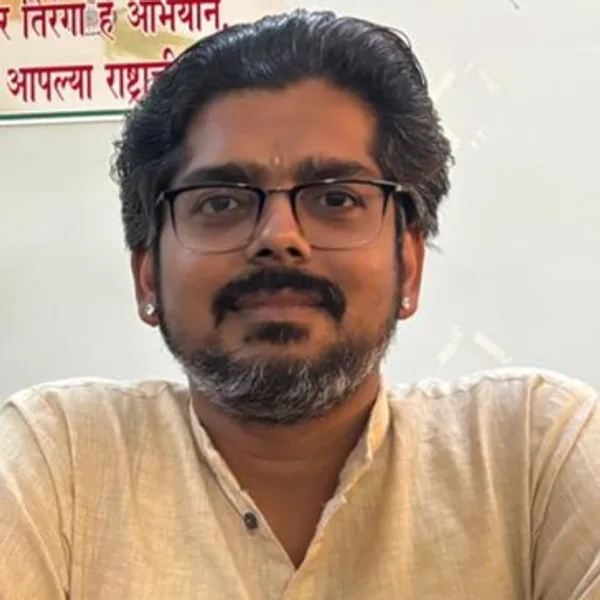
Dr. Ashish J
Dr. Ashish J is an Assistant Professor of Jyotiṣa at Kavikulaguru Kalidas Sanskrit University with over five years of experience specializing in Phalita-Jyotiṣa and Vāstu Śāstra. He holds a Ph.D. and M.Phil. in his field from Rashtriya Sanskrit Vidyapeetha, Tirupati, complemented by an M.Sc. in Psychology and multiple diplomas in technical and śāstrika subjects. His research portfolio includes serving as a co-investigator for an IKS-sponsored project on the Dakārgala system, authoring the book Prāśnikadrstih, and receiving honors such as the Global Eminent Academician Award. Beyond his academic publications on topics like Sūryasidhdānta and ancient Indian astronomy, he is a multilingual educator proficient in Saṃskṛtam, Hindi, and English, actively integrating ICT tools into his teaching.
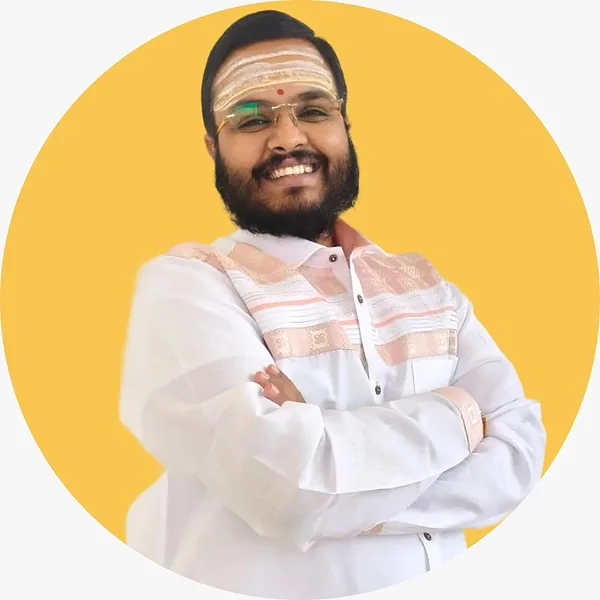
Dr. Srinivas Jammalamadaka
A distinguished scholar of Indian philosophy and śāstric traditions who has studied Nyāya (Tarka Śāstra) under Śrī A. Radhe Shyama Shastri garu, Advaita Vedānta under Śrī R. Mani Dravida Sastrigal, and Vyākaraṇa under Śrī Ganti Dattatreya Murthy. He has completed the Tenali examinations in Tarka Śāstra and Advaita Vedānta, and holds an MPhil and PhD in Nyāya Śāstra. He has served as Assistant Professor and Director of the School of Śāstric Learning at Kavikulaguru Kalidas Sanskrit University, Ramtek, and as Scholar for IKS courses at Siddhanta Knowledge Foundation
Our Draṣṭā online courses are designed to help you in your learning journey
Become a part of the community and engage, share, discuss and deepen your learnings
Interact with the course instructor through live sessions
Access to session recordings and materials

Become a member and dive into the Indic universe
Brhat subscription gives access to exclusive member-only content rooted in the Dharmic worldview.
Starts at ₹500 per month.