Introduction
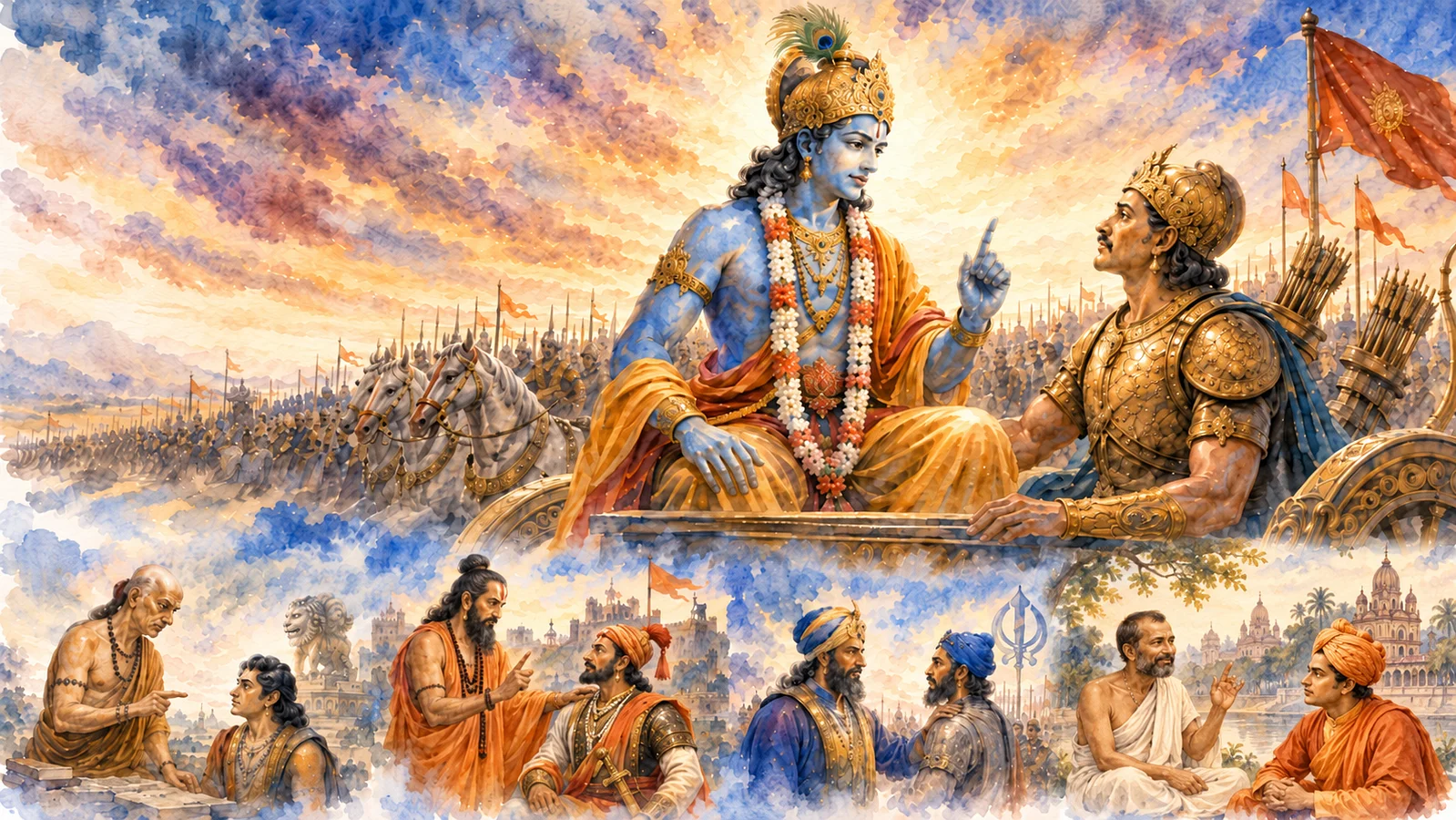
The dialogue between Śrī Kṛṣṇa and Arjuna on the battlefield of Kurukṣetra was not a one-time event.
It was not merely a historical conversation preserved in the Mahābhārata. It was not only a philosophical teaching delivered before a great war. It was not simply a moment where one warrior, overwhelmed by doubt, received guidance from his charioteer.
It was a civilizational archetype.
Again and again, across Bhārata’s history, the same inner drama has resurfaced. Whenever confusion has clouded clarity, whenever adharma has risen with force, whenever the future of society has demanded courage, another Arjuna has stood at the edge of action. And whenever such a moment has arrived, a guru has appeared - not to command, but to awaken.
The battlefield changes.
The warriors change.
The political circumstances change.
But the deeper Kurukṣetra remains.
Kurukṣetra as the Field of Human Crisis
Kurukṣetra is not only a physical battlefield. It is the field of dharma, the place where moral crisis becomes unavoidable. It is the point at which one can no longer remain neutral, passive, confused, or withdrawn.
Arjuna’s crisis was a crisis of discernment. He saw before him not enemies in the abstract, but teachers, elders, cousins, and loved ones. He was not afraid of fighting alone. He was troubled by the consequences of action. He was caught between affection and duty, between personal emotion and larger responsibility, between his role as an individual and his svadharma as a kṣatriya.
This is why the Bhagavad Gītā begins with vulnerability. Arjuna collapses. He questions. He refuses. He places his bow down.
And then, crucially, he turns to Śrī Kṛṣṇa as śiṣya.
That moment changes everything.
The teaching of the Gītā emerges only when Arjuna moves from argument to surrender, from confusion to inquiry, from emotional paralysis to the humility of learning. The guru does not erase Arjuna’s agency. Śrī Kṛṣṇa does not fight the war for him. He does not reduce Arjuna to an instrument without reflection. Instead, he expands Arjuna’s vision until he can act with clarity.
This is the essence of the guru-śiṣya relationship.
The guru awakens the śiṣya to his own higher possibility.
The Living Continuity of the Gītā
The conversation of Kurukṣetra did not end with the Mahābhārata. It became a living pattern within Bhārata’s civilizational memory. In every age, when dharma required protection, restoration, or rearticulation, the same archetype reappeared.
The guru saw what the śiṣya could become before the śiṣya fully knew it.
The battle was external, but the first victory had to be internal.
This continuity is visible across many decisive moments in Indian history.
Cāṇakya and Candragupta: Reclaiming Sovereignty
When Cāṇakya guided a young Candragupta Maurya, the challenge before them was not merely the rise of one ruler. It was the reorganization of political power and the recovery of sovereignty.
Candragupta was not born into ready-made imperial certainty. He had to be trained, disciplined, and prepared. Cāṇakya did not merely offer advice; he shaped a leader. He recognized potential and forged it through strategy, education, austerity, and political clarity.
In this relationship, we see another echo of Kurukṣetra.
The guru provides vision. The śiṣya undertakes action.
Cāṇakya’s instruction was not sentimental. It was rooted in artha, statecraft, realism, and the protection of the realm. Yet it was not divorced from dharma. The purpose of political power was not personal enjoyment. It was order, sovereignty, protection, and the flourishing of society.
Candragupta’s rise was therefore not simply a military or political event. It was the outcome of a knowledge tradition shaping leadership for civilizational purposes.
Samartha Rāmdās and Shivaji Maharaj: Awakening Dharma-Rakṣaṇa
Centuries later, the same pattern emerged in the relationship between Samartha Rāmdās and Shivaji Maharaj.
Shivaji Maharaj was not merely a warrior-king. He became a symbol of Hindū self-rule, civilizational protection, and political courage. But such courage does not emerge from military skill alone. It requires inner conviction. It requires the ability to see one’s struggle not as personal ambition, but as a larger duty.
Samartha Rāmdās helped awaken and strengthen that inner resolve. His guidance reinforced the idea that rulership must be anchored in dharma, self-restraint, responsibility, and protection of the people.
Here again, the guru did not replace the warrior. He clarified the warrior’s purpose.
Shivaji Maharaj had to act. He had to build institutions, fight battles, take risks, and carry the burden of rule. But the force behind such action was not mere conquest. It was dharma-rakṣaṇa - the protection of dharma.
In this, we see Arjuna again.
The warrior does not fight because he hates. He fights because there are times when protection itself becomes a sacred duty.
Guru Gobind Singh and Banda Bahadur: Fearless Action
The flame of this paraṃparā also resounded in the transformation of Banda Bahadur under the inspiration of Guru Gobind Singh.
Banda Bahadur’s life reminds us that a person can be turned from withdrawal to action when touched by a higher call. Guru Gobind Singh did not merely give him a political mission. He awakened in him the spirit of fearless resistance to injustice.
This was not an ordinary rebellion. It was an action born of dhārmika urgency.
The śiṣya, when awakened, is no longer driven by personal insecurity or narrow gain. He becomes capable of sacrifice. He becomes ready to bear consequences. He becomes an instrument through which a larger force moves.
That is the power of the guru’s call.
It does not flatter the ego. It burns away hesitation.
It does not create blind aggression. It creates fearless responsibility.
Vidyāraṇya, Hakka, and Bukka: Rekindling the Light of Vijayanagara
The founding of the Vijayanagara Empire is remembered in civilizational memory as another moment where knowledge and power came together to protect dharma.
Svāmi Vidyāraṇya’s guidance to Hakka and Bukka was not merely religious instruction. It was civilizational reorientation. In a time of political turbulence and cultural threat, the need was not only for resistance, but for reconstruction.
Vijayanagara became more than a kingdom. It became a luminous center of art, temple culture, scholarship, administration, commerce, and dhārmika confidence. It showed that sovereignty is not only the ability to defend borders, but the ability to create conditions where civilization can flourish.
This too reflects the Gītā’s deeper teaching.
Action is not merely destruction of adharma. It is the establishment of dharma.
A warrior may win a battle. But a civilization must build, nourish, preserve, and transmit.
Vidyāraṇya’s role reminds us that behind every great act of political renewal lies a deeper knowledge system. The sword may protect, but it is wisdom that gives direction.
The Guru Does Not Command, He Awakens
In each of these examples, the guru does not function as a mere instructor. He is not simply a teacher of information. He does not merely transfer skills.
The guru awakens vision.
He sees the śiṣya’s svadharma and calls it forth.
He pierces confusion.
He places individual pain within a larger frame.
He reminds the warrior why action matters.
This is why the guru-śiṣya relationship cannot be reduced to modern mentorship. Mentorship may improve performance. Coaching may sharpen skills. Training may build capacity. But the guru-śiṣya paraṃparā works at a deeper level.
It transforms the being of the student.
It does not merely ask, “What can you achieve?”
It asks, “What are you here to uphold?”
It does not merely prepare one for success.
It prepares one for responsibility.
The Śiṣya Must Also Be Molded
The presence of a guru alone is not enough. The śiṣya must also be ready.
Arjuna had to listen.
Candragupta had to be disciplined.
Shivaji Maharaj had to carry the burden of kingship.
Banda Bahadur had to act with courage.
Hakka and Bukka had to translate guidance into institutional creation.
The śiṣya is not passive clay. He is an active participant in transformation. He must be willing to be corrected, refined, and strengthened. He must surrender ego, but not agency. He must cultivate humility, but not weakness. He must receive guidance, but then stand in the field of action himself.
This is the profound balance of the tradition.
The guru shows the path.
The śiṣya must walk it.
The guru awakens clarity.
The śiṣya must act upon it.
The guru reveals dharma.
The śiṣya must embody it.
The Inner and Outer Kurukṣetra
Every age has its external Kurukṣetra: invasions, injustice, social decay, political confusion, cultural amnesia, moral weakness, intellectual colonization, and institutional failure.
But the outer Kurukṣetra is always preceded by the inner one.
Before Arjuna can face Bhīṣma, Droṇa, and Karṇa, he must face grief, attachment, fear, and confusion within himself. Before a leader can confront external adharma, he must confront internal disorder. Before a civilization can reclaim its strength, it must overcome self-doubt.
This is why the Gītā remains eternally relevant.
It does not merely teach war. It teaches clarity in a crisis.
It does not glorify violence. It teaches responsibility in action.
It does not ask us to abandon tenderness. It asks us not to let tenderness become paralysis.
It does not deny moral complexity. It teaches us how to act within it.
The true warrior is not one who enjoys conflict. The true warrior is one who can act without hatred, with steadiness, and in alignment with dharma.
Knowledge Systems as Civilizational Force
Bhārata’s unmatched strength lies in the continuity of its knowledge systems. Our civilization did not rely only on military power or political structures. It cultivated śāstra, sampradāya, tapas, pedagogy, memory, practice, and transmission.
The guru-śiṣya paraṃparā is not just a method of education. It is a civilizational technology for preserving and renewing dharma across time.
Through it, knowledge does not remain abstract. It becomes embodied.
Through it, values do not remain slogans. They become character.
Through it, leadership does not remain ambition. It becomes sevā and kartavya.
Through it, each generation receives not merely information about the past, but orientation for the future.
This is why civilizational continuity depends on living teachers and prepared students. A book can preserve knowledge, but a guru can ignite it. A text can contain wisdom, but a teacher can reveal its relevance. A tradition can survive in archives, but it lives only when transmitted through awakened human beings.
The Forces That Shape Every Epoch
Behind every epoch of dhārmika resurgence, we find certain forces at work.
There is a crisis that demands response.
There is a śiṣya who carries potential but also confusion.
There is a guru who sees the deeper order.
There is a teaching that converts hesitation into clarity.
There is action that restores balance.
And there is a legacy that outlives the individuals involved.
This pattern is not accidental. It is woven into the way Bhārata renews itself. Our civilization has faced rupture many times, but it has repeatedly found within itself the means of renewal. Not because there was never danger, but because there was always transmission. Not because confusion never arose, but because guidance remained possible.
The guru-śiṣya paraṃparā is therefore not nostalgia. It is a living force.
It is how dharma remembers itself.
When Our Moment as Arjuna Comes
The question before us is not whether Kurukṣetra will return. It always does.
It returns in different forms.
It may come as a personal moral crisis.
It may come as institutional responsibility.
It may come as cultural confusion.
It may come as the need to protect truth when falsehood becomes fashionable.
It may come as the pressure to act when comfort tempts us into silence.
At such moments, each of us must ask: when my moment as Arjuna comes, will I be ready?
Will I have the humility to listen?
Will I have the courage to reflect?
Will I have the discipline to act?
Will I recognize my guru, my śāstra, my dharma, and my responsibility?
The Gītā does not allow Arjuna to remain indefinitely in despair. Śrī Kṛṣṇa teaches, reveals, clarifies, and then asks him to rise.
That call remains alive.
It is heard whenever a young leader is awakened to civilizational responsibility.
It is heard whenever a teacher shapes a student for more than personal success.
It is heard whenever a society remembers that dharma must not only be admired, but established.
Conclusion: The Dialogue That Never Ends
The dialogue between Śrī Kṛṣṇa and Arjuna did not end on the battlefield of Kurukṣetra. It continues wherever confusion seeks clarity, wherever courage is born from wisdom, wherever a guru awakens a śiṣya to his svadharma.
It echoed through Cāṇakya and Candragupta.
It emerged through Samartha Rāmdās and Shivaji Maharaj.
It resounded through Guru Gobind Singh and Banda Bahadur.
It stirred through Svāmi Vidyāraṇya, Hakka, and Bukka.
And it continues today, in every field where dharma must be protected, restored, and lived.
The battlefield shifts.
The warriors change.
But the call remains eternal.
Let us recognize this paraṃparā.
Let us revere it.
And let us be ready , when our moment as Arjuna comes, to listen, reflect, and act.

.png)