देवि प्रपन्नार्तिहरे प्रसीद
प्रसीद मातर्जगतोऽखिलस्य ।
प्रसीद विश्वेश्वरि पाहि विश्वं
त्वमीश्वरी देवि चराचरस्य ॥
devi prapannārtihare prasīda
prasīda mātar jagato ’khilasya |
prasīda viśveśvari pāhi viśvaṃ
tvam īśvarī devi carācarasya ||
Devīmāhātmya - 11.3
As the vrata and utsava of Gaṇeśa Caturthī concludes , Śrī Mahāgaṇapati ushers in His Mother, Devī Jagadambikā. There are four Navarātris observed during a year, yet the Śāradīya Navarātri or Śarannavarātri is the most special among them all. The celebrations take on a distinct flavor regionally. For many southern-native homes, as odd as it sounds, Śarannavarātri begins with the excited opening of a carton.
My fondest childhood memories revolve around my father buzzing around the house and bringing down large cartons from the attic, frantic discussions between my parents on guests to be invited and gifts to be purchased. I would wait (and still do!) to see the layers of paper being gently pulled out from the carton to reveal familiar faces: a Kṛṣṇa whose smile has survived several generations, a pair of auspicious wooden dolls dressed afresh each year, a merchant-couple known as ‘Ceṭṭiār-Ceṭṭicci’ seated beside miniature measures of grain. Before the lamps are lit, the work of remembrance and honoring tradition has already begun.
There is a particular tenderness in handling the Golu bommais (dolls) and the assemblage of steps (golu padi) that hold them. We remember who bought them, how carefully they are stored, whose hands arranged them, and where they stood last year. Childhood finds its place in adulthood through the excitement of helping with Golu at home, choosing a place for a favourite doll, exploring creative ways of arranging the Golu exhibits, waiting for guests, and eventually wrapping everything carefully away. The bommais endure because someone has cared for them. The tradition endures because that care is learned, practised and revered.
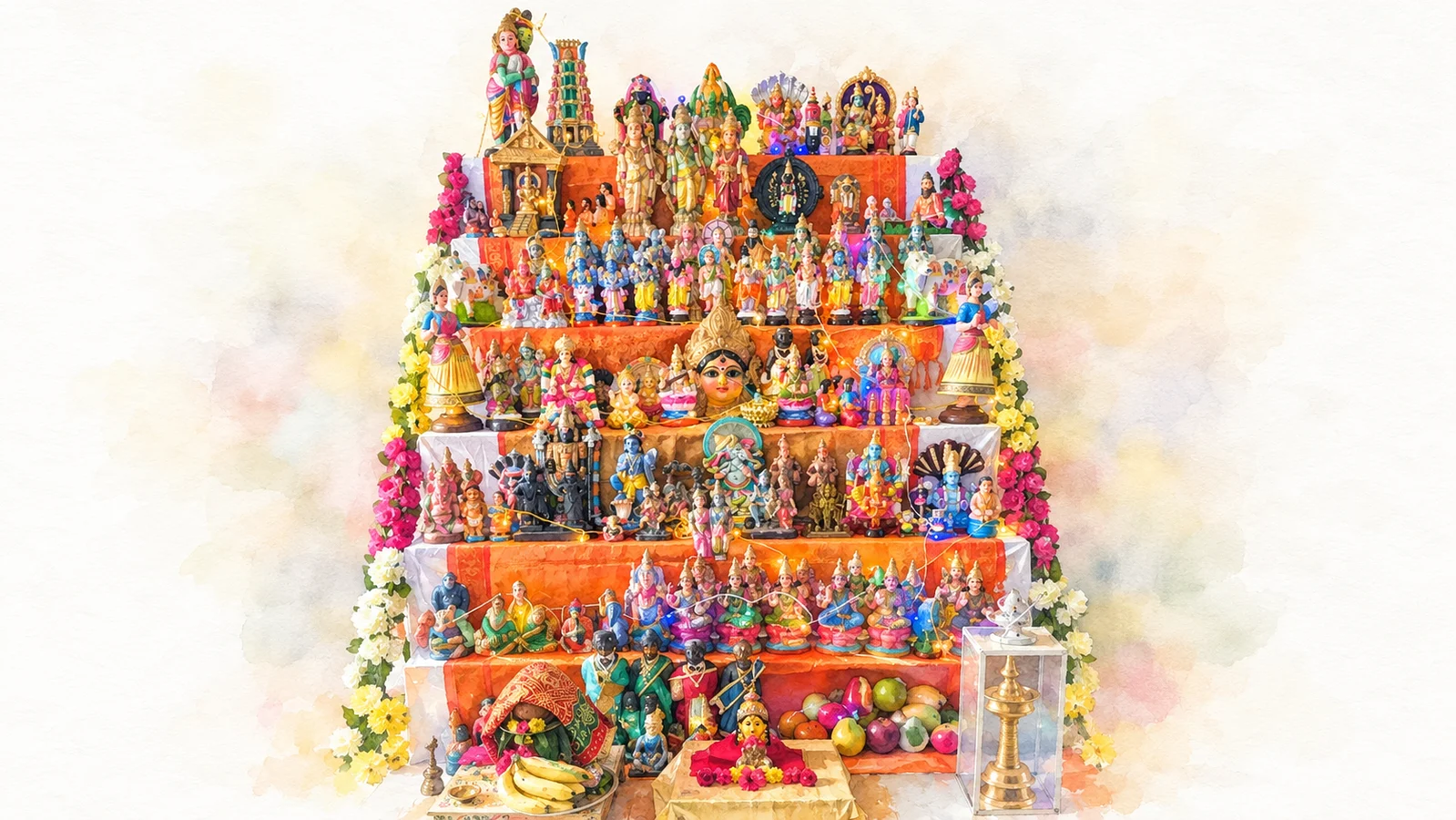
Across Tamil Nadu, Andhra Pradesh and Karnataka, the festival takes distinct regional forms, known as Bommai Kolu or Golu, Bommala Koluvu and Gombe Habba. Its stepped display gathers deities, saints, animals, households and scenes of work into a miniature world. For nine nights, a home becomes a much-awaited joyful setting for worship, community gatherings, conversations with loved ones who visit and storytelling. The doors are open for golu-darśana.

Part of the Golu Display at the author’s home
Another half of my memories revolve around helping my mother with arranging the gift items, offering prasāda and haldi-kumkum to guests and cultivating this warm quality of being a hospitable and genial host. The golu thus becomes the pride of a home, ushering in vibrance, auspiciousness, love and camaraderie and most critically, the bhāva of bhakti and sevā.
Interestingly, the dolls also carry an inheritance beyond the family. Behind each handmade figure is an artisan’s carefully cultivated and practised knowledge of material, proportion, expression and colour. The dolls are usually made of clay, stone or wood in the villages of the southern states.
Conservation architect Prathyusha Ravi’s documentation describes dolls fashioned from wood, clay, terracotta, cloth and plant fibres, with techniques shaped by local resources and craft traditions. The practice of adding a new doll to a collection helps sustain these makers and their livelihoods, adding another dimension to a growing heritage conservation and cultural economy.
UNESCO’s understanding of intangible cultural heritage offers another useful way to recognise this inheritance for its emphasis falls on living knowledge, practices and skills transmitted between generations. In traditional craftsmanship, the concern extends beyond the finished object to the knowledge required to make it. In this sense, the tradition of Navarātri Golu brings craftsmanship, skill, knowledge, traditions and practices together in one wholesome weave.
Tracing the Origins: From Temples & Royal Courts to Households
A historical line of inquiry by Smt. Vasudha Narayanan’s (Distinguished Professor, University of Florida) connects domestic Golu with the royal Navarātri celebrations of Vijayanagara that then spread through the Nāyakas and Polygars to modern-day Tamil Nadu, Andhra Pradesh and parts of Karnataka. The research explains that household displays were probably inspired by the tiered arrangements from which the king and his subordinates watched the festivities. TheTamil term ‘kolu’ literally means sitting in state or holding a court. It can also be understood as the court of the deities.
Prathyusha Ravi’s research speaks of how the tiered display of dolls, its strict symmetry and the colorful spread of kathās from the itihāsa-purāṇa, closely resembles the towering gopurams of temples in the South. Curiously, the steps that hold the dolls are arranged in odd numbers of 1,3,5,7,9,11 or 13, akin to the traditional custom of gopurams being constructed in an odd number of tiers.
As our awe-struck eyes begin to take in the multiplicity of the carvings and sculptings on the gopuram, it travels upward to pause at the kalaśa, which houses the cetanā-tattva and the śakti of the kṣetra. It is this kalaśa along with the mūla vigraha that is re-energized when a kumbha-abhiṣeka happens.
Similarly, at the center of the diversity that a golu display showcases, stands the kalaśa as an embodiment of auspiciousness, divinity and prosperity. In most homes, it is consecrated to hold the tattva of Devī Durgā for nine nights. Thus it becomes symbolic of how the Supreme Consciousness or the Divine Mother pervades the entirety of her magnificent creation.

Kalasha at the center, at the author’s relative’s home in Mumbai.
The paramparā of golu draws from the larger dhārmika traditions, each of which are diverse yet coherent at the core. There is beauty, grace and propriety to each ritual, each art form and every aspect of the Bhāratīya Jñāna Paramparā.
Thus there is an aucitya to the Navarātri golu - a sense of fittingness and coherence in how its many elements find their place. A deity, a kathā from the Itihāsas, a wedding procession, a village shop and a small animal each contribute to the whole. The arrangement urges the host to reflect upon the order of relationships, the ṛta: between figures, between stories, and between the world represented and the presence being honoured.
Symbolic Narratives and Sanātana Principles
The golu padi lends itself to multiple symbolic readings, a manifestation of the principles of Sanātana Dharma.
One reading begins with Śakti. At the center of all celebration and worship, stands the Great Goddess - Durgā Devī. The multiplicity and grandeur of the Golu becomes a celebration of Her manifestation: the nourishment of the earth, the movement of animals, the skill of workers, the affection of a household and the insight of a saint. Through a Śākta lens, each can be contemplated as sustained by Her presence.
The Devīmāhātmya praises the Goddess as abiding in beings in the forms of consciousness, intelligence, nourishment, memory and power. It also salutes Her as the cetanā-śakti that pervades the entire world. This integrated vision allows us to see the Golu as an emanation of the Śakti-tattva: its many figures invite remembrance and reverence of the caitanya, the Supreme Consciousness, that animates all existence.

Durgā, Lakṣmī, Sarasvatī occupy a central place
Another symbolism looks at how the jīva travels across different forms of life. The tiered display also represents the shift in the quality of consciousness with deities occupying the topmost tier. The lower tiers are utilised for vegetation and animal forms. As one moves higher, different forms of human activity start appearing. At the topmost steps, the saints, ācāryas and deities are arranged. The kalaśa occupies a central position.
From such an arrangement, one may contemplate the diversity of embodied existence: plants, animals, human beings, saints and deities. Read through the idea of saṃsāra, these forms can invite reflection on birth, the passage through different conditions of life and the possibility of liberation. Read as spiritual ascent, the steps suggest the cultivation of awareness and the movement towards the divine.

The complete golu display at the author’s home
Yet another way of reading is that each life form holds its unique space on the golu padi, for each form is sacred. As part of creation, each life form is imbued with the presence of Bhagavatī. Thus the display reminds us of sacred ecology - of the divinity of prakṛti.
When tied back to the beginning of this essay - the golu tradition is representative of the holistic nature of Bhāratīya jñāna. It can be looked at through multiple lenses - the sacred and philosophical core, education, pedagogy and storytelling, culture and heritage economy, ecology and natural ecosystems and more.
The caturvidha puruṣārthas offer a further interpretive lens. Dharma appears in service, worship and responsibility; artha in farming, trade and the means of sustaining life; kāma in marriage, affection, beauty, music and festivity; mokṣa in the presence of sages, saints, deities and the aspiration towards liberation. Artha and kāma, are infused by the sacred and book-ended by Dharma and mokṣa. Each of the catur-āśramas and catur-varṇas also find expression on the golu padi.
For instance, there is the brahmacārī who is immersed in śāstra-adhyayana (at our home we have Śrī Kṛṣṇa and Śrī Balarāma at Sāndīpani Maharṣi’s Gurukulam amongst our latest additions), gṛhastha-dharma embodied by the Marapachi bommais.
The Ceṭṭiār-Ceṭṭicci bommais, or the merchant-couple, are placed foremost on the steps along with the Marapachi bommais. They symbolize artha and the vaiśya varṇa, i.e. prosperity and entrepreneurship as the cornerstone of a fulfilled, dhārmika society and how these duties lie primarily with the householders.
Seen this way, Golu offers a reflection on the fullness of human life, the intricacies of how society is formed and upheld from a dhārmika lens, holding its pursuits within a larger sacred horizon.

Ceṭṭiār-Ceṭṭicci dolls - symbolic of business and economy
Marapachi Bommais - Householdership Anchored in the Sacred
Among the most cherished figures are the paired wooden Marapachi bommais. Anasuya Soundararajan’s account for Singapore’s National Library Board describes them as Śrī Veṅkaṭeśvara and Devī Mahālakṣmī, as well as a husband and wife symbolising prosperity and fertility. She also records the custom of a mother gifting a pair to her daughter at marriage, enabling her to begin a Golu in her new home. The Marapachi dolls therefore represent continuity of tradition.
These meanings bring the divine and domestic close together. The pair can be understood as an image of abundance and continuity, sacralizing the responsibilities through which a household sustains life.

Marapachi Bommais - special dolls made of red sandalwood
Here, the importance of gṛhastha āśrama becomes distinctly visible. A family receives an inheritance and gives it a future: tending relationships, welcoming guests, sustaining makers, teaching children and maintaining ritual and tradition. A gift at marriage carries these possibilities into another home. The transition is invested with auspiciousness, and the work of building a household is placed within the grace of the divine.
The Home as a Space of Sādhanā
The tradition and method of the Indian Knowledge Systems harmonize the will, attention, intellect and memory of a human being in service of the divine. That is how these faculties are elevated and strengthened. Navarātri golu is no different.
Setting up the Golu asks for time, attention and willing hands. Steps must be assembled, cloth laid evenly, fragile dolls supported, offerings prepared and guests welcomed. Through devotion, each action becomes part of sādhana for the entire household.
Opening a carton, arranging the bommais, ensuring the aesthetics are in place, preparing naivedya each day, gathering gifts for haldi-kumkum, or invoking Durgā Devī in the kalaśa: the tasks acquire a common, unified direction. They are undertaken for Bhagavatī-prītyartham. They are offered as sevā to Her.

Puja offered to the Kalasha at the author’s home
The home begins to feel like a temple because its attention has been gathered around Bhagavatī. Its daily movements become part of an offering. Even the child carrying a small plate or helping arrange flowers has a place in this service.
There is discipline within the celebration. Care must continue after the initial excitement has passed; worship and hospitality ask for steadiness over the nine nights. Utsava holds room for ūrjā and utsāha - energy and enthusiasm - alongside the commitment of vrata. Joy and observance deepen one another through the bhāva of bhakti.
Navarātri is also a potent period for spiritual renewal, for Devī-upāsanā during this time is known to cleanse impurities and sanctify the sādhaka’s citta with Her anugraha. The Divine Mother takes Her rightful place at the center of our life, actions and consciousness - ushering in new beginnings and abundance, both material and spiritual.
Women, Hospitality and the Taste of Navarātri
Women are central to Golu’s devotional and social life. Invitations, songs, arrangements and exchanges of tāmbūlam create relationships between homes, families and friends. The honour accorded to sumaṅgalīs, married women whose auspicious marital status is ritually recognised, and to kanyās, young girls, gives the celebration a particular texture.
Each woman is presented with a tāmbūlam - a tray that contains auspicious items for a sumangali such as the kumkuma, turmeric, a comb and mirror, betel leaves, flowers and fruits and other gifts. It is believed that what you offer, is returned to you in abundance with the anugraha of Devī. In some homes, girls are also worshipped through kanyā pūjā, where nine prepubescent girls or nava-kanyās are worshipped and offered gifts such as new clothing and sweets.
This centrality carries a responsibility for everyone participating. The work of cooking, cleaning and welcoming itself becomes shared sevā, allowing those who sustain the festival to enjoy its worship and fellowship. Each sumangali and kanya, each guest who visits is regarded as Bhagavatī Herself.
Down south, sundal is one of the most familiar expressions of this hospitality. Made in different varieties from cooked legumes, often seasoned with mustard seeds, curry leaves and coconut, it is offered to the Goddess and shared with visitors as prasāda.

Some oral accounts suggest that the protein-rich sundals were offered to Durgā Devī and her army as they relentlessly fought the asuras across nine nights. Today, it has a unique place in family memory and is associated with sustenance during the Navarātri vrata. For little ones, it is always an exciting wait to see which tasty sundal they receive as prasāda at which home!
This small serving holds much grace and devotion: an offering, nourishment and the pleasure of being welcomed. Moving between homes, guests carry songs, conversation and prasāda with them. The festival therefore renews the individual and the collective through these repeated acts of service, attention and bhakti.
A world of stories, waiting to be told
Golu offers a remarkable setting for introducing young people to the principles and the worldview of Sanātana Hindū Dharma through storytelling. A child may first be drawn by colour, scale or an unfamiliar figure. A question follows: Who is this? What happened here? Which deity is this? Why does this deity hold that object?
The display gives the storyteller something concrete to begin with: Itihāsa-purāṇa narratives, the lives of saints and seers, regional traditions, festivals and everyday occupations. Adults, too, encounter figures they cannot immediately name. Wonder makes room for curiosity and deeper inquiry and offers ground for gratitude towards this inheritance.
Creative arrangements extend these possibilities. A themed display can trace a pilgrimage, unfold a kathā or bring a landscape into miniature. Imagination flourishes through the patient work of giving a story visible form. I have always had the creative freedom to build these thematic displays for our golu. For a growing child, this brings sheer joy and greater engagement with the whole process.

Sacred Geography of Bhārata - themed park at the author’s home
We could build on this capacity with dedicated storytelling and bhajana gatherings for children. A few dolls, a well-told episode and a familiar melody may be enough to open a meaningful conversation. Heritage home visits, organised with willing hosts, could invite children to observe a display, identify a figure, learn a song and hear why a particular doll matters to its keeper.
Digital experiences could offer another doorway. Selecting a bommai might lead a visitor into its historical setting, its kathā, its iconography and the tattva of the devatā it represents. Such experiences would be strongest when developed with practitioners, scholars and artisans, carrying their voices into the interpretation.
These efforts will also help ensure that the tradition, its meaning and practice is preserved and passed on to the next generation in engaging, contemporary formats.
Collective Lalitāsahasranāma and Devīmāhātmya pārāyaṇa, and bhajana gatherings can further deepen the shared experience of Devī-bhakti for adults.
The stories, songs and acts of worship give each visitor an immersive way to participate and discover more about Hindu cultural traditions, knowledge systems and practices.
An Inheritance Offered in Sevā
For me, Golu carries a multitude of bhāvas: affection for familiar dolls, reverence and love for the Divine Mother, excitement at having an opportunity to introduce guests to Bhāratīya jñāna and pride in having inherited a tradition this magnificent. There is a palpable joy in the home when everyone’s attention turns towards Bhagavatī’s presence - every thought and action oriented towards Her feet.
I have seen eyes widen in wonder when people step into our home. They linger over the figures, notice an unexpected detail and ask a question. The multiplicity and beauty of the display draw them into a world of jñāna, bhakti and dharma that they may have known only in fragments.

Kamakshi Devi Vilakku Puja and the Tanjore Dancing Doll
This is a beautiful opportunity for sevā: to Bhagavatī through the care of Her festival, and to the loka through offering a space to experience shared warmth and learnings. As the golu introduces guests, adult and child alike, to the worlds of Bhāratīya jñāna-paramparā, every story shared gives the inheritance another place and heart to live.
When the dolls are eventually wrapped and stored, the work of care continues. The home returns to its usual rhythm, carrying memories of song, conversation and worship. Until the next Navarātri, the bommais rest - and the prayer remains:
या देवी सर्वभूतेषु शक्तिरूपेण संस्थिता ।
नमस्तस्यै नमस्तस्यै नमस्तस्यै नमो नमः ॥
yā devī sarvabhūteṣu śaktirūpeṇa saṃsthitā |
namastasyai namastasyai namastasyai namo namaḥ ||
To the Goddess who abides in all beings as Śakti,
salutations to Her, salutations to Her, salutations again and again.
- Devīmāhātmya, chapter 5, verses 32–34.

Durgā Devī at a societal premises in Mumbai. Courtesy of the author.
References:
-
Dolls That are Worshipped: https://www.sahapedia.org/dolls-are-worshipped
-
Golu and a side of Sundals: https://www.goya.in/blog/golu-a-side-of-sundal-this-navratri
-
Celebrating Navaratri through the lens of Smt. Vasudha Narayanan: https://www.hinduamerican.org/blog/on-celebrating-navaratri-and-dussehra-through-the-lens-of-distinguished-professor-vasudha-narayanan
-
Navaratri Golu - The Hindu Festival of Dolls: https://biblioasia.nlb.gov.sg/all-sections/vol-15-issue-3-oct-dec-2019-navaratri-golu/
-
Photographs credited to Kum. Lakshmi Sivaraman

.png)