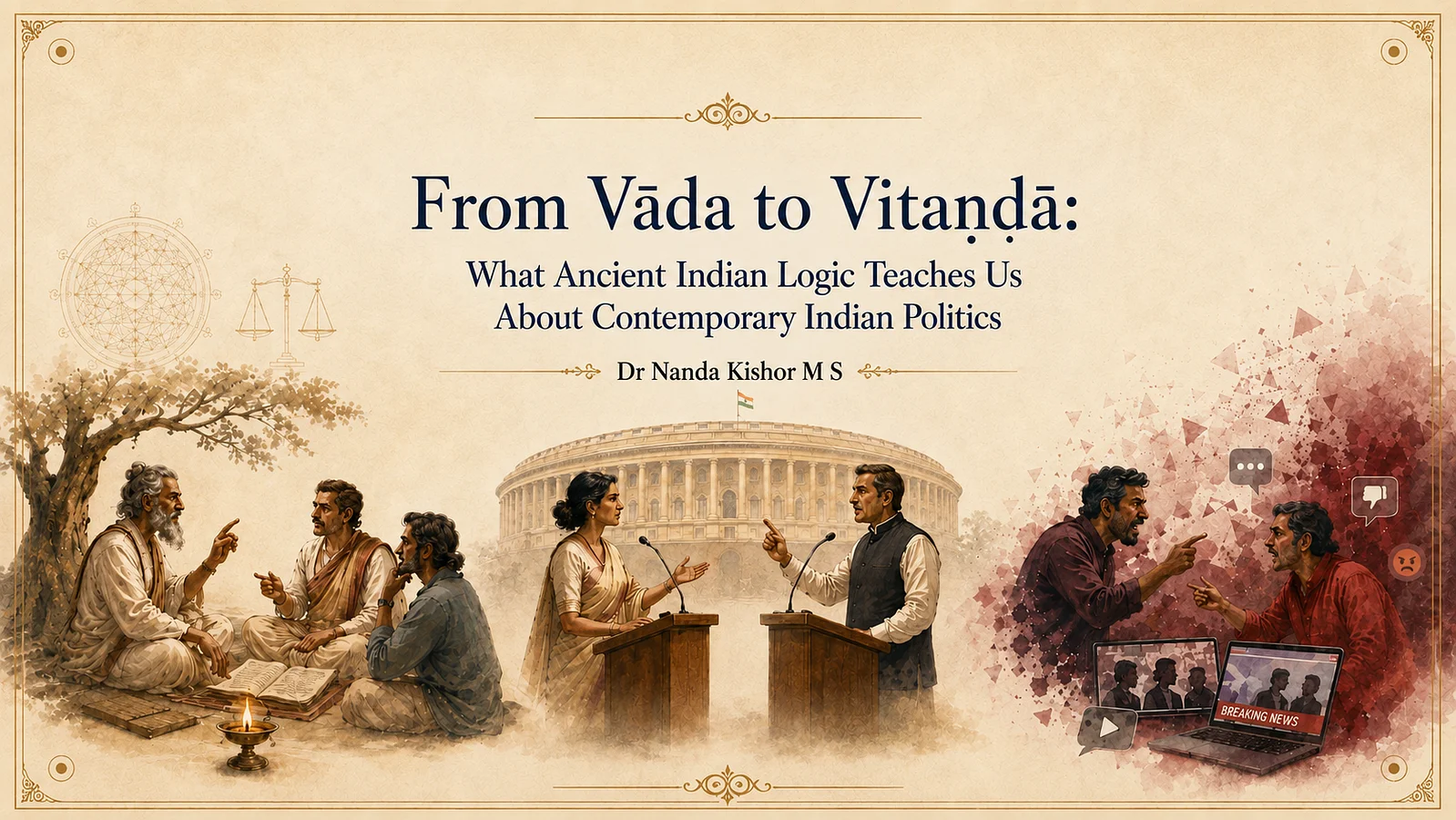
The essence of a democracy is not so much about how often people vote as about how well they reason about it. Democracies flourish when disagreements yield improved ideas and strengthened institutions and informed citizens. They falter when political conversation turns into a contest to outshout an opponent or to discredit all of the oppositional voices. The same juncture is being faced by the world's biggest democracy, India. One of the most useful analytical frameworks is the one that is within the Indian intellectual tradition, but is often borrowed by the critics and commentators of the contemporary political landscape in India. Nyāya school of philosophy is one of the six classical schools of Indian philosophy which differentiated between three types of debate: Vāda, Jalpa, and Vitaṇḍā. These ideas have been developed in the Nyāya Sūtras of Akṣapāda Gautama (the first especially), and further elaborated in Vātsyāyana's Nyāyabhāṣya, which were not just meant as methods of argumentation but as ethical guidelines for public debate. All these ideas are amazingly relevant to the Indian politics of today, over two thousand years later.
Discuss the issue as a quest for truth & Debate as a search for truth
Vāda is a conversation carried out with the use of accepted knowledge methods (pramāṇa) and logical reasoning (tarka) to establish truth (tattva-nirṇaya), according to the Nyāya Sūtras. It's not about winning, it's about understanding. Both participants agree on the rules of reasoning, meanwhile, they accept the valid evidence and are willing to change their own viewpoints when better arguments turn up. This idea is quite different from today's political discussion, which is about the ultimate aim of overcoming an opponent in front of a television audience. Vāda has been exemplified in Indian civilization. Perhaps the best example of this philosophical debate is the one between Ādi Śaṅkarācārya and Maṇḍana Miśra, which was judged by Ubhaya Bhāratī. Both parties had very strong differences of opinion between the two philosophies of Advaita Vedānta and Mīmāṃsā, but neither party attacked the other personally. The result was decided by logic, the interpretation of scripture and philosophical consistency. In the same way, the ancient universities of Nālandā, Takṣaśilā and Vikramaśīla established academic discussion platforms for Buddhists, Jains, Vedāntins, Naiyāyikas and other philosophical groups. Disagreements among the intellects reinforced their knowledge, not their divisions.
Vāda in Modern Indian Politics
In the modern age of the Indian political arena, there are occasional moments of real Vāda, although this is less common these days. The most outstanding example is the Goods and Services Tax (GST). The concept was framed during the UPA government and executed under the NDA after being worked out with successive governments, state finance ministers, constitutional experts and opposition parties for a number of years. Although the parties had opposing views on politics, they all knew that consensus was essential in tax reform as they had to adopt a cooperative approach due to India's federal structure. The GST Council is one of the rare forums where political parties compete for a while and engage in a rational debate. One such example came to light in the management of COVID-19 in India. Political differences were sure to have been there, but the Union Government had held several meetings with the Chief Ministers from the BJP, Congress, DMK, BJD, TRS, Left parties and others. Through ongoing dialogue between the political executives, scientific advisors and bureaucrats, the procurement, containment zones and reopening strategies were developed. There was no absence of criticism in the discussions, however, the spirit of the discussions was mainly one of problem-solving in a collective manner. Vāda is also reflected in Indian foreign policy. The Congress and the BJP have delivered continuity in various areas such as strategic autonomy, India-United States relations, ASEAN engagement, Indo-Pacific maritime security and counter-terrorism since economic reforms began in 1991. National security has prevailed over partisan politics on a few occasions, such as the parliamentary debates after the Uri surgical strikes (2016), the airstrikes on Balakot (2019) and the clash with Galwan Valley (2020). The examples illustrate that Indian democracy continues to be able to have constructive deliberation when national interest is put above the electoral advantage.
The Rise of Jalpa
According to the Nyāya tradition, Debate (Jalpa) is a process of discussion with the main goal being "to win" rather than "to find truth". Participants still use evidence and reasoning, but to a lesser extent. Facts turn into weapons and not tools of comprehension. It is a good description of the majority of modern politics. Take up discussion on the issue of unemployment. Rising infrastructure investment, digital payments, enrolment in EPFO and growth of start-ups are used to show employment generation, the government says. Opposition parties point to the periodic labour force survey and youth unemployment, and employment delays to make just the opposite case. Both parties use the real data, but each side cherry picks statistics to support their story, ignoring contradictory data. This trend was witnessed when debates were held on the Citizenship Amendment Act (CAA). The government called attention to the issue of humanitarian protection of persecuted minorities from neighboring countries, while critics raised issues of secularism, constitutional equality, and the exclusion of Muslims. Both sides emphasized their own constitutional principles and past experiences and virtually ignored the concerns of the other. The debates in the Parliament about the Women Reservation Bill (Nari Shakti Vandan Adhiniyam) also had a tinge of Jalpa. There was a general agreement that there needed to be more women in politics, but there were differences on implementation, delimitation and caste based reservations in reserved seats. Institutional design was discussed for brief periods, with most of the public debate focused on performing a politics of political ownership of women's empowerment. Jalpa is reinforced by election campaigns. In the general elections of 2024, both the NDA and the INDIA Alliance presented their narratives on economic growth, inflation, constitutional amendments, welfare schemes, federalism, and social justice. The campaign did not generate competing policy ideas, it generated competing realities.
When Politics gets into the mood of Vitaṇḍā
Worse still, the growing number of instances of debate that is considered the lowest form of debate in the Nyāya tradition, known as Vitaṇḍā. Vitaṇḍā is not even trying to carve out a space for itself as Jalpa does when it attempts to create an independent outlook. The only goal is to destroy the case of the opposing side. The victory is defined as discrediting. Much of political conversation in India these days is of this type. Few debates ever try to achieve policy clarity at prime time. Rather, there's a lot of fireworks and each of the spokespeople will be talking over each other, the moderators will be pushing for confrontation and the candidates will be trying to make viral sound bites. Very few viewers leave these programmes with a proper understanding of economic policy, constitutional law or foreign affairs. The majority go away with more partisan feelings. Social media has also helped to speed Vitaṇḍā along. The way politics is communicated has become heavily focused on hashtags, edited video snippets, memes and personal accusations. The algorithms like to be outraged, not nuanced. Political actors, therefore, have an incentive to demonize rather than scrutinize policies. The discussion about the Electoral Bonds Scheme is a case in point. In 2024, after the Supreme Court ruled the scheme unconstitutional, public debate soon moved on from the institutional debates about campaign financing reform to accusations of hypocrisy from both sides of politics. There has been more focus on determining which party had won more funds, rather than transparent alternatives to electoral funding. In a similar way, when we consider the Enforcement Directorate (ED) and Central Bureau of Investigation (CBI), we often hear debates focused on the concept of "Vitaṇḍā". Likewise, whenever we hear about the Enforcement Directorate (ED) and the Central Bureau of Investigation (CBI), it is often in relation to "Vitaṇḍā". The government backs investigations as anti-corruption measures. Opposition parties characterize them as political persecution. But the issue of investigating the independence, oversight or accountability of prosecutors is comparatively little addressed in institutional reform. This is during the protracted political debate that ensued after the Manipur violence, the farmers' protests and even parliamentary disturbances. The focus was on finding someone to blame, not on working together to find institutional solutions.
Kauṭilya's Warning
While the Nyāya tradition concerns itself with the importance of analyzing methods of reasoning, Kauṭilya's Arthaśāstracomplements this discussion by emphasizing the duties of a ruler. Kauṭilya insists on the importance of consulting with ministers and listening to conflicting views; it becomes a matter of evidence to make decisions without flattery. When an individual surrounds himself with only agreeable voices, he will be likely to make bad decisions due to information becoming distorted. This is an insight that has remained very much the same today. Democratic governments of today also need mechanisms that allow for and foster disagreement, within the boundaries of the constitution. Parliamentary committees, independent constitutional bodies, judicial review and free media and universities are provided for just so that informed criticism can be made. An over-partisan institutional environment erodes government's access to reliable information and citizens' trust in public institutions.
The Judiciary as an Arena of Vāda
The Supreme Court is perhaps a representative of Vāda among the democratic institutions in India. Examples of the structure of disagreement include constitutional bench hearings on issues like privacy (Puttaswamy case), Article 370, electoral bonds, same-sex marriage, Ayodhya, and the Aadhaar project. Both sides of the case argue precedents and constitutional issues. Judges challenge their own assumptions and others' before making reasoned decisions. The Court is not always perfect. The Court's decisions are not always acceptable to everyone. But its processes are closer to reasoned deliberation, as in the Nyāya understanding, than to the confrontational politics that prevails in electoral politics.
The Cost of Vitaṇḍā
The implications of Vitaṇḍā are deeper than mere politics. First, it undermines the trust of the public. All institutions, such as the Election Commission, judiciary, universities, media, civil services and constitutional bodies, are seen through partisan lenses. Secondly, policy quality decreases. Consultation may be forced out of the way, and opposition parties that object to every move lose their legitimacy as credible alternatives to the government. Thirdly, citizens are polarized themselves. It is increasingly becoming acceptable for people to do what the public says, instead of thinking independently. Last, the role of education in democracy is lost. Elections should inform the citizens about alternative conceptions of government. Rather, they tend to become contests of personality, identity, and political branding.
Recovering the Spirit of Vāda
Resolving Indian democracy is not about wiping out disagreements. Differences are essential to democracy. What is in need of recovery is the civilizational ethic with regard to disagreement. Political parties have to differentiate between opposition and obstruction. Criticism must be viewed as the voice of democracy, not as disloyalty. Opposition parties need to offer clear alternatives to policy rather than simply oppose government initiatives. Social media needs to shift from confrontational programming to evidence-based public discussion. The aim of universities should be to have habits of disciplined reasoning rather than of ideological mobilization. Intellectual honesty needs to be rewarded by civil society even when it is uncomfortable. Citizens themselves need to call for better debates, most of all. Whatever it takes, politicians act in response to electoral incentives. Voters will bring Vitaṇḍā to bloom if they are rewarded for outrage. With smart electoral leadership, Vāda will slowly come back.
Conclusion
India proudly claims to be the largest democracy in the world. Equally important, however, is to keep in mind that it is also the civilisational tradition that provided one of the earliest models of moral public reasoning. The terms Vāda, Jalpa and Vitaṇḍā do not belong to the category of relics of ancient philosophy. They are still alive analytical tools. They remind us that there are no equal intellectual disagreements. Some debates clarify, others amuse, and others erode democratic life. Indian politics today is certainly a mix of all three. Parliamentary committees, judicial deliberations and federal negotiations still represent the essence of Vāda. The elections and the media debates can lead to Jalpa. Social media communications and politics based on personalities are becoming increasingly like Vitaṇḍā. The outcome of the next election will not only determine which political party will rule India, but also whether the political elite of the country can restore the art of debate to its former glory, a trait that is part of Indian democracy. The Nyāya philosophers' wisdom is more than a thousand years old: it is a victory won without truth that is empty, and a truth gained through respectful discussion that is strengthened both in the knowledge and the Republic.