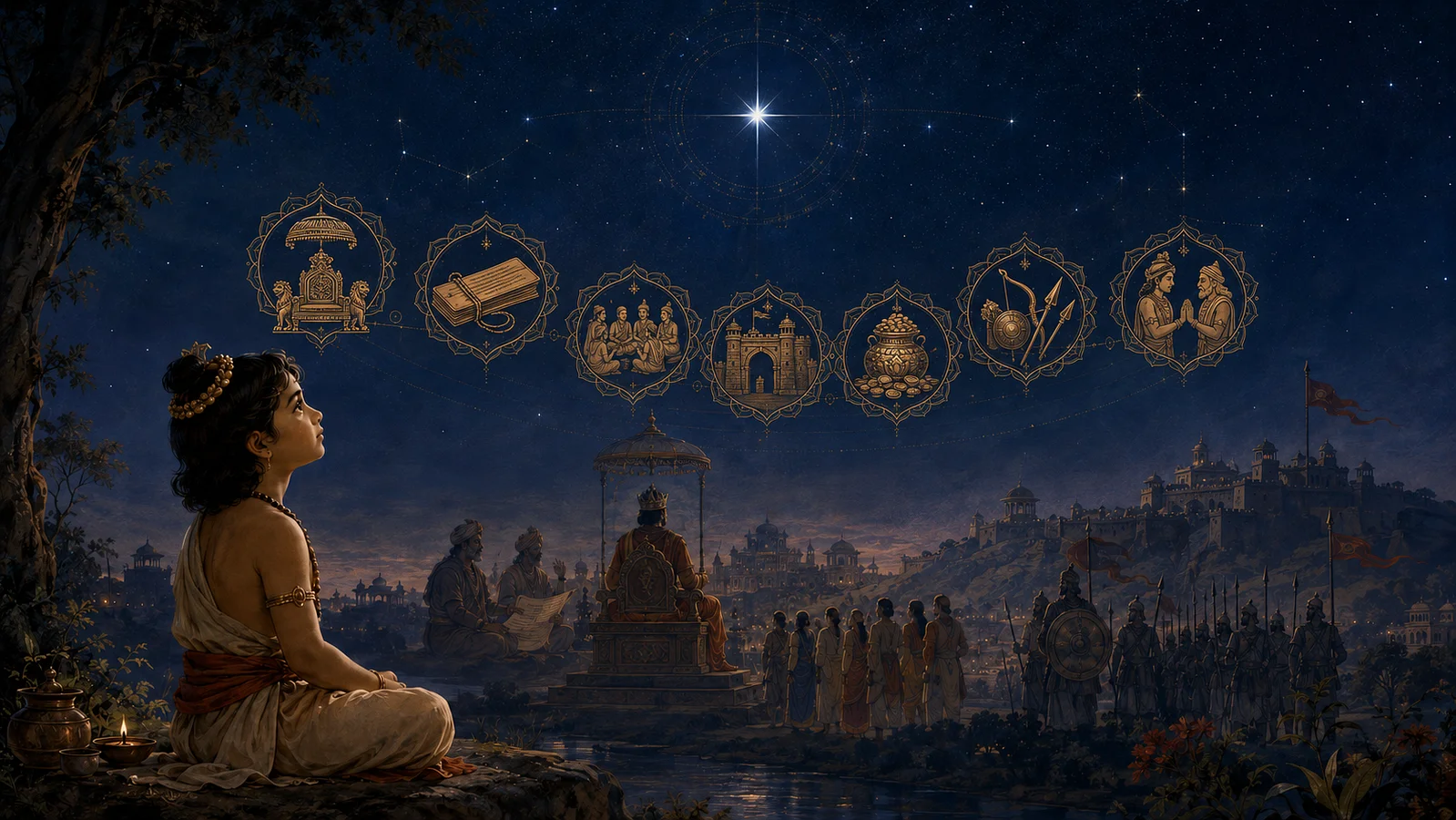
Introduction
The story of Dhruva, from our Purāṇas, is a tale of extraordinary devotion. A child, wounded by rejection and humiliation, turns inward with fierce resolve, performs tapas, receives the grace of Viṣṇu, and is venerated as the Dhruva tārā or Pole Star, the fixed point in the sky by which others orient themselves.
But like many Paurāṇika stories, the narrative of Dhruva is not limited to one layer of meaning. It is devotional, psychological, ethical, and civilizational at once. Read carefully, it also offers a profound insight into governance and policymaking.
At the heart of the story is a question every ruler, institution, and society must confront: should policy be guided by what is merely pleasing, popular, and immediately attractive, or by what is steady, principled, and enduring?
The State as a Living Body
Dhruva is the son of King Uttānapāda. The name Uttānapāda literally evokes the image of one with outstretched limbs. This itself offers a suggestive entry into the Indic understanding of the state as an organic entity composed of limbs.
Classical Indian political thought does not imagine the state as a mechanical contract alone. It imagines it as a living organism, a rāṣṭra with interdependent parts.
The Saptāṅga Rājya model describes the seven vital limbs of the state:
Svāmī, the sovereign or ruler.
Amātyaḥ, the ministers and administrative counsel.
Rāṣṭram, the territory and people.
Durga, the fortified infrastructure and protective capacity.
Kośa, the treasury and economic resources.
Balam, the force or disciplined power of the state.
Suhṛt, the ally, friend, or supportive external relationship.
A state is not healthy merely because one limb is strong. A wealthy state without wise counsel may become arrogant. A militarily powerful state without allies may become isolated. A popular ruler without a treasury may be helpless. A policy-rich state without implementation capacity may remain rhetorical.
The name Uttānapāda, therefore, may be read as a reminder that rulership requires the coordination of many limbs. Governance is never one-dimensional. It must harmonize power, counsel, resources, territory, protection, and friendship.
Yet even a ruler with all the limbs of the state must decide what principle animates them.
Sunīti and Suruci: Two Options Before Governance
King Uttānapāda has two wives: Sunīti and Suruci.
Their names are deeply instructive.
Sunīti means wise conduct, just laws and rules, and right guidance. It symbolizes discernment, foresight, restraint, and moral clarity.
Suruci means good taste, refined liking, or pleasing preference. It represents what is attractive, elegant, emotionally gratifying, and often popular.
Both are necessary in society. A culture without ruci, without taste, refinement, beauty, and emotional appeal, becomes dry and lifeless. Governance cannot be tone-deaf to people’s aspirations, sentiments, or aesthetic expectations. Public communication, cultural legitimacy, and popular resonance matter.
But the Paurāṇika narrative makes a sharper point: when the ruler becomes attached to Suruci and neglects Sunīti, disorder begins.
In the story, Suruci is the favoured queen. Her son Uttama receives affection and recognition. Sunīti, and her son Dhruva are neglected. The emotional drama of the royal household becomes an allegory for the political drama of the state.
When a ruler is wedded to Suruci alone, the state begins to chase what is pleasing rather than what is right. It becomes captive to flattery, optics, popularity, and short-term approval. The ruler may still produce what appears “uttama” - excellent, polished, and impressive. But excellence without moral steadiness can remain superficial.
When a ruler is aligned with Sunīti, however, the state gives birth to Dhruva - steadfastness, clarity, and the capacity to endure.
The Problem with Chasing Only the Popular
Modern governance often struggles with the tension between Sunīti and Suruci.
Public life today is increasingly shaped by immediacy. What is trending? What is popular? What will receive applause? What will look good in a campaign, a dashboard, a headline, or a public announcement?
This is the rule of Suruci.
Suruci wants refinement, appeal, and visible excellence. It wants the policy that sounds beautiful, the slogan that travels fast, the reform that can be easily branded, the announcement that generates instant approval.
But good governance cannot be built only on that which pleases. A serious state must sometimes do things that are not immediately glamorous. It must invest in capacity building, institutional memory, local knowledge, administrative discipline, long-term education, environmental resilience, and civilizational confidence. These may not always be spectacular. They may not always produce instant applause. Yet they create the conditions for lasting stability.
A policy that is only attractive may fade when public attention shifts. A policy rooted in nīti can become a civilizational anchor.
Dhruva as the Fruit of Sunīti
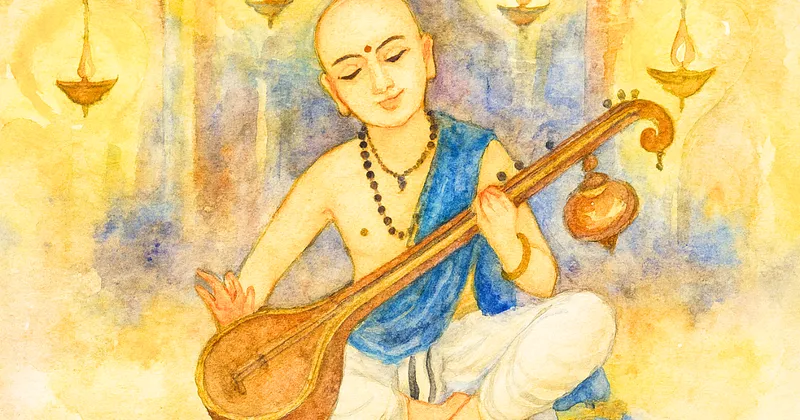
Dhruva’s greatness does not emerge from comfort. Denied a place on his father’s lap, he seeks a place that no one can take away, in Srī Viṣṇu’s lap. Guided by his mother Sunīti, he turns his wound into tapas.
This is a powerful psychological lesson, but it is also a political one.
Civilizations, institutions, and nations often discover their deepest strength when they are forced to ask: what is our fixed point? What is our dhruva? What principle will remain steady when circumstances change?
Sunīti gives him direction. She orients him toward a higher pursuit. That is what good policy does.
Good policy channels energy toward a durable goal.
Good policy disciplines emotion into purpose.
Good policy does not chase immediate compensation. It creates a path toward lasting dignity.
Dhruva’s tapas is the transformation of pain into clarity. Through discipline, devotion, and single-pointed pursuit, he becomes worthy of the highest recognition. He does not merely win back a place in the palace. He becomes the Pole Star.
This is the destiny of governance rooted in Sunīti. It creates institutions and principles that outlive the personalities who initiated them.
Policy as a North Star
The image of Dhruva as the Pole Star is central to the civilizational imagination. The Pole Star is not merely bright. Its significance lies in its fixity. Travellers, sailors, seekers, and observers look at it because it gives direction.
This is what good policy must do.
Policy is not merely a scheme, document, or administrative decision. At its best, policy becomes an orienting principle for collective life. It tells a society what to prioritize, what to protect, what to cultivate, and what to refuse.
A Dhruva-like policy is not driven by every gust of opinion. It is responsive, but not restless. It listens, but does not surrender its discrimination. It communicates, but does not reduce itself to optics. It adapts, but does not lose its core.
Such policy is rooted in dharma. This does not mean a narrow religious reading of governance. It means alignment with order, responsibility, balance, and the long-term welfare of the whole. Dharma asks not merely, “What is popular?” but “What sustains?” Not merely, “What is excellent?” but “What is right?” Not merely, “What is desired now?” but “What will remain beneficial across time?”
The Lesson for Leaders
The story of Dhruva offers a warning and a possibility.
The warning is this: a ruler or institution that abandons Sunīti for Suruci may still produce impressive outcomes. It may appear successful. It may create what is refined, excellent, and admired. But without steadiness, such success remains vulnerable to time.
The possibility is this: when leadership chooses Sunīti, it can generate Dhruva - good policies and outcomes, moral clarity, institutional stability, and enduring direction.
This does not mean leaders must ignore public sentiment. Suruci has its place. Taste, beauty, communication, and emotional resonance matter. But they must be guided by Sunīti. Popular sentiment must be educated by policy wisdom. Refinement must be anchored in responsibility and subordinated to dharma.
A society guided only by Suruci will chase approval. A society guided by Sunīti will cultivate direction. One may produce moments of brilliance. The other creates a North Star.
And in times of confusion, it is not momentary brilliance that saves a civilization. It is the steady light by which it remembers where it must go.
The deeper lesson is simple: in chasing the best, do not abandon the good.
The good may not always shine first. It may be quiet. It may be demanding. It may require tapas, patience, and sacrifice. But over time, it becomes the point by which others navigate.
That is the promise of Dhruva.
Dhruva is steady. Dhruva is followed. Dhruva becomes a point of orientation.

.png)