The Controversy Surrounding the Poster
It started, the way these things tend to nowadays, with a first-look poster: Jr. NTR and veteran Tollywood director Trivikram announced a film on Murugan — the God with six faces, a spear, a peacock. They introduced their Murugan to the whole country with the oldest description of Him as the son of Śiva.

(Image source: Instagram handle Actor Jr.NTR)
A section of Tamiḻ speakers reacted as they always do: “He’s not yours (to tell stories about)”. To them, a studio from another land had appropriated the God of the Tamiḻ hills and was trying to sell Him back to the people he belonged to.
The reaction from the Tamiḻ film industry was quick and provocative. Suddenly, a teaser dropped for an upcoming film titled “Tamizh Murugan” — reclaiming Murugan and scrubbing Him of anything that felt Sanskritic, portraying Him on an elephant instead of a peacock. The lead actor of the proposed movie, Dhanush, shared the same with a caption meant to end the argument: “Son of Kottravai (or Koṟṟavai)”— referring to the Tamiḻ mother, in place of “the son of Śiva”.

(Image source: Twitter handle Actor Dhanush)
The issue of giving Murugan a “Tamiḻ only” identity cannot be overlooked as a simple disagreement within the film fraternity. It needs to be taken seriously, because the reaction comes from the people who firmly believe they are defending the Tamiḻ culture. However, is the outrage valid? More importantly, is the disagreement itself valid?
Let me set out the case clearly. Putting aside the film, the isolationist logic behind it comes down to four claims.
Claim One — Murugan is Koṟṟavai’s son: Koṟṟavai is a native Tamiḻ Goddess, not the Paurāṇika Durgā, so “Son of Koṟṟavai” makes Murugan unrelated to Śiva.
Claim Two — Murugan goes to war mounted on his elephant: The elephant mount, instead of the peacock, for Murugan is a true Tamiḻ convention.
Claim Three — the tiṇai, the Tamiḻ system that assigns a God and a mood to each landscape, is a Tamiḻ invention with no vaidika parallel.
Claim Four — veṟiyāṭṭu, the frenzied possession-dance of the priest, is a purely Dravidian mode of worship, alien to the sober Veda.
Here is the thing. You do not need to know one word of Saṃskṛta to take all four arguments apart. You only need to read the Tamiḻ — because the Tamiḻ texts these Tamiḻ isolationists are waving about are the exact texts that dismantle the claims.
A note on terms used here before we start: Tamiḻ is a language, not a race — the literature, the land and the long memory rides with a language, not a bloodline. Also, the term “Vaidika” does not refer to “the religion of Saṃskṛta-speakers”; it means a sacral order — a way of arranging fire, death, kingship and the sky — the way a body of law can be Roman without only Romans obeying it. Fix the meaning of those two words and the posited question - “Was Murugan Tamiḻ or Vaidika?” dissolves into asking something like “Is your mother a woman or a doctor?”
The Metaphysical Singularity
The argument is best begun by and, I think, also ends — not with the debate about the nature of the God but with his name. Trace the word ‘Murugan’ back to its etymological roots and you arrive at ‘muruku’. The Madras Tamiḻ Lexicon's entry for muruku (முருகு) is a metaphor for the whole problem.
The entry lists sixteen senses in which the word is used. Reading just four of them renders a clear picture
The first is fragrance — maṇam. Paṭṭiṉappālai 37 speaks of "muruku amar pū", "flowers laden with scent". Nothing sacred is implied; this is muruku as an ordinary sensory fact.
The second is the rite itself, a vēḷvi performed with an offering of flesh. Maturaikkāñci 38: "paṭaiyōrkku muruku ayara" — "they perform the muruku-rite for the warriors".
The third is the dance of possession, the veṟiyāṭṭu, in which a ritual specialist called the vēlaṉ dances until the power takes hold of him. Kuṟuntokai 362.1 addresses one directly: "muruku ayarntu vanta mutuvāy vēla" — "O wise-mouthed vēlaṉ, come from performing the muruku-rite".
The fourth is the power itself — and here the entry splits in a way worth pausing over. Muruku is a force that seizes a body, with no form attached: Puṟanāṉūṟu 259.5 describes a woman as "muruku meyppaṭṭa pulaitti pōla", "a washerwoman into whom muruku has entered".
Elsewhere, Muruku is also a God with a name and a cult of followers: Maturaikkāñci 611 has the vēlaṉ encircling with muruku in a closely guarded rite (aruṅkaṭi) — a fenced, restricted ceremony, not a public spectacle. Line up the various meanings, and a sequence appears.
A fragrance is smelt. A rite is performed with an offering. A divine essence enters the body. Only then is a name attached. Before muruku is anyone, it is a state — a potency perceived by the nose before the eye, capable of entering a person, sustained by feeding. The God is what that potency is called once it has arrived and inhabited.
The Same Grammar, in the Veda
The aforementioned is a peculiar way for a divinity to be constructed, but it is no local South Indian oddity. The Vedic hymns build Agni by the same logic, and in the same order.
For a reader coming to this subject cold: Agni is not a God who happens to be associated with fire. He is the fire on the altar, and his job is to consume what people place there and carry it upward to the gods. He is the point of contact between two worlds: “tvāṃ dūtam aratiṃ havyavāhaṃ devā akṛṇvann amṛtasya nābhim” (Ṛgveda (RV) 3.17.4), and the hymns describe him almost entirely in terms of what He is doing rather than what He is like.
His standing epithet is dhūmaketu, "he whose banner is smoke" (RV 1.27.11; 10.12.2). The visible sign of the God is not a face or a weapon but a column of smoke — a sensory medium, exactly as scent is for muruku. And the hymns are relaxed about the paradox this creates. In one verse Agni is simultaneously yaviṣṭha, perpetually the youngest, and also grey-haired, smoke-bannered, standing in the wood (RV 10.4.5) — eternally new because every fire is newly kindled, and grey because that is the colour of smoke.
Fragrance is not Just a Decoration
The medium, crucially, is not only the smoke. Fragrance is what Agni actually does to an offering, and the making of the scent is the act of carrying the offerings.
RV 10.15.12 states the operation plainly: “tvam agna īḷito jātavedo 'vāḍ ḍhavyāni surabhīṇi kṛtvī” — “You, Agni Jātavedas, when invoked, carried the oblations, having made them fragrant”. The grammar is the point. Making them fragrant is not something done alongside the carrying; it is the mechanism by which the carrying happens. Butter and grain placed in fire become smoke and scent, and that is the only form in which they can travel.
The hymns even name the organ. Agni sends the offerings up “deva āsā sugandhinā” — “with his fragrant mouth” (RV 8.19.24). And the traffic is not one-way: “prati na īṃ surabhīṇi vyantu”- “let them, fragrant, come back toward us” (RV 7.1.18). What goes up as scent returns as scent. Where the God takes his seat, fragrance and youth are named in one breath: “agnir hotā ny asīdad yajīyān upasthe mātuḥ surabhā u loke … yuvā kaviḥ” — “Agni the Hotṛ, the better sacrificer, sat down in his mother's lap, in the fragrant place, the young sage” (RV 5.1.6).
Fragrance here is not atmosphere or piety. It is the physics of the ritual. And that is the same status muruku has in Tamiḻ: an action-power named before any person is named.
One Office, Held Twice
Strip both vocabularies of everything ornamental and a single function remains, described in each language with unusual precision.
The Veda gives it outright: “dūto devānām asi martyānām antar mahāṃś carasi rocanena” — “you are the envoy of gods and of mortals; great, you travel between them with your radiance” (RV 10.4.2).
Envoy. The one who goes between.
That is the whole of it. Whether the fire is called Agni and rises to the sky as fragrant smoke, or is called Muruku and comes down into the body of a washerwoman on the scent rising from a battlefield offering, the office is the same and cannot be reduced further: the messenger between two worlds — the single medium by which what is offered below is made to arrive above, and by which what is above is made to enter a body below.
Two languages have independently named that messenger; they are not separate entities.
As an aside, Muruvu of Telugu is a cognate of muruku in Tamiḻ (If only the director Vetrimaran asked why these two cognates have the same meaning, he could have spared us the unnecessary drama!
Claim 1 — “Koṟṟavai -Durgā”
This is the load-bearing claim, and it is the quickest to fall, because the oldest Tamiḻ epic we have draws Koṟṟavai’s portrait in full and describes every feature of Hers. In the Cilappatikāram, canto twelve — the Vēṭṭuva Vari, the Hunters’ Song — the dryland hunters describe her head to foot through song:
மதியின் வெண்தோடு சூடுஞ் சென்னி
நுதல்கிழித்து விழித்த இமையா நாட்டத்துப்
நஞ்சுண்டு கறுத்த கண்டி வெஞ்சினத்து
matiyiṉ veṇtōṭu cūṭum ceṉṉi / nutalkiḻittu viḻitta imaiyā nāṭṭattup / nañcuṇṭu kaṟutta kaṇṭi veñciṉattu
“The head that wears the white crescent of the moon; the unwinking eye that opened, splitting the forehead; the throat blackened from drinking poison, and the fierce wrath.”
— Cilappatikāram 12, Vēṭṭuva Vari, ll. 54–57
The clinching argument is the throat. A crescent on the head and a third eye in the brow you might argue about — but there is exactly one figure in the whole tradition with a throat gone dark from swallowing poison: Nīlakaṇṭha, the blue-throated Śiva, who drank the world-poison at the churning of the sea. When a Tamiḻ poem describes that throat on Koṟṟavai, it is telling you, in Tamiḻ, that She is His — His power in a woman’s body. Then it arms Her, and the arming is Durgā’s, piece for piece: the Devī Māhātmya (DM) has Śiva hand His own trident to Her ("śūlaṃ śūlād viniṣkṛṣya dadau tasyai pinākadhṛk", DM 2.20), and the Tamiḻ poem puts that very trident in Her hand and the buffalo-demon under Her feet. Here is the map, attribute by attribute — Caṅkam Tamiḻ on one side, Saṃskṛta on the other:

The pose that names Her comes twice. First the verse freezes the instant — She stands on the head of “the asura of two forms,” man and beast, which is the buffalo-demon Mahiṣa; then a vari-song a little later says the animal outright:
இரண்டுவேறு உருவில் திரண்டதோள் அவுணன் தலைமிசை நின்ற தையல்
கானத் தெருமைக் கருந்தலைமேல் நின்றாயால்… மாமயிடற் செற்று
iraṇṭu vēṟu uruvil tiraṇṭatōḷ avuṇaṉ talaimicai niṉṟa taiyal / kāṉat terumaik karuntalaimēl niṉṟāyāl… mā-mayiṭaṟ ceṟṟu
“The maiden who stood upon the head of the broad-shouldered asura of two forms… you stood on the dark head of the forest-buffalo, having slain the great Mahiṣa.”
— Cilappatikāram 12, Vēṭṭuva Vari, ll. 65–66 and vari-songs 7–8
And the Saṃskṛta freezes the same instant: “pādenākramya kaṇṭhe ca śūlenainam atāḍayat” — “pressing his neck under Her foot, She ran him through with the trident” (DM 3.40). One Tamiḻ poem, one Saṃskṛta poem, one single Goddess with one foot on a buffalo. If you still want it said in plain words, the Hunters’ Song says it: in its ninth vari-song it stops describing and simply names Her as the left half of Śiva’s body, praised by the Vedas —
கங்கை முடிக்கணிந்த கண்ணுதலோன் பாகத்து
மங்கை உருவாய் மறையேத்த வேநிற்பாய்
kaṅkai muṭikkaṇinta kaṇṇutalōṉ pākattu / maṅkai uruvāy maṟai ēttavē niṟpāy
“You stand as the woman-form in the [left] half of the three-eyed god who wears the Gaṅgā on his crown, while the Vedas praise you.”
— Cilappatikāram 12, Vēṭṭuva Vari, vari-song 9
That is the second-century Tamiḻ epic, in its own Hunters’ Song, calling Koṟṟavai the Ardhanārī — Śiva’s own half — and adding conch and discus to Her hands as Viṣṇu’s sister for good measure. The Tamiḻ scholar R. Nagaswamy read the same verses and stated it plainly: the goddess of the pālai is “Koṟṟavai or Durgā,” and the Vēṭṭuva Vari is a hymn to Mahiṣāsuramardinī (Tamiḻ Nadu: The Land of the Vedas, ch. 4). There is even a whole academic book on the equation — R. Mahalakshmi’s The Making of the Goddess: Koṟṟavai–Durgā in the Tamiḻ Traditions. Kamil Zvelebil, no one’s idea of a Hindu partisan, says it in one line in The Smile of Murugan: Koṟṟavai is Durgā.
So follow the logic to where it lands. Koṟṟavai is Umā, the poison-throated wife of Śiva. And now watch what Nakkīrar’s Tirumurukāṟṟuppaṭai (a classical Tamiḻ guide-poem in the Caṅkam era, mapping the path to Murugan ) does in three consecutive lines. It calls Him the son of the banyan-seated God, then the son of the Mountain’s Daughter, then the son of Koṟṟavai:
ஆல்கெழு கடவுட் புதல்வ மால்வரை
மலை மகள் மகனே மாற்றோர் கூற்றே
வெற்றி வேல் போர்க் கொற்றவை சிறுவ
āl-keḻu kaṭavuṭ putalva māl-varai / malai makaḷ makaṉē māṟṟōr kūṟṟē / veṟṟi vēl pōrk koṟṟavai ciṟuva
“O son of the god seated beneath the banyan [Śiva], of the great mountain; O son of the Mountain’s Daughter [Umā], Death to your foes; O son of Koṟṟavai, victorious in the spear-battle!”
— Tirumurukāṟṟuppaṭai 256–258 (numbered 257–259 in some editions)
Son of Śiva, son of the Mountain’s Daughter, son of Koṟṟavai — three names in three breaths, because to the poet the father was one father and the mother was one mother. So the first claim refutes itself, and not with a Saṃskṛta text but with the most Tamiḻ text there is.
To be the son of Koṟṟavai is to be the son of Śiva’s wife, which is to be the son of Śiva.
Dhanush’s epithet does not beat the Telugu poster.
It agrees with it, in Tamiḻ, seventeen centuries early.
Claim 2 — “The Elephant is Tamiḻ, the Peacock is Northern”
Here the movement has not just slipped; it has grabbed the wrong flag and sprinted the wrong way. Start with the fact that settles the disagreement: the oldest full Tamiḻ hymn to Murugan, the Tirumurukāṟṟuppaṭai, gives Him both mounts. It names peacock, i.e. மஞ்ஞை (maññai) (ll. 121, 210–211), and it names elephant, i.e. Piṇimukam, “of unconquerable might” (l. 248), in the same poem, with no hint that they are rivals or that one is more Tamiḻ. The tradition never had room for the fight the film provoked.
And which of the two is actually the northern one? Not the peacock. The peacock is deep in the oldest Tamiḻ verse and, at the very same time, is the pan-Indian mount — on the record from the Kuṣāṇas to the Guptas, ridden in the Mathura sculptures, stamped on the coins of Kumāragupta and Skandagupta in the fifth century.

Kartikeya riding his peacock mount (Mathura style)- 2nd to 4th Century CE.
Source: Heritage Images / Heritage Images via Getty Images

Kumāragupta I 'Peacock Rider' Gold Coin. Dating: c. 415 – 455 CE
Source: Pacific Press / LightRocket via Getty Images

Skandagupta Silver Drachm featuring the Peacock. Dating: c. 455 – 467 CE.
Source: Virasat Auctions
It is the one mount both traditions plainly share; calling it a foreign intrusion is exactly backwards. The elephant, by contrast, is tied to the most Sāṃskṛtika layer of the whole story. Skanda gets an elephant because He is made Devasenāpati, commander of the army of the Gods, and marries Devasenā — deva-senā, “the army of the Gods,” Indra’s own daughter — and in the Mahābhārata (Mbh), Indra hands Him the bells of His elephant Airāvata Mbh 3.220.18–19 (crit. ed., BORI). The elephant is the war-god’s mount as Indra’s general, and that whole apparatus is Saṃskṛta and pan-Indian.
The elephant enters as inheritance, not vehicle. Skanda takes Indra's office — devasenāpati — and with it Indra's daughter, Indra's army, and finally Indra's Airāvata, her dowry in the Kanta Purāṇam. The same shows in her name: Saṃskṛta Devasenā, "army of the gods," arrives in Tamiḻ as Teyvayāṉai and is reheard as teyva-yāṉai, "divine elephant" — a pun the tradition then furnished with the story of Airāvata raising the child Teyvayāṉai. And no evidence anywhere puts the elephant before the peacock: Paripāṭal and Puṟanāṉūṟu already have him riding the mayil, and no image ever shows him on an elephant. Evolution, not displacement.
Claim 3 — “Tiṇai is Unique to Tamiḻ”
This one is different, because it is half right, and the half that is right is genuinely glorious. The tiṇai system — five landscapes, each fused with a season, a flower, a bird, a drum, a god, and a phase of love, so that the land itself carries the emotion. Concede that fully; it is one of the great inventions of the human literary mind. But the isolationist needs more than “Tamiḻ did it best”. He needs the habit behind it — carving the world into named terrains, each with its own presiding power — to be unknown to the Vedas. It is not. It is all over the Vedas.
The Yajurveda’s Camakam simply lists the terrains and asks for them, one after another, the way a tiṇai scheme would:
अश्मा च मे मृत्तिका च मे गिरयश्च मे
पर्वताश्च मे सिकताश्च मे वनस्पतयश्च मे
aśmā ca me mṛttikā ca me girayaś ca me / parvatāś ca me sikatāś ca me vanaspatayaś ca me
“May the rock be mine, and the soil, and the highlands, and the mountains, and the sands, and the forest-trees.”
— Taittirīya Saṃhitā 4.7.5 (Camakam)
There are the terrains, named as terrains. And each has its power. The forest is not scenery in the Veda; She is a goddess with Her own hymn, the eerie Araṇyānī, spirit of the wildwood:
अरण्यान्यरण्यान्यसौ या प्रेव नश्यसि
कथा ग्रामं न पृच्छसि न त्वा भीरिव विन्दतीं
araṇyāny araṇyāny asau yā preva naśyasi / kathā grāmaṃ na pṛcchasi na tvā bhīr iva vindatīm
“Araṇyānī, Araṇyānī, you who seem to melt away — why do you never ask the road to the village? Does no fear ever find you?”
— Ṛgveda 10.146.1
That is a kuṟiñci-mood poem in Saṃskṛta a thousand years early: the wild hill-forest given a voice and a loneliness. The Vedic hymns worship the ploughed Furrow Herself as the Goddess Sītā, and the Śatarudrīya salutes Rudra as lord of the forest and the field, of the forester, the fisherman and the hill-rover — a tiṇai roll-call with the serial numbers filed off. The clincher is that the Tolkāppiyam’s (the earliest treatise on Tamiḻ grammar and poetics written by Tolkappiyar, a disciple of the legendary Vedic sage Agastya) own scheme already contains a vaidika god by name: it hands the seashore tract, neytal, to Varuṇaṉ — Varuṇa of the Ṛgveda, lord of waters, seated in a Tamiḻ landscape under his own name in the founding book of Tamiḻ poetics.
The Tamiḻ poets took a shared ritual imagination and did with it what nobody else dreamed of — they made the land carry the whole psychology of love. That is not borrowing a template. That is owning the material so completely you can build something with it that its other speakers never imagined.
Claim 4 — “Veriyāṭṭu is Uniquely Tamiḻ”
The last claim is the deepest, and it deserves the most room, because it is the true redoubt: grant the mother, the mounts, the landscapes — the isolationist says — the living religion is still something else. Not fire [Ta. tī, aḻal; Skt. agni] and sacrifice (Skt. Yajña, Ta. Vēḷvi) but frenzy. In the veṟiyāṭṭu, the vēlaṉ, the spear-priest, is seized by the god and shakes; the lovesick girl is diagnosed as god-struck; there is blood and millet and toddy on a hilltop. That ecstatic, possessed religion, the argument runs, is the untouchable Tamiḻ core, with nothing like it in the tidy Vedas
(Veṟi is scent — of blossom [Aiṅkuṟunūṟu 91.2], braid [Kalittokai 57] — and the Vēlaṉ's possession-dance [Akanāṉūṟu 292]; structurally similar to muruku: fragrance [Paṭṭiṉappālai 37], godhead [Puṟanāṉūṟu 259], frenzy [Kuṟuntokai 362])
But there is something exactly like it on nearly every page of the Vedas that touches Rudra — the claim only survives by comparing real Tamiḻ practice with a sanitised cartoon of vaidika religion. Put the wildness back, and it vanishes. The Ṛgveda has its own ecstatic: the Keśin, the long-haired one, wind-wrapped, “maddened” by His own silence (unmaditā, RV 10.136.3), who rides the winds and, in the last verse, drinks from the cup with the God himself —
केशी विषस्य पात्रेण यद्रुद्रेणापिबत्सह
keśī viṣasya pātreṇa yad rudreṇāpibat saha
“…when the long-haired one drank from the cup of poison, together with Rudra.”
— Ṛgveda 10.136.7
A frenzied, poison-drinking trance-figure, right there in the Ṛgveda, drinking with Rudra. Go one Kāṇḍa over and the whole fifteenth Kāṇḍa of the Atharvaveda is given to the vrātyas — roving, homeless bands living outside settled society in their own austerity and frenzy — and their archetype, the Eka-vrātya, “the sole Vrātya”, is named in the Rudra-names, Bhava, Śarva, Rudra, Mahādeva, Īśāna. The god of the ecstatic wanderers is Rudra. His storm-troop, the Maruts, are “the sons of Rudra” (RV 1.85), a roving band of young men, the divine template of the war-brotherhood. Skanda is the commander of exactly such a band, the general of Śiva’s wild gaṇas.
Then the piece that lands on Murugan directly — and it is in Saṃskṛta, in the most orthodox register there is, the medical literature. Early Āyurveda treats Skanda Himself as a graha, a “seizer.” The Suśruta Saṃhitā gives a run of chapters (Uttaratantra 27–37) to the bāla-grahas, the spirits that seize children — Skanda-graha, Skandāpasmāra, Śakuni, Revatī, Pūtanā — and Skanda heads the list. The word is literal: graha, from grah, “to seize.” A child gripped by Skanda-graha is possessed by the god, and the cure is not medicine but mantra and offering — counter-possession.
Richard Mann, the standard scholar of the northern Skanda, argues this seizing-spirit layer is not a late add-on but the earliest identifiable stratum of the whole cult. So centuries before any Caṅkam poem describes a veṟiyāṭṭu, there is already a Saṃskṛta theology in which Skanda’s signature act upon a human body is to seize it.
Now, why is this God a frenzy-god at all? Here is the archetype, and it is worth getting right, because it explains everything above. Possession has one grammar and two directions. A power — the Saṃskṛta graha, the Tamiḻ aṇaṅku that George Hart identified as the dangerous sacred force running through Caṅkam poetry — enters and seizes a body.
When it comes uninvited, it is affliction: the graha the physician must drive out. When it is called and contained, it is worship: the veṟiyāṭṭu the vēlaṉ dances to draw the God down. Same verb, opposite direction — the invasion you expel and the descent you invite are one event seen from two sides. That is why Murugan, of all gods, owns this mode. He is the son of the ecstatic god and the general of His frenzied troop; the fire that leaps and cannot be handled; in the medical texts a seizer, on the hills a descent to be danced. The mad God is the God of the threshold — the power that lives outside the settled village and the tidy altar and can never be tamed, only bargained with: drawn in, embodied, sent back.
The Atharvaveda bargains with it through the vrātya rite, the physician through mantra, the hill community through the possession-dance. Three dialects, one grammar. Veṟiyāṭṭu is not the Tamiḻ exception to vaidika religion. It is the southern, worship-side accent of a possession-theology the Saṃskṛta texts had already written down — the same seizing god, welcomed instead of exorcized. And we are reminded time and again that vaidīkam was the culture of Bhārata, and that Tamiḻ is a form of expression within it.
The Sky Doesn’t Lie
Four claims, four answers. But there is one witness left that cannot be borrowed, faked, or bought, and it settles the whole thing. Almost everything in a culture travels — words, gods, rituals all move with traders and brides and priests, which is why arguments about culture become arguments about theft. The sky is the exception. So follow one thread up into it, because it runs cleanly from the Veda’s oldest fire-child to the boy on the Tamiḻ hill, and it is anchored the whole way to a single cluster of stars.
Start with fire. In the Ṛgveda, Agni is not the elemental force but a child — “the young mother carries the boy, swaddled, in secret” (RV 5.2.1) — and the Śatapatha Brāhmaṇa makes it more precise: Prajāpati’s child is given eight names, from Rudra to Īśāna, and the passage ends, “these are the eight forms of Agni; Kumāra, the Boy, is the ninth” (Śatapatha Brāhmaṇa 6.1.3.8–18). Fire’s ninth form is a boy. Now give that boy a birth-kathā, and it must run: born of fire, nursed by six mothers, six-faced to drink from all six, red complexioned, forever young, spear in hand, general of the gods because fire goes before an army. That is Skanda in the Mahābhārata, whom the Amarakośa flatly calls Agnibhū or fire-born. This is the same Murugan in the Caṅkam corpus, Āṟumukaṉ, the six-faced. One archetype — Agni the fire-boy, Skanda the fire-born, Murugan the six-faced — wearing whichever language it woke up in.
And all three are pinned to the same stars. The six mothers are the six Kṛttikās, the Pleiades, and the Yajurveda deeded that cluster to Agni long ago: “the Kṛttikās are Agni’s asterism” (Śatapatha Brāhmaṇa 2.1.2.1), “under the Kṛttikās one kindles the sacred fires” (Taittirīya Brāhmaṇa 1.1.2.1). Skanda is named after them — Kārttikeya, son of the Kṛttikās. The Tamiḻ god is named after them too: aṟumīṉ, “the six stars,” is the Pleiades, and Āṟumukaṉ, “six-faced”, is that number made flesh. Nakkīrar calls him, flatly, the son of the six:
அறுவர் பயந்த ஆரமர் செல்வ
aṟuvar payanta āramar celva
“O cherished one whom the six brought forth.”
— Tirumurukāṟṟuppaṭai, c. line 255
He never explains why there are six. It is a poetic device. He says “the six” the way you would say “the Twelve” to a Christian and move on, because what is implied is common knowledge— and the reason is available, thousands of years earlier, in the Yajurveda. A borrowing announces itself; an inheritance goes without saying. And here is where the sky stops being an argument and becomes a thing you can watch.
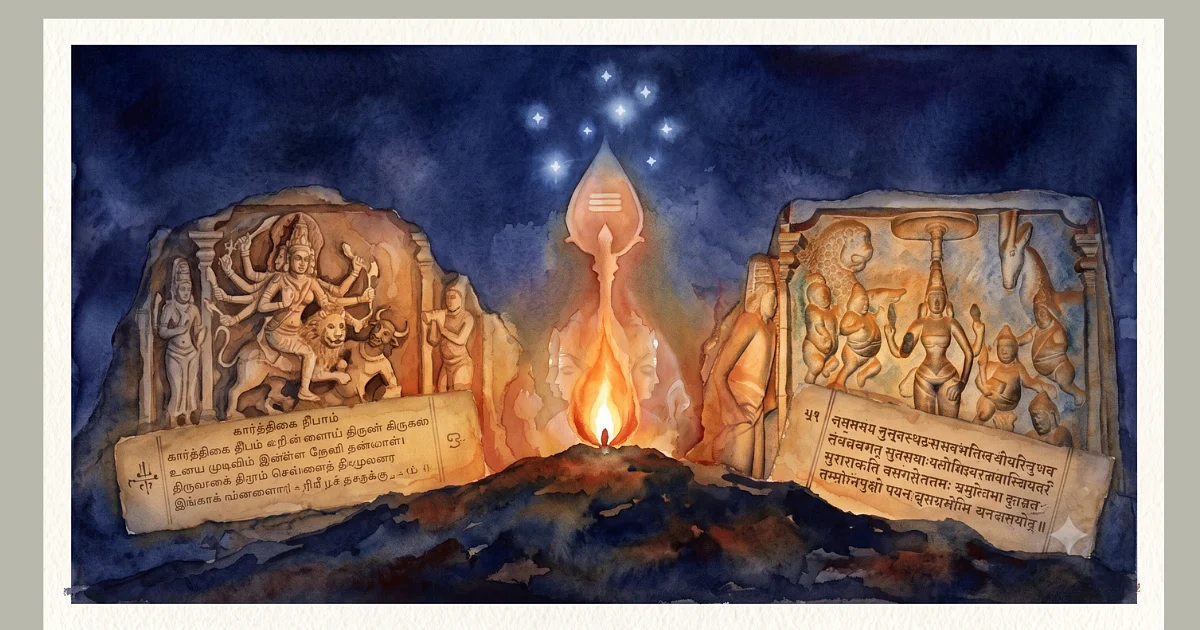
The Tamiḻ months are the vaidika stars, each named for the nakṣatra the full moon falls in — Kārttikai from Kṛttikā, exactly as Saṃskṛta gets Kārttika. And in the month of Kārttikai, on the full-moon night under the Kṛttikai star, the Tamiḻ country climbs the hill at Tiruvaṇṇāmalai and lights a vast lamp of ghee, the Kārttikai Dīpam. On the night of the Pleiades, Tamiḻ Nadu lights a fire on a mountain — a ritual that has been in practice for several centuries after seers wrote that the Pleiades are Agni’s asterism and that beneath them you kindle the flame. You cannot order a whole country up a mountain on one particular night and keep it going for so many years. That is not an imposition. It is one sky, native to this land, doing its work in Tamiḻ.
So the “Son of Koṟṟavai” declaration attached to the Tamiḻ Murugan poster shared by Dhanush creates a false opposition where none exists. Murugan is not ‘the son of Śiva, instead of the son of Koṟṟavai’, and He was never Tamiḻ at the cost of being Indian. He is historically the most ancient boy/ Kumāra in the Indian sky — born of fire, nursed by six stars, red complexioned, spear in hand — and Koṟṟavai who bore Him is the poison-throated bride of Śiva himself. Argue about the poster as long as you like. The sky doesn’t take sides, and it has been saying the same thing, over the whole subcontinent, every clear night, for thousands of years.
Key Sources:
-
-
Cilappatikāram, canto 12, “Vēṭṭuva Vari,” ll. 54–66; Vēṭṭuva Vari songs 7–9. Project Madurai / U. V. Swaminatha Iyer mūlam numbering.
-
Tamiḻ Lexicon. Madras: University of Madras.
-
Tolkāppiyam, Poruḷatikāram, Akattiṇaiyiyal, sūtra 5.
-
Tirumurukāṟṟuppaṭai, ll. 121, 210–211, 248, and c. 255–259.
-
Durgā Sūkta, v. 2. Taittirīya Āraṇyaka / Mahānārāyaṇa Upaniṣad.
-
Devī Māhātmya, 2.17, 2.20, 2.24, 2.29, 3.40, and chapter 1 (“Kālarātri”).
-
Ṛgveda, 1.85; 5.2.1; 10.146.1; 10.136.3–7.
-
Atharvaveda, kāṇḍa 15.
-
Taittirīya Saṃhitā, 4.5 (Śatarudrīya); 4.7.5 (Camakam).
-
Taittirīya Brāhmaṇa, 1.1.2.1.
-
Śatapatha Brāhmaṇa, 2.1.2.1; 6.1.3.8–18.
-
Suśruta Saṃhitā, Uttaratantra, chapters 27–37.
-
Mahābhārata, Skanda cycle.
-
Amarakośa, 1.1.40.
-
Hart, George L. The Poems of Ancient Tamil: Their Milieu and Their Sanskrit Counterparts. Berkeley: University of California Press, 1975.
-
Mahalakshmi, R. The Making of the Goddess: Korravai–Durgā in the Tamil Traditions. 2011.
-
Mann, Richard D. The Rise of Mahāsena. 2011.
-
Nagaswamy, R. Tamil Nadu: The Land of the Vedas. Ch. 4.
-
Werner, Karel. Yoga and the Ṛg Veda. 1977.
-
Zvelebil, Kamil V. The Smile of Murugan: On Tamil Literature of South India. Leiden: E. J. Brill, 1973.
Astronomical Reference
-
Kṛttikā (the Pleiades) is located in the zodiacal region of Vṛṣabha (Taurus).
Author’s Note: The reading of veṟiyāṭṭu as expressing a worship-valence associated with the graha/aṇaṅku grammatical category is the author’s synthesis, based on the attested textual materials cited above.
-
.png)