“Whether we and our politicians know it or not, Nature is party to all our deals and decisions, and she has more votes, a longer memory, and a sterner sense of justice than we do.”
― Wendell Berry
As Artificial Intelligence (AI) increasingly becomes a more and more crucial component of our everyday, its environmental costs are becoming harder to ignore. Even a seemingly innocuous query to an AI chatbot carries a physical cost that is largely invisible to us. An AI search query consumes more than 10 times more electricity than a traditional Google search. Behind what looks like a mere few lines of text lies vast data centres that consume endliess power and water. The protests taking place in Visakhapatnam over the rapid expansion of AI data centres ought to force India into a conversation it has so far largely evaded. On paper, the proposition appears irresistible: billions of dollars in foreign investment, a new technology hub, thousands of jobs, renewable-energy infrastructure and the promise of making Visakhapatnam a global destination for artificial intelligence. Yet beneath the language of investment and technological progress lies a more basic question: what exactly is being developed, and for whom?
In recent months, citizens, environmental organisations and civil-liberties groups in Visakhapatnam have been protesting the proposed proliferation of hyperscale data centres around the city. Green Visakha and other groups have raised concerns about water consumption, electricity demand, land use, deforestation, displacement and the ecological consequences of placing enormous computing facilities in and around environmentally sensitive areas. The Human Rights Forum has described the projects as creating potentially far-reaching pressures on a city already constrained by land, water, energy and civic infrastructure.
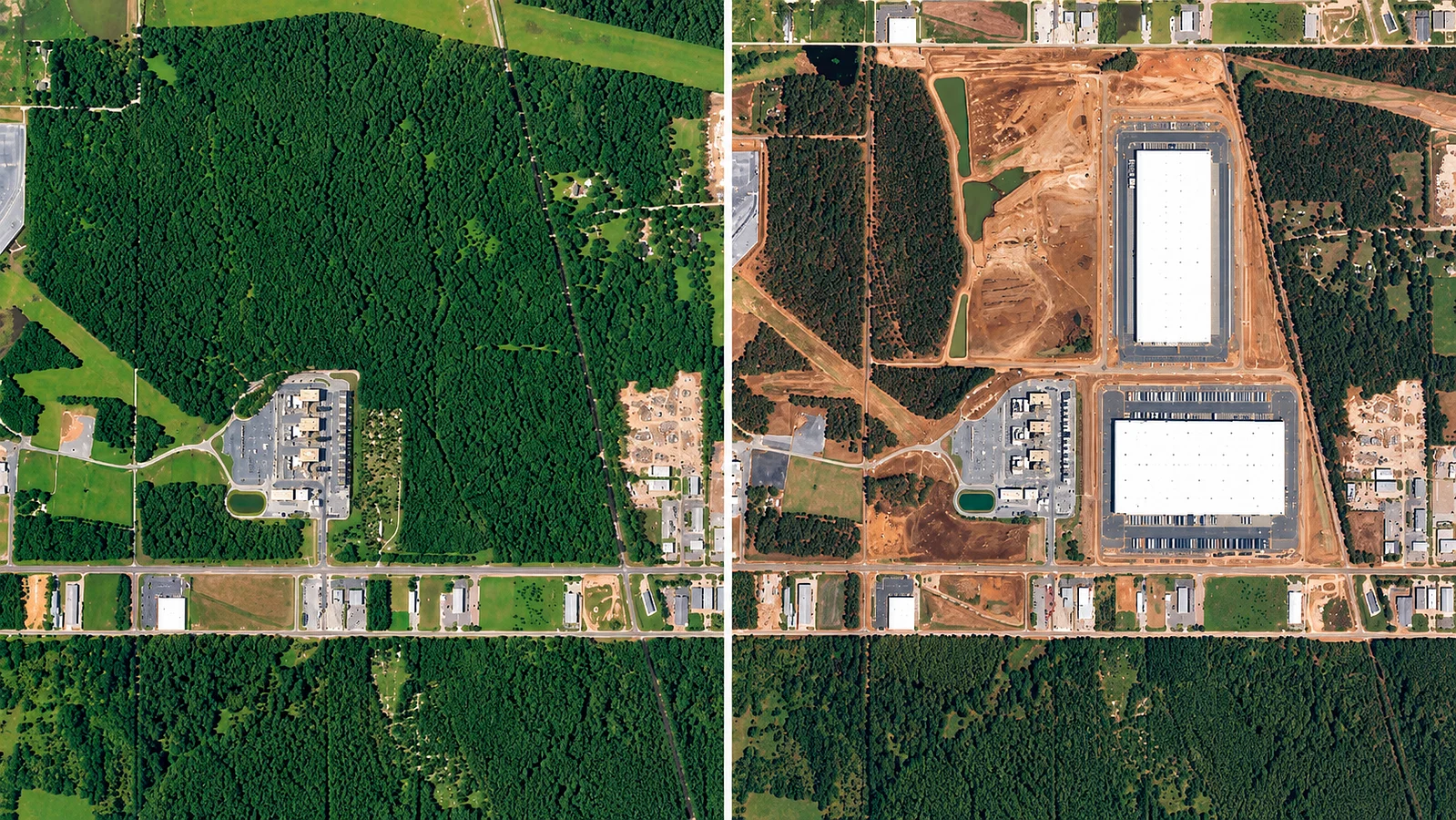
The scale of the proposed “development” is extraordinary. According to some recent reports, more than 2,000 acres have been earmarked for data-centre projects in Visakhapatnam, while a broader campaign opposing the proposed expansion identifies more than 10 projects across more than 2,500 acres and a potential 6.5 GW of AI data-centre capacity. One of the Google-Adani facilities is a proposed $15bn “hyperscale” AI centre, the largest outside of the US. This facility at Tarluvada, a drought-prone region in Andhra Pradesh, is expected to draw 1 GW of power; other proposed facilities include a 1 GW project at Rambilli and a 512 MW facility at Adavivaram-Mudasarlova. According to a report by The Guardian, on seeing bulldozers start to strip the landscape of trees and clearing land, locals have expressed skepticm over the real value it will bring to the community.
Such a hyperscale AI data centre is a new kind of industrial infrastructure: enormously capital-intensive, energy-intensive, dependent on sophisticated cooling systems, yet relatively automated once operational. It occupies land, consumes power and water, generates heat and noise, and requires a supporting network of substations, transmission lines, roads, cooling infrastructure and backup power. Like all things "digital" this, too, is very starkly physical in its components and impact. That is precisely why the protests in Visakhapatnam deserve attention. India needs to ask whether becoming a major destination for data centres is necessarily synonymous with an idea of development that is markedly our own, or merely what is imposed by the global north.
Data centres consume enormous quantities of water for their cooling architecture. A study by the International Energy Agency (IEA, 2025) estimates that, on average, about two-thirds of all water used by data centers is linked to electricity generation, while one-fourth is tied to cooling. Moreover, semiconductor fabrication requires large quantities of ultrapure water, citing an estimate of around 10 million gallons (38 million litres) per day for an average chip facility. A facility's water footprint, therefore, extends beyond merely the premises itself and starts as far back as manufacturing. The issue of water consumption becomes particularly troubling when hyperscale facilities are located in drought-prone or population-dense regions, where water is already scarce. Reporting on the Visakhapatnam projects has highlighted that the city's water demand already exceeds supply by roughly 70 million litres a day, and the proposed data-centre expansion could consume a substantial share of the city's water. The Andhra Pradesh government has pledged to meet the increased demands, and while they may be able to do so at the moment, what happens when the demand is unable to be met?
India is not entering this debate from a position of water abundance. The country's data-centre capacity has expanded rapidly, reportedly rising from around 375 MW in 2020 to approximately 1,500 MW in 2025. Data Center Map lists around 305 facilities in India, although the number of operational sites is considerably lower according to industry estimates. One recent report estimated that India's data centres consumed around 150 million tonnes of water in 2025, while noting that projections could rise significantly by 2030. There is something particularly perverse about placing large resource-intensive facilities in environmentally stressed regions and then describing them as a “clean” form of development because the product they generate is digital. Data centres are not necessarily being introduced into environmentally intact or “pristine” landscapes; rather, they are being superimposed upon geographies that are already industrialised and environmentally strained.
AI data centres are also extraordinarily energy hungry. A modern AI facility can consume as much electricity as tens of thousands of households, while the largest facilities being planned are approaching power requirements measured in gigawatts. Dedicated power generation to meet the massive demand requires additional fossil-fuel consumption, increasing air pollution while placing further demands on water resources. The physical cost of a single AI query extends far beyond the digital interaction itself, encompassing electricity consumption, water use and the wear and depreciation of specialised computing hardware. A standard text query to an AI chatbot is estimated to consume approximately 0.24–0.34 watt-hours (Wh) of electricity—potentially several times more than a conventional text-based Google search, estimated at around 0.03 Wh. More computationally intensive tasks, including complex reasoning and multimodal or video generation, can require substantially more energy, ranging from several watt-hours to tens of watt-hours per request.
The United States is already experiencing political and regulatory conflicts over the speed at which data-centre electricity demand is growing (see footnote 1). The problem is not solved merely by saying that technology companies will purchase renewable energy. The procurement of renewable-energy might lower the impact marginally, but it is not synonymous with energy independence. Solar power is often intermittent, and unless sufficient storage and generation are available, the facility remains embedded within a larger electrical grid. Even worse is the pollution (both noise and air) that back-up diesel generators emit. The relevant question for India is not simply how much renewable energy a corporation promises to incorporate, but rather, how much total electricity the data centre will actually require, how much additional transmission and generation infrastructure will be necessary, who will finance it and who ultimately bears the cost.
The recent diesel spill at an Equinix data centre in Secaucus, New Jersey, provides another reminder that the environmental footprint of a data centre does not end with electricity consumption. In September 2026, more than 5,000 gallons of diesel leaked from a storage system into Anderson Creek, a tributary of the Hackensack River; cleanup crews recovered thousands of gallons of fuel from the waterbody. The incident was contained, but it illustrates the industrial systems that sit behind the supposedly non-material digital economy. As Wendell Berry notes in The Unsettling of America, “there can be no small disaster” when it comes to a highly centralised industry.
At the very least, the American experience should make us pause. The United States has approximately 4,767 to 5,427 operational data centers, which is the highest number of any country in the world. However, according to a recent Frontline report, local resistance to the expansion of data centres in the United States has reportedly led Google, Amazon, Microsoft and Meta either to withdraw plans or face restrictions, including effective bans. Of late, at least 45 projects valued at nearly $68 billion were either blocked or delayed, according to information from Data Center Watch. Polling cited by Frontline found that between 57 and 75 per cent of Americans opposed having a data centre in their area. The contention, then, is not whether resistance to data centres is an irrational rejection of technology and more broadly, of “development” itself: which is exactly what discourse online has been reduced to. The same concerns are being raised even in some of the world's most technologically advanced economies, precisely because communities are beginning to experience the physical consequences of the AI boom.
The experience of the residents of Vantage VA2 in Loudoun County, Virginia, illustrates the consequences of allowing data-centre expansion to outpace environmental oversight and public consultation. Located in a region dubbed “Data Center Alley”, which is home to the world's largest concentration of data centres, the facility operates off the electricity grid, relying on eight on-site natural-gas turbines and 51 permitted diesel generators. Residents say they were not informed that the campus would include its own power plant and discovered it only after experiencing persistent noise. The controversy extends beyond noise pollution: a study commissioned by the Piedmont Environmental Council and conducted by EmPower Analytics Group estimated that emissions from the facility's permitted power system could cause $53-99 million in annual health-related damages, including costs associated with premature mortality, respiratory illness and cardiovascular disease. The study, which used the US Environmental Protection Agency's health-impact model, estimated that more than 2.5 million people could experience some increase in fine-particulate pollution. The case raises an important policy concern: when data centres bypass grid constraints through on-site fossil-fuel generation, the environmental and public-health costs of powering AI can be transferred directly to surrounding residents. “Who’s going to want to live in this dystopian hellscape with these behemoth buildings, and the constant noise, and then breathing in the diesel fumes?” This quote from a resident of Prince William County, Virginia demonstrates why communities must be informed and consulted before any major infrastructure of any kind is approved.
The potential thermal pollution by data centres is also overlooked. A preliminary analysis by Utah State University physicist Rob Davies, cited by the environmental group Grow the Flow, estimates that the proposed Stratos data-centre project in Box Elder County, Utah, and its associated natural-gas power plant could generate approximately 7–8 GW of waste heat. The analysis warns that this could raise daytime temperatures in Hansel Valley by 2–5°F and nighttime temperatures by 8–12°F, potentially increasing evaporation, disrupting natural moisture cycles and accelerating ecological degradation in an already water-stressed watershed. These temperature projections remain preliminary and require independent verification; the comparison to the heat released by 23 atomic bombs per day is an illustrative analogy for energy output, not a direct measure of equivalent environmental damage. As a country already prone to extreme heat, India should require independent thermal-impact assessments for hyperscale projects, and limit the potential effects on local microclimates and residents in the area.
There is another externality that is not featured in glossy investment announcements: noise. Data-centre construction, rooftop cooling equipment and backup generators can create shocking levels of noise. The World Resources Institute notes that smaller diesel generators can reach around 85 decibels, while larger industrial units can approach 100 decibels. Residents near US data centres have reported sleep disruption, headaches and diminished quality of life associated with prolonged noise. This may sound like a minor inconvenience compared with billions of dollars of investment, but it is not. Noise is one of the ways in which an ostensibly remote industrial facility enters the daily life of the people living around it.
The irony of all of this is difficult to ignore. AI is often marketed as weightless technology: algorithms in the cloud, “intelligence” through a digital interface, and an economy seemingly liberated from physical constraints. But the “cloud” is not in the ether. It is a vast collection of buildings filled with processors, connected to enormous electrical systems, cooled by elaborate mechanical infrastructure and supported by backup generators. The more computationally intensive AI becomes, the more physical its infrastructure and the heavier the burden on the surrounding environment. A week ago, Finland ordered Google to halt work on two planned data centres after Tuike Finland Oy, the company representing Google, had felled 330 hectares (815 acres) of forest in Muhos illegally without completing the mandatory environmental impact assessments. Corporations will always push the limits of what they can get away with, wherever they operate.
As elaborated in a paper by Privette et al., transparency is another critical concern. Investment agreements often contain confidentiality clauses that obscure the environmental obligations undertaken by data-centre operators, while utilities providers may withhold water-use records on grounds of commercial sensitivity or security. Governments must therefore make the disclosure of resource consumption a prerequisite for public support. Projected water withdrawals and consumption, electricity requirements, public infrastructure expenditure and the terms attached to tax concessions and other incentives should be made publicly available.
Another striking feature of the current controversy has been the struggle over public communication. It was reported that the Instagram account of the Stop Vizag Data Centre campaign was blocked in India in September under Section 79(3)(b) of the Information Technology Act before being restored, while posts by journalists, environmental campaigners and the Human Rights Forum critical of the projects have also reportedly been restricted. Reportage about farmers facing displacement in the Tarluvada area was also blocked. These allegations concern specific government orders and platform actions and remain contested; they should therefore be evaluated through the relevant legal proceedings and responses from the authorities. But the episode further underscores the importance of transparency when projects have such significant local consequences. Public consultation should not be treated as an obstacle to development, a nuisance to be stifled.
Environmental policy cannot be based on the fantasy that there is an empty landscape somewhere waiting to absorb the next industrial revolution. Every new facility is thrust into an existing ecological and social system. It competes with existing users for water. It places additional demand on existing electricity networks. It changes land use. It generates traffic, noise and waste. And it can impose costs on communities that never asked for the infrastructure in the first place.
Data centres undoubtedly generate government revenue. Property taxes, sales taxes, use taxes, business activity and construction spending can provide substantial fiscal benefits. A national estimate cited by the World Resources Institute puts total government revenues associated with the US data-centre sector at more than $162 billion in 2023, up from $66 billion in 2017. But gross revenue for corporations does not equate to a net public benefit. Governments frequently offer tax abatements, subsidies and other incentives to attract data centres. Moreover, locally, authorities have to spend on expanding substations, transmission infrastructure, roads, water systems and emergency services. But that aside, how much tax revenue is truly used to benefit the local villages and towns, given the Indian political landscape and seemingly endless corruption?
Next, there is the proposition that data centres will generate employment in a job-scarce country. This argument is perhaps the most politically attractive justification for bringing data centres to developing regions. Governments point to enormous headline numbers: tens or hundreds of thousands of jobs created, direct and indirect, a much needed relief for a job-scarce region. But this claim is misleading. Data centres are not factories in the conventional sense. Once construction is complete, a hyperscale facility is a highly automated industrial operation. It does not require a workforce proportional to the size of its capital investment.
Consider the OpenAI Stargate facility in Abilene, Texas. The 1.2 GW campus has generated enormous construction activity. But reporting has emphasised the contrast between the thousands of workers required during construction and the much smaller permanent workforce required once the facility becomes operational. Another example is Amazon’s proposed $10 billion facility north of Jackson, Mississippi, which is expected to create 1,000 jobs. A capital investment of this scale, if put towards manufacturing or other industries, would naturally generate far greater employment numbers. In contrast, data centres, as stated earlier, are highly automated facilities with limited permanent workforces.
The very efficiency that makes hyperscale data centres attractive to corporations also makes them relatively labour-light. The community can therefore bear the land-use, water, energy and environmental costs without receiving employment commensurate with those costs. Indirect employment such as construction workers, contractors, electricians, equipment suppliers, transport companies, restaurants and local services arises from a large project. But temporary construction employment is not the same economic proposition as permanent employment. Nor is an estimated “indirect job” necessarily equivalent to a direct job created by the facility. The distinction is particularly important in Visakhapatnam. If a project is advertised as creating 1.5 lakh jobs, citizens have every right to ask how many are permanent, how many are temporary construction positions, how many are indirect jobs calculated through economic multipliers, and how many will actually be available to residents of Visakhapatnam.
To clarify, a critique of industrial society is not a rejection of technology outright. As Wendell Berry puts it, the deeper objection is to an economic system that treats production and efficiency as unquestioned measures of progress. In The Unsettling of America, Berry criticises an industrial logic that treats land, resources and people as inputs into a system whose ultimate objective is maximum production. He connects industrialisation not only to ecological degradation but also to the loss of community and the devaluation of human work. In What Are People For? he extends the critique to an economic culture increasingly organised around consumption and the widening distance between people and the land. The question Berry forces us to ask is deceptively simple: what does “more” actually mean?
More investment, more energy consumption, more servers, more and more land converted to industrial use. Potentially more revenue. But when is it all enough? When does “more” stop being the only definition of development? GDP growth is not automatically equal to “progress”. An economy can become larger while a particular community becomes poorer in ecological security, public infrastructure and/or quality of life.
And this is where India's data-centre debate ought to become much more sophisticated. If the world's largest technology corporations require enormous quantities of land, electricity and water to sustain the AI boom, they should not be able to externalise those costs onto resource-strained developing countries simply because land and utilities are cheaper or regulatory barriers are weaker there. Resource-rich countries with abundant land, water and reliable energy are better positioned to host infrastructure of this scale. Developing countries such as India, which are already resource-stressed, should be extremely cautious about facilities whose primary economic purpose may be to serve consumers, shareholders and corporations abroad. India should not become the place where the physical costs of the world's AI revolution are dumped while its benefits accrue disproportionately to corporations and affluent societies abroad. India should distinguish between strategically necessary, limited digital infrastructure for its own ends and speculative hyperscale expansion driven by the global race for AI.
If future employment is the ultimate justification for the expansion of data centres in India, there must be a disclosure of how many permanent jobs will be created. If tax revenue is the justification, tax concessions and public infrastructure costs must be accounted for, along with how much of it goes towards local development. And if technological prestige is the justification, we must ask what tangible, long-term benefits can accrue, when data centres at the end of the day are not centres of innovation but simply glorified warehouses for servers. This is the larger question India should confront. Are we building infrastructure that strengthens our own society, or are we simply offering land and natural resources to service the computational demands of the world's wealthiest corporations and consumers? Developing countries should be cautious about hosting data centres for the global elite—the fact that the product is digital does not make it any less of an extractive exercise.
Footnote:
-
The Schneider Electric report estimates that all generative AI queries consume 15 TWh in 2025 and will use 347 TWh by 2030; that leaves 332 TWh of energy—and compute power—that will need to come online to support AI growth. That implies the construction of dozens of data centers along the lines of the Stargate Project, which plans to build the first ever 1-gigawatt facilities. Each of these facilities will theoretically consume 8.76 TWh per year—so 38 of these new campuses will account for the 332 TWh of new energy required. From IEEE Spectrum
References:
POWER HUNGRY: AI and our energy future
https://www.technologyreview.com/supertopic/ai-energy-package/
AI has high data center energy costs — but there are solutions
https://www.technologyreview.com/2026/09/15/1144028/ai-infrastructure-boom-investment-bubble-risk/
Data centers are facing an image problem. The tech industry is spending millions to rebrand them. Through television ads and online campaigns, industry-backed groups are promising jobs, clean energy, and lower electricity bills.
PRESS RELEASE: ANALYSIS FINDS BOX ELDER DATA CENTER COULD RELEASE AS MUCH HEAT AS 23 ATOMIC BOMBS PER DAY
Virginia couldn't stop Sterling data center's 24-hour diesel generator use, regulator says https://www.wusa9.com/article/news/investigations/vantage-data-center-loudoun-county-air-pollution-piedmont-environmental-council/65-ffa00add-bb5a-4b8b-8873-f28b577c6abe
Thousands of gallons of diesel spill from AI data center in Secaucus, N.J.
https://www.cbsnews.com/newyork/news/secaucus-nj-data-center-fuel-spill/
Broken promises, confiscated land: the hyperscale AI datacentre being built in a tiny Indian village
Drought made us desperate. Google’s data centre will bring disaster
Privette, A. P., Barros, A., & Cai, X. (2026). Data centers water footprint: The need for more transparency. AGU Advances, 7, e2025AV002140. https://doi.org/10.1029/2025AV002140