
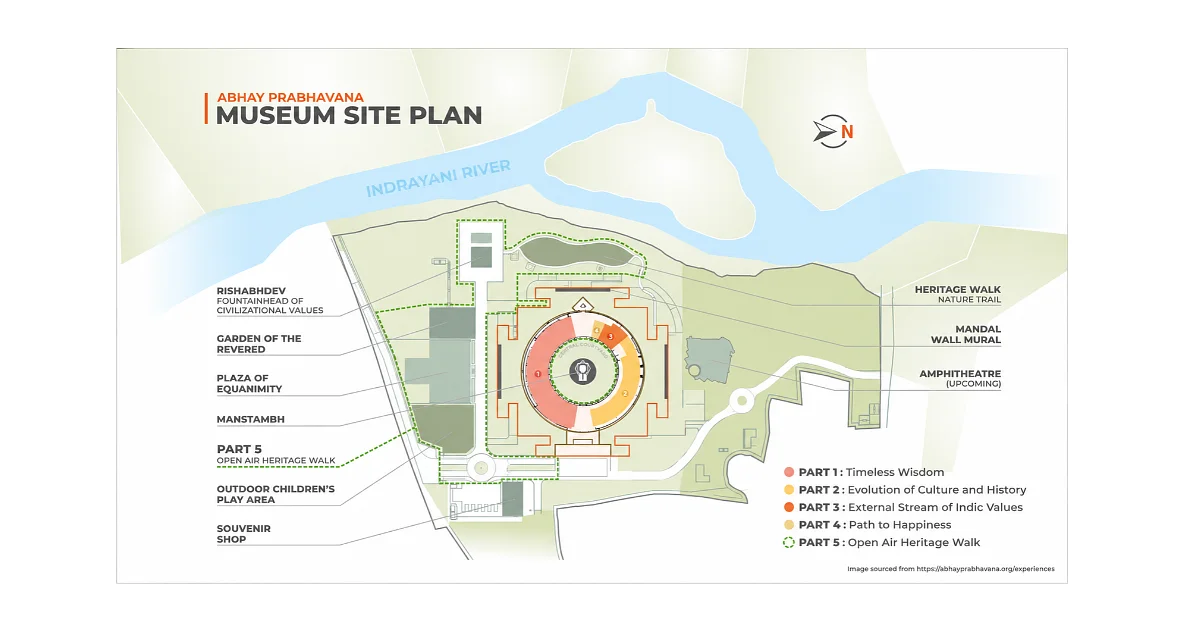
(Image sourced from abhayprabhavana.org)
India is witnessing the emergence of a new generation of cultural and knowledge centres that are attempting to do more than just preserving the past. This shift is visible in the changing cultural infrastructure of the country. The Government of India noted in 2023 that more than 100 museums had been commissioned in the preceding years, alongside a renewed push to modernise existing museums through technologies such as audio guides for the visually impaired, QR based interventions for extra details, light and sound shows, basic AR setups, and interactive storytelling. More recently, the Ministry of Culture reported that, through its Museum Grant Scheme, 21 new museums had been established and 23 existing museums developed over the preceding five years [1] .
This growing ambition is beginning to receive international recognition as well. In recent news, the Bihar Museum in Patna was ranked 9th among the World’s 100 Best Museums, by an internationally renowned travel guide forum called ‘Worth a Journey’. This makes it the highest-ranked museum in Asia and the only Indian institution on the list. Its placement alongside globally renowned institutions puts contemporary Indian cultural infrastructure firmly on the international cultural map.

The question, therefore, is no longer simply about data conservation, but about: how can our colourful culture and civilization prowess become a learning experience for the audience today?
In this growing list of centres, Abhay Prabhavana particularly comes out as an important example on how this translation of knowledge through technology is becoming worthwhile.
Introduction:


Recently our team had the opportunity to do a case study of Abhay Prabhavana, a cultural and knowledge centre located on the outskirts of Pune. Opened in the year 2024, this museum is funded by Abhay Firodiya, chairman of Force Motors. The complete site is spread over 60 acres, where the indoor museum building is about 32,500 sq. metres and the landscaping is spread over 20 acres of land. The remaining site is being used for expansion, by building new centres on general Indian philosophies of Sṛṣṭi, Samṛddhi, etc. Its setting along the Indrayani river, surrounded by green hills echoes the age-old Indian tradition of locating temple kṣetras and other sacred spaces in the lap of nature alongside rivers and hills. Its primary aim is to create a space that tells the story of Jainism through its history, core philosophies and timeless values, in a format relevant to audiences globally.
Architecture and Visitor Experience:
The simplicity and rootedness of the Jain philosophies are reflected in the very architecture of the museum building through its choice of sandstone, earthy colours and a circular shape. The circular shape represents the circular nature of everything in the Indian schools of thoughts and also enables ease in navigation where we can easily move from one zone to another in continuity and also take an exit to other outdoor areas and service zones such as food courts at any given point of time in the journey. A replica of the Kīrti Stambha, a revered Jain tīrtha located in Chittorgarh, stands at the focal point of the circle, serving as a powerful visual anchor from any point.
The seamless user experience begins upon entry into the campus. The museum staff welcome us to the centre by giving a quick introduction on what we are in for- they explain the different formats they have and give directions on how we can begin our journey here. There are two access options to choose from - only viewing the outdoor landscape or taking a ticket to view both indoor museum plus outdoors. Climbing to the top of the Kīrti Stambha is optional and the entry fee for that is separate. After buying a ticket, we are taken to the main zone via, of course via a Force Traveller.
Every time we enter a different museum zone, we have to tap the digitally enabled wrist bands on to the automated turnstiles. Upon entering the main building, we enter a grand double-heighted hall, with a huge model of the site in the centre, some waiting and seating area, adorned by beautiful Jain style paintings on cloth, showing different Jain philosophies and some other interesting Bhāratīya elements like the Mokṣa Paṭam. Every visitor is accompanied by a staff member, who assists with the technological touchpoints and answers questions along the way. They start by giving a brief introduction of the complete experience centre using the model.
The museum is divided into 4 zones:
Zone 1 | Timeless Wisdom:
Philosophy, Values and Spirituality


This zone is the largest one and occupies about 50% of the circle. It has 16 galleries of high quality audio visual content that explains various philosophies and concepts of existence through storytelling, explanatory voiceovers and interactive panels. Each gallery focuses on a specific sub-theme such as who am I, Karma - the outcome of actions, self restraint. It also takes us through some important Jain ideas of Samavasaraṇa – The Tīrthaṅkara’s Grand Assembly and the Anekāntavāda – Respecting other viewpoints.
Zone 2 | Evolution of Culture and History

This zone has six major galleries that walk us through the Jain heritage, the great personalities, the sacred geography, the beauty of arts and languages and more through larger than life static installations. This zone also explains the distinctions in certain philosophies and rituals, between the two sects of Śvetāmbara and Digambara. They have also shown the grand procession, the rituals and the practices of the alluring and valourous tradition of taking Dīkṣā.
Zone 3 | Path to Happiness
Practising Jain Values

This zone comprises five galleries exploring how a life rooted in time-tested Jain values and practices can nurture physical well-being, mental peace, and harmonious relationships with family and society. The concepts stem from our shared pursuit of happiness, security, prosperity, and well-being.
Zone 4 | Eternal Stream of Indic Values

Apart from the core Jain philosophies, they have a dedicated zone to the overall Indic value systems that unite the roots of Jainism in the land of Bhārata and also gives one an understanding of how all such similar traditions with a single core, flourish in this geography. This gallery showcases many 2d and 3d installations, featuring distinguished thinkers, teachers, and enlightened individuals, primarily from India, whose ideas and lives have shaped the inclusive, compassionate, and ethical foundations of the Bhāratīya spiritual tradition.
Open Air Heritage Walk


The surrounding landscape extends the experience outdoors, with a heritage park featuring exquisite replicas of Jain tīrthas, a large Ṛṣabhadeva fountainhead statue, recreational areas, and nature trails along the Indrayani River. However, from a thematic perspective, the outdoor experience does not currently create a continuation of the indoor journey. It functions largely as a standalone experience rather than transitioning seamlessly from the museum to the landscape. While the design makes good use of the natural setting, most of the outdoor activities are purely recreational. There is an opportunity here to create a stronger connection between the indoor narratives and the outdoor landscape, allowing the two to come together as parts forming a whole.
Content Programming
Each indoor zone has been carefully designed to communicate complex ideas in simple, memorable and experiential ways. Historical facts, philosophical concepts and cultural values are not presented merely as textual panels. They are brought alive through projections, sculptural installations, lighting, storytelling formats and interactive experiences.
Zone 1 is perhaps where the centre comes most alive. Across its sixteen galleries, Jain philosophical ideas are communicated through sixteen distinct applications of light and projection. The technology itself is quite simple, but the way it is used makes the experience evocative.
The journey begins with the ‘Dawn of Civilization’. You step into a dome theatre, and the familiar format of a science centre becomes a window into the Jain understanding of the creation of the universe. A little further ahead, ‘Modern Lifestyle Challenges’ takes a simple sculptural temple relief and transforms its surface into a screen. What unfolds is a simple yet impactful story of children visiting a temple, allowing the significance of the temple to emerge through the story rather than explanation. Then comes the ‘Samavasaraṇa: The Tīrthaṅkara’s Grand Assembly’. As you enter, the room falls into darkness. Slowly, one element after another of the magnificent assembly lights up, allowing the story to reveal itself. Perhaps the most endearing is the gallery on ‘Self Restraint’. Here, a beautiful flower garden becomes the setting for a story about greed and restraint.

A continuous play of audio-visual content can easily become cognitively heavy. The centre addresses this by creating pauses between more immersive experiences, with some galleries relying on simple installations or a single AV presentation. The use of motion sensor lights is particularly effective in spaces that gradually illuminate as visitors move through them.
Across the other three zones, the experience gradually becomes more information-led, with installations and panels explaining a range of concepts. The use of technology and immersive storytelling also becomes more limited, although the uniqueness of installations continues through examples such as a map that traces all Indian languages to its roots. Interactive exercises are limited to digital displays as some additional touchpoints. As the visitor moves from Zone 1 towards Zone 4, the experience consequently feels more familiar and, given the length of the journey, increasingly tiring.
A Strong Foundation, an Evolving Experience:
Abhay Prabhavana is, in many ways, an ambitious attempt to bring Indic values into a contemporary cultural experience. It brings together ancient ideas with contemporary storytelling, design and technology. The centre’s greatest strength lies in its ability to make complex knowledge tangible. Its larger-than-life installations, simple spatial language and carefully designed transitions allow the content to remain the hero. The circular form also offers considerable flexibility, allowing new installations and experiences to be introduced over time.
At the same time, the sheer volume of content presents a challenge. A four-hour guided journey through the centre demands considerable attention from the visitor. However, the surrounding landscape offers an opportunity to create meaningful pauses and connect the indoor narratives with the natural setting, making the overall journey more cohesive and restorative.
Abhay Prabhavana is a compelling model for how traditional knowledge can be interpreted through contemporary design, technology and storytelling without losing its depth and character. By doing so, it demonstrates how cultural infrastructure itself can become a powerful device for transmitting civilizational knowledge.
References:
-
All images are sourced from the Abhay Prabhvana website
-
The Bihar Museum Photo source: Gallery of The Bihar Museum / Maki and Associates + Opolis - 3
