Viṣṇu Vaibhavam
Exploring the Daśāvatāras - Part 1
A 12-session exploration of the stories, sanskrit sources and ideas behind Viṣṇu's principal avatāras.
The avatāra narratives not as isolated stories, but located within the broader Hindu understanding of dharma, cosmic order, divine intervention and more.
We will explore:
- How different Sanskrit texts narrate the same avatāra differently?
- What the avatāras reveal about dharma and cosmic order?
- How familiar kathās evolved across textual traditions?
- How textual traditions eventually shaped iconography and temple traditions?
Overview
The Daśāvatāras - the ten principal avatāras of Viṣṇu, occupy a central place in Hindu theological, narrative, and cultural traditions. Their stories appear across the Itihāsas, Purāṇas, Vedic literature, regional traditions, and later devotional compositions, with each source offering distinct perspectives on their purpose, character, and significance. The stories have always held curiosity across all age groups, alike.
This course offers an exploration of the narrative traditions associated with the Daśāvatāras. It introduces participants to the principal Sanskrit sources through which these manifestations are described. It then examines the theological, cultural, ethical, and philosophical ideas embedded within their kathās.
The course will consider how different textual traditions present the identity, purpose, actions, and significance of each avatāra. Participants will analyse areas of continuity and variation across the Itihāsas, Purāṇas, Vedic passages, and later devotional traditions. Rather than approaching the avatāra narratives as isolated stories, the course will place them within the broader Hindu understanding of dharma, cosmic order, divine intervention, and the relationship between the sacred and the material world.
Intent
We often encounter the Daśāvatāra through a wide range of stories we have heard since childhood, images we have from temple visits, hari kathās enacted during festivals or simplified retellings passed on from one generation to another. Contemporary familiarity, however, is not always the same as deep understanding.
Viṣṇu Vaibhavam invites learners to return to the sources and ask deeper questions:
What do the texts actually say? Why do narratives vary? What does each avatāra reveal about dharma, disruption, restoring balance after disorder, different dimensions of the divine and the relationship between the sacred and our lived experience?
The course brings śraddhā and inquiry into conversation, approaching the tradition with scholarly rigour and an understanding that careful textual inquiry need not diminish reverence, but in fact deepen it.
Prerequisites
The course is designed for Hindu adults with a genuine interest in the Daśāvatāra tradition. Participants are expected to possess:
● Basic familiarity with Hindu religious concepts and terminology
● Interest in Sanskrit literature and Indian art history
● Openness to both traditional and academic approaches to religious study
● Willingness to engage in scholarly discussions and critical analysis
No prior knowledge of Sanskrit is required, though familiarity with basic Sanskrit terms would be advantageous.
Assessment and Participation
While this is a non-credit course, participants are encouraged to:
● Engage actively in online discussions and activities
● Complete optional reading assignments from primary and secondary sources
● Prepare brief presentations on specific aspects of interest
● Contribute personal reflections and observations throughout the learning journey
Structure
From Kathā to Understanding
The course explores a multi-faceted pedagogical approach.
- Textual Analysis: Close reading of Sanskrit texts in translation, with attention to linguistic nuances and cultural contexts.
- Comparative Study: Cross-referencing of different textual sources and artistic traditions to trace developments and variations.
- Interactive Discussions: Structured discussions encouraging critical thinking and peer learning.
Viṣṇu Vaibhavam Part 1 - is the first part of a larger three-part exploration of the Daśāvatāra. The journey begins with text and narrative, moves towards iconographic traditions, and eventually opens into the sacred landscape of the temple.
PART I - KATHĀ & TEXT
The avatāra in texts
12 sessions (1.5 hours each) | Selected Sanskrit sources | Guided readings & comparative study
The first part journeys through the principal avatāras, encountering their narratives across different textual traditions.
PART II — ICONOGRAPHY
The avatāra in images
The second part will explore how the narratives of the avatāras take visual form - through iconography, sculpture and artistic traditions.
PART III — SACRED LANDSCAPE
The avatāra in temples
The journey culminates in an optional experiential exploration of Viṣṇu traditions through temples and sacred sites in Kanchipuram, where text, image, ritual and sacred space can be encountered together.
Details of Part II and the Kanchipuram immersion - an experiential study visit, will be announced separately.
This course forms Part I of a three-part Daśāvatāra programme, beginning with the narrative traditions of the ten avatāras in Sanskrit literature. It will be followed by Part II on their iconographic traditions and Part III, an immersion into the temples and sacred sites in Kanchipuram.
Resources and Materials
- Primary Sources: Selected translations from Purāṇas, Vālmīkirāmāyaṇa, and Mahābhārata.
- Secondary Sources: Academic works by scholars such as Vettam Mani, T. A. Gopinatha Rao, Ananda Coomaraswamy, and other researchers in Hindu studies.
- Visual Material: Photographs and digital resources from major museum collections and archaeological sites.
- Digital Resources: Access to online databases of Sanskrit texts and archaeological imagery.
- Temple Resources: Direct access to temple architecture, sculpture, and iconographic traditions during Part III, the optional study tour to Kanchipuram temples
Contents
Module 1
Narratives and Kathās
-
11 Sept - Matsya
The deluge and the preservation of life and knowledge
-
12 Sept - Kūrma
Samudramanthana and the cosmic drama of churning
-
18 Sept - Varāha
The rescue of the earth across Purāṇic traditions
-
19 Sept - Narasiṃha
Prahlāda, Hiraṇyakaśipu and the manifestation of the divine
-
25 Sept - Vāmana
From Vāmana to Trivikrama
-
26 Sept - Paraśurāma
Power, order and the Kṣatriya narrative
-
2 Oct - Rāma
Vālmīki's Rāmāyaṇa and the later traditions of Rāma
-
3 Oct - Balarāma
The narratives of an avatāra whose place in the Daśāvatāra invites closer examination
-
9 Oct - Kṛṣṇa
The many dimensions of the Kṛṣṇa narrative
-
10 Oct - Kalki
The eschatological avatāra and the imagination of cosmic renewal
-
16 Oct - Other Avatāras
A glimpse into lesser-known manifestations of Viṣṇu and the wider avatāra tradition.
-
17 Oct - Synthesis Session
Bringing together the recurring ideas, variations and theological concepts that emerge across the Daśāvatāra.
Key Takeaways
Demonstrate
a clear understanding of the principal literary sources and narrative traditions associated with the Daśāvatāra.
Analyse
similarities, variations, and developments in the accounts of individual avatāras across the Itihāsas, Purāṇas, Vedic passages, and later literature.
Interpret
the theological, philosophical, ethical, and cultural ideas expressed through the narratives of the ten avatāras.
Compare
different textual presentations of the purpose, actions, attributes, and significance of each avatāra.
Articulate
how textual traditions provide the foundation for understanding the later iconographic and temple-based representations of the Daśāvatāra.
Who is this course for?
- Learners interested in Hindu theology, sacred narratives, and Sanskrit literature.
- Readers who wish to move beyond popular retellings and engage with primary textual sources.
- Teachers, educators, curriculum developers, and facilitators working with Hindu knowledge traditions.
- Students and researchers interested in the Itihāsas, Purāṇas, comparative mythology, theology, or religious studies.
- Temple guides, heritage interpreters, cultural practitioners, and professionals working in the fields of art, culture, and heritage.
- Parents and community members seeking an informed foundation for transmitting Hindu narratives to younger generations.
Know your Instructor
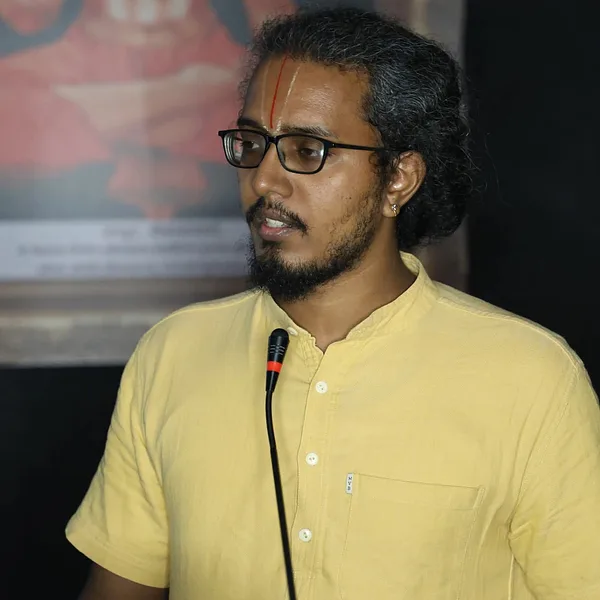
Śrī Abhinav Kadambi
Abhinav Kadambi is a trained engineer (M.Tech. in Medical Nanotechnology) with an academic research background in STEM (bioengineering, nanotechnology, animal cognition and behaviour, and cognitive neurosciences) and science journalism. He is a traditional student of Nyāyaśāstra and Yogaśāstra. After a masters in Sanskrit, he has submitted a PhD thesis in Sanskrit at the University of Madras, Chennai. He is an educator and researcher in Indian Knowledge Systems. He is always excited to bridge ancient Indian Knowledge Systems for contemporary applications.
What Our Draṣṭā Participants Say
My Gratitude to you sir, for giving me a new perspective. As I used to feel negative about the kings and the varna system. This light has burnt that ignorance. You have also shown us that if you genuinely want to learn something go to the authentic sources which are definitely available. All we need is passion for it. Greatly inspired by your passion towards the inscriptions.
Rachana Katta
Overjoyed! If I were to put it in 1 word! Attending any lecture -discourse by Sir is a ज्ञान यज्ञा in itself. For me I realised that inscriptions are the most authentic form of history vis-a vis granthas/texts, copper plates or coinage. Also, Sir is such a good teacher that every word of any श्लोक or सूत्र mentioned in inscriptions is elaborated upon in a simple & easy to understand fashion. Newer perspectives on caste, society, events etc were gathered from this series - even setting aside exaggerated claims of caste dominance & suppression. In short - it was learning all the way. Some digressions from the main topic however could have been avoided though.
Dr Mrinalini Menon
It was fascinating. The best way to understand and explore the real history of this land.
Maya Ramaswamy
Viṣṇu Vaibhavam
Our Draṣṭā online courses are designed to help you in your learning journey
Become a part of the community and engage, share, discuss and deepen your learnings
Interact with the course instructor through live sessions
Access to session recordings and materials

Become a member and dive into the Indic universe
Brhat subscription gives access to exclusive member-only content rooted in the Dharmic worldview.
Starts at ₹500 per month.